

420
C Symmetries and the Hamiltonian Matrix
ˆ
O| = ˆ
O(c 1 |ψ 1 + c 2 |ψ 2 ) = c 1 ( ˆ
O|ψ 1 ) + c 2 ( ˆ
O|ψ 2 ).
(C.1)
Scalar products involving linear operators behave as (χ | ˆ
O)|ψ = =χ |( ˆ
O|ψ).
Scalar products involving the Hermitian adjoint of a linear operator behave as
χ | ˆ
O † |ψ = [[ψ| ˆ
O|χ ] ∗ .
Antilinear Operators
An antilinear operator, ˆ
A, when acting on the superposition | = c 1 |ψ 1 + c 2 |ψ 2 ,
gives
ˆ
A| = ˆ
A(c 1 |ψ 1 + c 2 |ψ 2 ) = c 1
∗ ( ˆ
A|ψ 1 ) + c 2
∗ ( ˆ
A|ψ 2 ).
(C.2)
Scalar products involving antilinear operators behave as (χ | ˆ
A)|ψ =
[[χ |( ˆ
A|ψ)] ∗ . Scalar products involving the Hermitian adjoint of an antilinear
operator behave as χ |( ˆ
A † |ψ) = =χ |( ˆ
A|ψ).
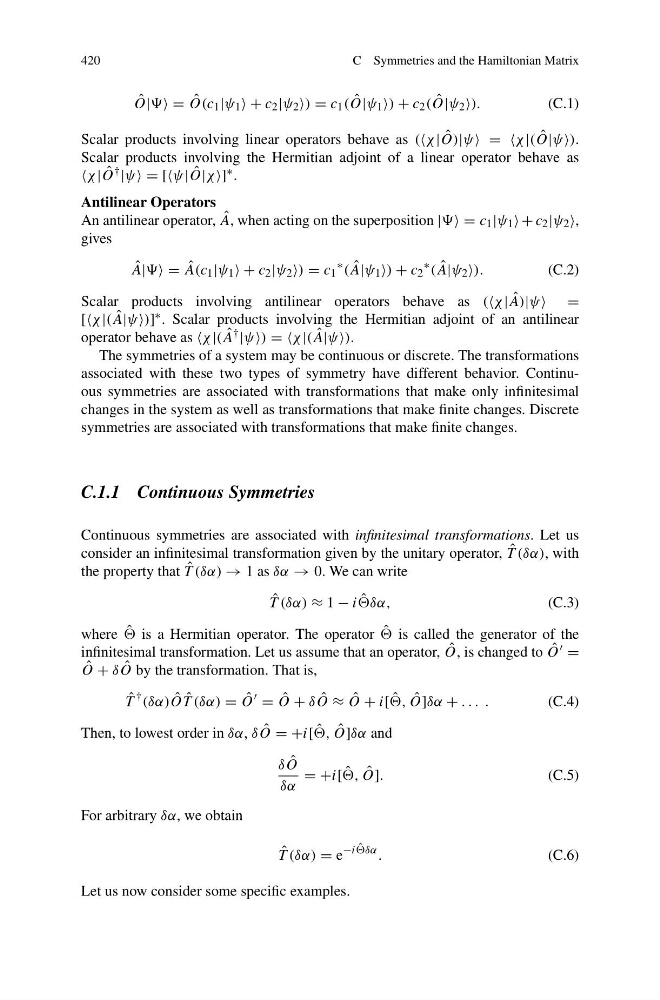
The symmetries of a system may be continuous or discrete. The transformations
associated with these two types of symmetry have different behavior. Continuous symmetries are associated with transformations that make only infinitesimal
changes in the system as well as transformations that make finite changes. Discrete
symmetries are associated with transformations that make finite changes.
C.1.1 Continuous Symmetries
Continuous symmetries are associated with infinitesimal transformations. Let us
consider an infinitesimal transformation given by the unitary operator, ˆ
T (δα), with
the property that ˆ
T (δα) → 1 as δα → 0. We can write
ˆ
T (δα) ≈ 1 − i ˆ
δα,
(C.3)
where ˆ
is a Hermitian operator. The operator ˆ
is called the generator of the
infinitesimal transformation. Let us assume that an operator, ˆ
O, is changed to ˆ
O =
ˆ
O + δ ˆ
O by the transformation. That is,
ˆ
T
† (δα) ˆ
O ˆ
T (δα) = ˆ
O
= ˆ
O + δ ˆ
O ≈ ˆ
O + i[ ˆ
, ˆ
O]δα + . . . .
(C.4)
Then, to lowest order in δα, δ ˆ
O = +i[ ˆ
, ˆ
O]δα and
δ ˆ
O
δα
= +i[ ˆ
, ˆ
O].
(C.5)
For arbitrary δα, we obtain
ˆ
T (δα) = e
−i ˆ
.
(C.6)
Let us now consider some specific examples.
C Symmetries and the Hamiltonian Matrix
ˆ
O| = ˆ
O(c 1 |ψ 1 + c 2 |ψ 2 ) = c 1 ( ˆ
O|ψ 1 ) + c 2 ( ˆ
O|ψ 2 ).
(C.1)
Scalar products involving linear operators behave as (χ | ˆ
O)|ψ = =χ |( ˆ
O|ψ).
Scalar products involving the Hermitian adjoint of a linear operator behave as
χ | ˆ
O † |ψ = [[ψ| ˆ
O|χ ] ∗ .
Antilinear Operators
An antilinear operator, ˆ
A, when acting on the superposition | = c 1 |ψ 1 + c 2 |ψ 2 ,
gives
ˆ
A| = ˆ
A(c 1 |ψ 1 + c 2 |ψ 2 ) = c 1
∗ ( ˆ
A|ψ 1 ) + c 2
∗ ( ˆ
A|ψ 2 ).
(C.2)
Scalar products involving antilinear operators behave as (χ | ˆ
A)|ψ =
[[χ |( ˆ
A|ψ)] ∗ . Scalar products involving the Hermitian adjoint of an antilinear
operator behave as χ |( ˆ
A † |ψ) = =χ |( ˆ
A|ψ).
The symmetries of a system may be continuous or discrete. The transformations
associated with these two types of symmetry have different behavior. Continuous symmetries are associated with transformations that make only infinitesimal
changes in the system as well as transformations that make finite changes. Discrete
symmetries are associated with transformations that make finite changes.
C.1.1 Continuous Symmetries
Continuous symmetries are associated with infinitesimal transformations. Let us
consider an infinitesimal transformation given by the unitary operator, ˆ
T (δα), with
the property that ˆ
T (δα) → 1 as δα → 0. We can write
ˆ
T (δα) ≈ 1 − i ˆ
δα,
(C.3)
where ˆ
is a Hermitian operator. The operator ˆ
is called the generator of the
infinitesimal transformation. Let us assume that an operator, ˆ
O, is changed to ˆ
O =
ˆ
O + δ ˆ
O by the transformation. That is,
ˆ
T
† (δα) ˆ
O ˆ
T (δα) = ˆ
O
= ˆ
O + δ ˆ
O ≈ ˆ
O + i[ ˆ
, ˆ
O]δα + . . . .
(C.4)
Then, to lowest order in δα, δ ˆ
O = +i[ ˆ
, ˆ
O]δα and
δ ˆ
O
δα
= +i[ ˆ
, ˆ
O].
(C.5)
For arbitrary δα, we obtain
ˆ
T (δα) = e
−i ˆ
.
(C.6)
Let us now consider some specific examples.