

424
C Symmetries and the Hamiltonian Matrix
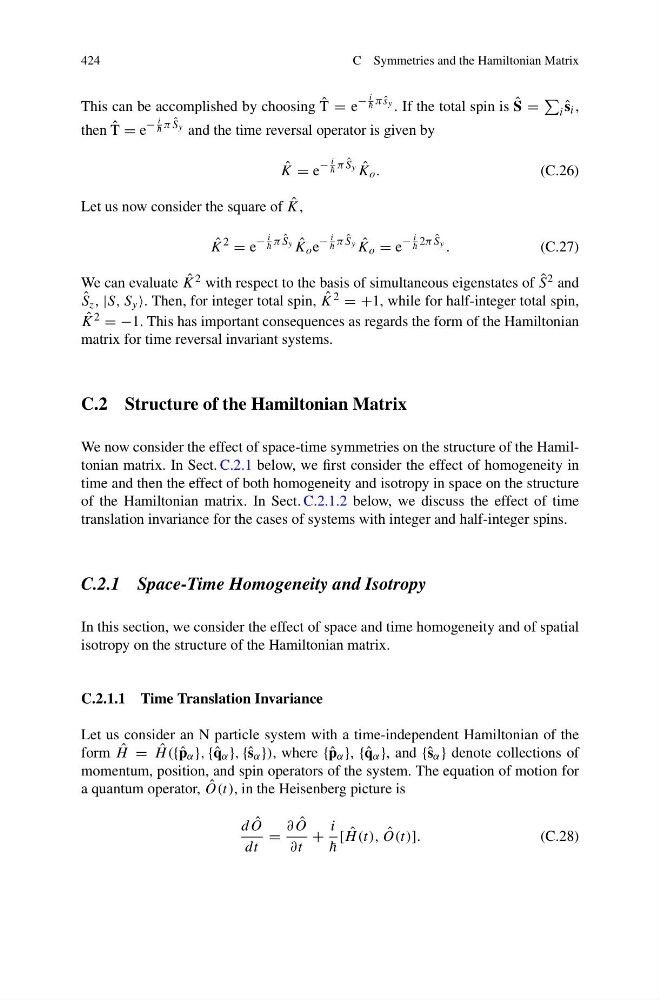
This can be accomplished by choosing ˆ
T = e
−
i
¯
h π ˆ
s y . If the total spin is ˆ
S =
i ˆ
s i ,
then ˆ
T = e
−
i
¯
h π ˆ
S y and the time reversal operator is given by
ˆ
K = e
−
i
¯
h π ˆ
S y ˆ
K o .
(C.26)
Let us now consider the square of ˆ
K,
ˆ
K
2
= e
−
i
¯
h π ˆ
S y ˆ
K o e
−
i
¯
h π ˆ
S y ˆ
K o = e
−
i
¯
h 2π ˆ
S y .
(C.27)
We can evaluate ˆ
K 2 with respect to the basis of simultaneous eigenstates of ˆ
S 2 and
ˆ
S z , |S, S y . Then, for integer total spin, ˆ
K 2 = +1, while for half-integer total spin,
ˆ
K 2 = −1. This has important consequences as regards the form of the Hamiltonian
matrix for time reversal invariant systems.
C.2 Structure of the Hamiltonian Matrix
We now consider the effect of space-time symmetries on the structure of the Hamiltonian matrix. In Sect. C.2.1 below, we first consider the effect of homogeneity in
time and then the effect of both homogeneity and isotropy in space on the structure
of the Hamiltonian matrix. In Sect. C.2.1.2 below, we discuss the effect of time
translation invariance for the cases of systems with integer and half-integer spins.
C.2.1 Space-Time Homogeneity and Isotropy
In this section, we consider the effect of space and time homogeneity and of spatial
isotropy on the structure of the Hamiltonian matrix.
C.2.1.1 Time Translation Invariance
Let us consider an N particle system with a time-independent Hamiltonian of the
form ˆ
H = ˆ
H ({ ˆ
p α }, { ˆ
q α }, {ˆ s α }), where { ˆ
p α }, { ˆ
q α }, and {ˆ s α } denote collections of
momentum, position, and spin operators of the system. The equation of motion for
a quantum operator, ˆ
O(t), in the Heisenberg picture is
d ˆ
O
dt
=
∂ ˆ
O
∂t
+
i
¯
h
[ ˆ
H (t), ˆ
O(t)].
(C.28)
C Symmetries and the Hamiltonian Matrix
This can be accomplished by choosing ˆ
T = e
−
i
¯
h π ˆ
s y . If the total spin is ˆ
S =
i ˆ
s i ,
then ˆ
T = e
−
i
¯
h π ˆ
S y and the time reversal operator is given by
ˆ
K = e
−
i
¯
h π ˆ
S y ˆ
K o .
(C.26)
Let us now consider the square of ˆ
K,
ˆ
K
2
= e
−
i
¯
h π ˆ
S y ˆ
K o e
−
i
¯
h π ˆ
S y ˆ
K o = e
−
i
¯
h 2π ˆ
S y .
(C.27)
We can evaluate ˆ
K 2 with respect to the basis of simultaneous eigenstates of ˆ
S 2 and
ˆ
S z , |S, S y . Then, for integer total spin, ˆ
K 2 = +1, while for half-integer total spin,
ˆ
K 2 = −1. This has important consequences as regards the form of the Hamiltonian
matrix for time reversal invariant systems.
C.2 Structure of the Hamiltonian Matrix
We now consider the effect of space-time symmetries on the structure of the Hamiltonian matrix. In Sect. C.2.1 below, we first consider the effect of homogeneity in
time and then the effect of both homogeneity and isotropy in space on the structure
of the Hamiltonian matrix. In Sect. C.2.1.2 below, we discuss the effect of time
translation invariance for the cases of systems with integer and half-integer spins.
C.2.1 Space-Time Homogeneity and Isotropy
In this section, we consider the effect of space and time homogeneity and of spatial
isotropy on the structure of the Hamiltonian matrix.
C.2.1.1 Time Translation Invariance
Let us consider an N particle system with a time-independent Hamiltonian of the
form ˆ
H = ˆ
H ({ ˆ
p α }, { ˆ
q α }, {ˆ s α }), where { ˆ
p α }, { ˆ
q α }, and {ˆ s α } denote collections of
momentum, position, and spin operators of the system. The equation of motion for
a quantum operator, ˆ
O(t), in the Heisenberg picture is
d ˆ
O
dt
=
∂ ˆ
O
∂t
+
i
¯
h
[ ˆ
H (t), ˆ
O(t)].
(C.28)