

414
B Simple Models
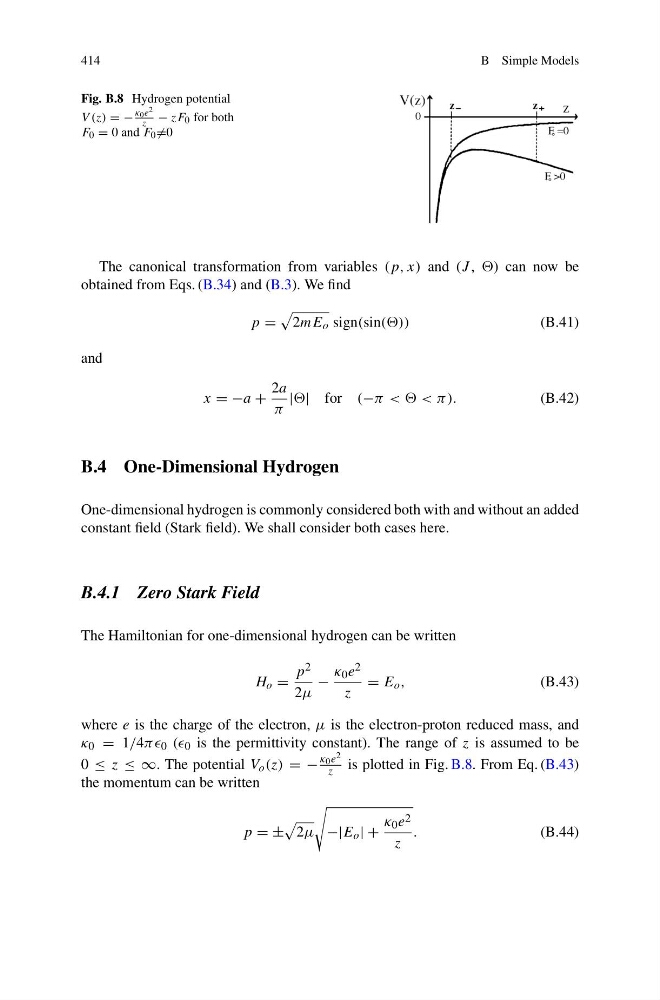
Fig. B.8 Hydrogen potential
V (z) = −
κ 0 e 2
z − zF 0 for both
F 0 = 0 and F 0 =0
The canonical transformation from variables (p, x) and (J , ) can now be
obtained from Eqs. (B.34) and (B.3). We find
p =
2mE o sign(sin(())
(B.41)
and
x = −a +
2a
π
| for (−π < < < π).
(B.42)
B.4 One-Dimensional Hydrogen
One-dimensional hydrogen is commonly considered both with and without an added
constant field (Stark field). We shall consider both cases here.
B.4.1 Zero Stark Field
The Hamiltonian for one-dimensional hydrogen can be written
H o =
p 2
2μ
−
κ 0 e 2
z
= E o ,
(B.43)
where e is the charge of the electron, μ is the electron-proton reduced mass, and
κ 0 = 1/4ππ 0 ( 0 is the permittivity constant). The range of z is assumed to be
0 ≤ z ≤ ∞. The potential V o (z) = −
κ 0 e 2
z is plotted in Fig. B.8. From Eq. (B.43)
the momentum can be written
p = ±
2μ
−|E o | +
κ 0 e 2
z
.
(B.44)
B Simple Models
Fig. B.8 Hydrogen potential
V (z) = −
κ 0 e 2
z − zF 0 for both
F 0 = 0 and F 0 =0
The canonical transformation from variables (p, x) and (J , ) can now be
obtained from Eqs. (B.34) and (B.3). We find
p =
2mE o sign(sin(())
(B.41)
and
x = −a +
2a
π
| for (−π < < < π).
(B.42)
B.4 One-Dimensional Hydrogen
One-dimensional hydrogen is commonly considered both with and without an added
constant field (Stark field). We shall consider both cases here.
B.4.1 Zero Stark Field
The Hamiltonian for one-dimensional hydrogen can be written
H o =
p 2
2μ
−
κ 0 e 2
z
= E o ,
(B.43)
where e is the charge of the electron, μ is the electron-proton reduced mass, and
κ 0 = 1/4ππ 0 ( 0 is the permittivity constant). The range of z is assumed to be
0 ≤ z ≤ ∞. The potential V o (z) = −
κ 0 e 2
z is plotted in Fig. B.8. From Eq. (B.43)
the momentum can be written
p = ±
2μ
−|E o | +
κ 0 e 2
z
.
(B.44)