

B.4 One-Dimensional Hydrogen
415
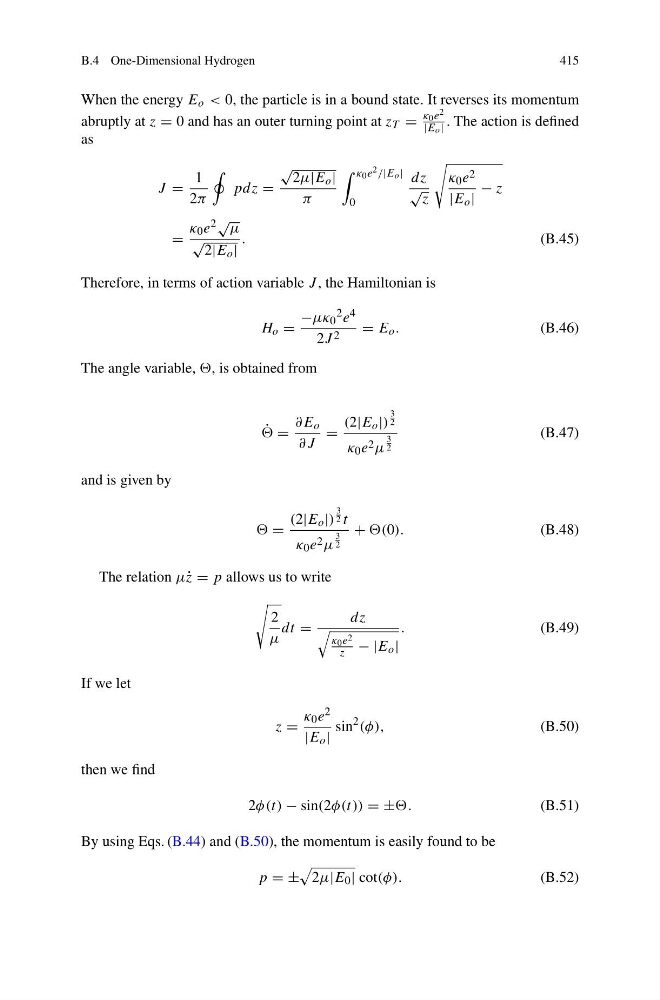
When the energy E o < 0, the particle is in a bound state. It reverses its momentum
abruptly at z = 0 and has an outer turning point at z T =
κ 0 e 2
|E o | . The action is defined
as
J =
1
2π
pdz =
√
2μ|E o |
π
κ 0 e 2 /|E o |
0
dz
√
z
κ 0 e 2
|E o |
− z
=
κ 0 e 2 √
μ
√
2|E o |
.
(B.45)
Therefore, in terms of action variable J , the Hamiltonian is
H o =
−μκ 0
2 e 4
2J 2
= E o .
(B.46)
The angle variable, , is obtained from
˙
=
∂E o
∂J
=
(2|E o |)
3
2
κ 0 e 2 μ
3
2
(B.47)
and is given by
=
(2|E o |)
3
2 t
κ 0 e 2 μ
3
2
+ (0).
(B.48)
The relation μ˙ z = p allows us to write
2
μ
dt =
dz
κ 0 e 2
z − |E o |
.
(B.49)
If we let
z =
κ 0 e 2
|E o |
sin
2 (φ),
(B.50)
then we find
2φ(t) − sin(2φ(t)) = ±.
(B.51)
By using Eqs. (B.44) and (B.50), the momentum is easily found to be
p = ±
2μ|E 0 | cot(φ).
(B.52)
415
When the energy E o < 0, the particle is in a bound state. It reverses its momentum
abruptly at z = 0 and has an outer turning point at z T =
κ 0 e 2
|E o | . The action is defined
as
J =
1
2π
pdz =
√
2μ|E o |
π
κ 0 e 2 /|E o |
0
dz
√
z
κ 0 e 2
|E o |
− z
=
κ 0 e 2 √
μ
√
2|E o |
.
(B.45)
Therefore, in terms of action variable J , the Hamiltonian is
H o =
−μκ 0
2 e 4
2J 2
= E o .
(B.46)
The angle variable, , is obtained from
˙
=
∂E o
∂J
=
(2|E o |)
3
2
κ 0 e 2 μ
3
2
(B.47)
and is given by
=
(2|E o |)
3
2 t
κ 0 e 2 μ
3
2
+ (0).
(B.48)
The relation μ˙ z = p allows us to write
2
μ
dt =
dz
κ 0 e 2
z − |E o |
.
(B.49)
If we let
z =
κ 0 e 2
|E o |
sin
2 (φ),
(B.50)
then we find
2φ(t) − sin(2φ(t)) = ±.
(B.51)
By using Eqs. (B.44) and (B.50), the momentum is easily found to be
p = ±
2μ|E 0 | cot(φ).
(B.52)