

10.9 Quantum Control
387
where the momentum operator is given by ˆ
p = −i∂/∂x. In order to satisfy the
boundary condition at x = ±1, the wavefunction should satisfy ψ(x = ±1, t) =
x = ±1|ψ(t) = 0 for all times, t.
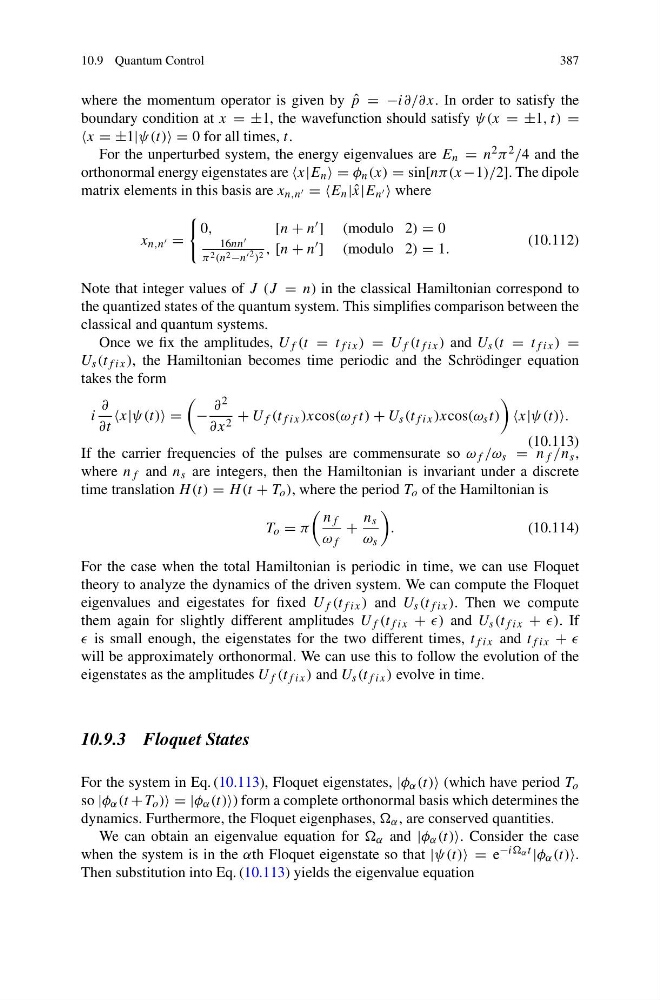
For the unperturbed system, the energy eigenvalues are E n = n 2 π 2 /4 and the
orthonormal energy eigenstates are x|E n = φ n (x) = sin[nπ(x −1)/2]. The dipole
matrix elements in this basis are x n,n = =E n | ˆ
x|E n where
x n,n =
0,
[n + n ] (modulo 2) = 0
16nn
π 2 (n 2 −n 2 ) 2 , [n + n ] (modulo 2) = 1.
(10.112)
Note that integer values of J (J = n) in the classical Hamiltonian correspond to
the quantized states of the quantum system. This simplifies comparison between the
classical and quantum systems.
Once we fix the amplitudes, U f (t = t f ix ) = U f (t f ix ) and U s (t = t f ix ) =
U s (t f ix ), the Hamiltonian becomes time periodic and the Schrödinger equation
takes the form
i
∂
∂t
x|ψ(t) =
−
∂ 2
∂x 2 + U f (t f ix )xcos(ω f t) + U s (t f ix )xcos(ω s t)
x|ψ(t).
(10.113)
If the carrier frequencies of the pulses are commensurate so ω f /ω s = n f /n s ,
where n f and n s are integers, then the Hamiltonian is invariant under a discrete
time translation H (t) = H (t + T o ), where the period T o of the Hamiltonian is
T o = π
n f
ω f
+
n s
ω s
.
(10.114)
For the case when the total Hamiltonian is periodic in time, we can use Floquet
theory to analyze the dynamics of the driven system. We can compute the Floquet
eigenvalues and eigestates for fixed U f (t f ix ) and U s (t f ix ). Then we compute
them again for slightly different amplitudes U f (t f ix + ) and U s (t f ix + ). If
is small enough, the eigenstates for the two different times, t f ix and t f ix +
will be approximately orthonormal. We can use this to follow the evolution of the
eigenstates as the amplitudes U f (t f ix ) and U s (t f ix ) evolve in time.
10.9.3 Floquet States
For the system in Eq. (10.113), Floquet eigenstates, |φ α (t) (which have period T o
so |φ α (t + T o ) = |φ α (t)) form a complete orthonormal basis which determines the
dynamics. Furthermore, the Floquet eigenphases, α , are conserved quantities.
We can obtain an eigenvalue equation for α and |φ α (t). Consider the case
when the system is in the αth Floquet eigenstate so that |ψ(t) = e −ii α t |φ α (t).
Then substitution into Eq. (10.113) yields the eigenvalue equation
387
where the momentum operator is given by ˆ
p = −i∂/∂x. In order to satisfy the
boundary condition at x = ±1, the wavefunction should satisfy ψ(x = ±1, t) =
x = ±1|ψ(t) = 0 for all times, t.
For the unperturbed system, the energy eigenvalues are E n = n 2 π 2 /4 and the
orthonormal energy eigenstates are x|E n = φ n (x) = sin[nπ(x −1)/2]. The dipole
matrix elements in this basis are x n,n = =E n | ˆ
x|E n where
x n,n =
0,
[n + n ] (modulo 2) = 0
16nn
π 2 (n 2 −n 2 ) 2 , [n + n ] (modulo 2) = 1.
(10.112)
Note that integer values of J (J = n) in the classical Hamiltonian correspond to
the quantized states of the quantum system. This simplifies comparison between the
classical and quantum systems.
Once we fix the amplitudes, U f (t = t f ix ) = U f (t f ix ) and U s (t = t f ix ) =
U s (t f ix ), the Hamiltonian becomes time periodic and the Schrödinger equation
takes the form
i
∂
∂t
x|ψ(t) =
−
∂ 2
∂x 2 + U f (t f ix )xcos(ω f t) + U s (t f ix )xcos(ω s t)
x|ψ(t).
(10.113)
If the carrier frequencies of the pulses are commensurate so ω f /ω s = n f /n s ,
where n f and n s are integers, then the Hamiltonian is invariant under a discrete
time translation H (t) = H (t + T o ), where the period T o of the Hamiltonian is
T o = π
n f
ω f
+
n s
ω s
.
(10.114)
For the case when the total Hamiltonian is periodic in time, we can use Floquet
theory to analyze the dynamics of the driven system. We can compute the Floquet
eigenvalues and eigestates for fixed U f (t f ix ) and U s (t f ix ). Then we compute
them again for slightly different amplitudes U f (t f ix + ) and U s (t f ix + ). If
is small enough, the eigenstates for the two different times, t f ix and t f ix +
will be approximately orthonormal. We can use this to follow the evolution of the
eigenstates as the amplitudes U f (t f ix ) and U s (t f ix ) evolve in time.
10.9.3 Floquet States
For the system in Eq. (10.113), Floquet eigenstates, |φ α (t) (which have period T o
so |φ α (t + T o ) = |φ α (t)) form a complete orthonormal basis which determines the
dynamics. Furthermore, the Floquet eigenphases, α , are conserved quantities.
We can obtain an eigenvalue equation for α and |φ α (t). Consider the case
when the system is in the αth Floquet eigenstate so that |ψ(t) = e −ii α t |φ α (t).
Then substitution into Eq. (10.113) yields the eigenvalue equation