

388
10 Time-Periodic Quantum Systems
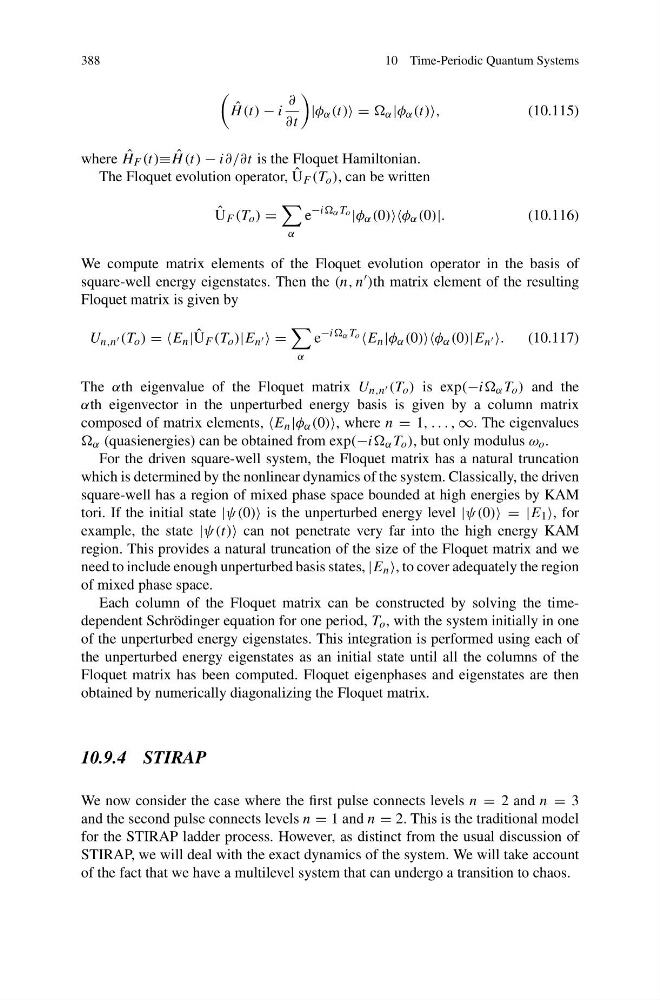
ˆ
H (t) − i
∂
∂t
|φ α (t) = α |φ α (t),
(10.115)
where ˆ
H F (t)≡ ˆ
H (t) − i∂/∂t is the Floquet Hamiltonian.
The Floquet evolution operator, ˆ
U F (T o ), can be written
ˆ
U F (T o ) =
α
e
−ii α T o |φ α (0)φ α (0)|.
(10.116)
We compute matrix elements of the Floquet evolution operator in the basis of
square-well energy eigenstates. Then the (n, n )th matrix element of the resulting
Floquet matrix is given by
U n,n (T o ) = =E n | ˆ
U F (T o )|E n =
α
e
−ii α T o E n |φ α (0)φ α (0)|E n .
(10.117)
The αth eigenvalue of the Floquet matrix U n,n (T o ) is exp(−ii α T o ) and the
αth eigenvector in the unperturbed energy basis is given by a column matrix
composed of matrix elements, E n |φ α (0), where n = 1, . . . , ∞. The eigenvalues
α (quasienergies) can be obtained from exp(−ii α T o ), but only modulus ω o .
For the driven square-well system, the Floquet matrix has a natural truncation
which is determined by the nonlinear dynamics of the system. Classically, the driven
square-well has a region of mixed phase space bounded at high energies by KAM
tori. If the initial state |ψ(0) is the unperturbed energy level |ψ(0) = |E 1 , for
example, the state |ψ(t) can not penetrate very far into the high energy KAM
region. This provides a natural truncation of the size of the Floquet matrix and we
need to include enough unperturbed basis states, |E n , to cover adequately the region
of mixed phase space.
Each column of the Floquet matrix can be constructed by solving the timedependent Schrödinger equation for one period, T o , with the system initially in one
of the unperturbed energy eigenstates. This integration is performed using each of
the unperturbed energy eigenstates as an initial state until all the columns of the
Floquet matrix has been computed. Floquet eigenphases and eigenstates are then
obtained by numerically diagonalizing the Floquet matrix.
10.9.4 STIRAP
We now consider the case where the first pulse connects levels n = 2 and n = 3
and the second pulse connects levels n = 1 and n = 2. This is the traditional model
for the STIRAP ladder process. However, as distinct from the usual discussion of
STIRAP, we will deal with the exact dynamics of the system. We will take account
of the fact that we have a multilevel system that can undergo a transition to chaos.
10 Time-Periodic Quantum Systems
ˆ
H (t) − i
∂
∂t
|φ α (t) = α |φ α (t),
(10.115)
where ˆ
H F (t)≡ ˆ
H (t) − i∂/∂t is the Floquet Hamiltonian.
The Floquet evolution operator, ˆ
U F (T o ), can be written
ˆ
U F (T o ) =
α
e
−ii α T o |φ α (0)φ α (0)|.
(10.116)
We compute matrix elements of the Floquet evolution operator in the basis of
square-well energy eigenstates. Then the (n, n )th matrix element of the resulting
Floquet matrix is given by
U n,n (T o ) = =E n | ˆ
U F (T o )|E n =
α
e
−ii α T o E n |φ α (0)φ α (0)|E n .
(10.117)
The αth eigenvalue of the Floquet matrix U n,n (T o ) is exp(−ii α T o ) and the
αth eigenvector in the unperturbed energy basis is given by a column matrix
composed of matrix elements, E n |φ α (0), where n = 1, . . . , ∞. The eigenvalues
α (quasienergies) can be obtained from exp(−ii α T o ), but only modulus ω o .
For the driven square-well system, the Floquet matrix has a natural truncation
which is determined by the nonlinear dynamics of the system. Classically, the driven
square-well has a region of mixed phase space bounded at high energies by KAM
tori. If the initial state |ψ(0) is the unperturbed energy level |ψ(0) = |E 1 , for
example, the state |ψ(t) can not penetrate very far into the high energy KAM
region. This provides a natural truncation of the size of the Floquet matrix and we
need to include enough unperturbed basis states, |E n , to cover adequately the region
of mixed phase space.
Each column of the Floquet matrix can be constructed by solving the timedependent Schrödinger equation for one period, T o , with the system initially in one
of the unperturbed energy eigenstates. This integration is performed using each of
the unperturbed energy eigenstates as an initial state until all the columns of the
Floquet matrix has been computed. Floquet eigenphases and eigenstates are then
obtained by numerically diagonalizing the Floquet matrix.
10.9.4 STIRAP
We now consider the case where the first pulse connects levels n = 2 and n = 3
and the second pulse connects levels n = 1 and n = 2. This is the traditional model
for the STIRAP ladder process. However, as distinct from the usual discussion of
STIRAP, we will deal with the exact dynamics of the system. We will take account
of the fact that we have a multilevel system that can undergo a transition to chaos.