

380
10 Time-Periodic Quantum Systems
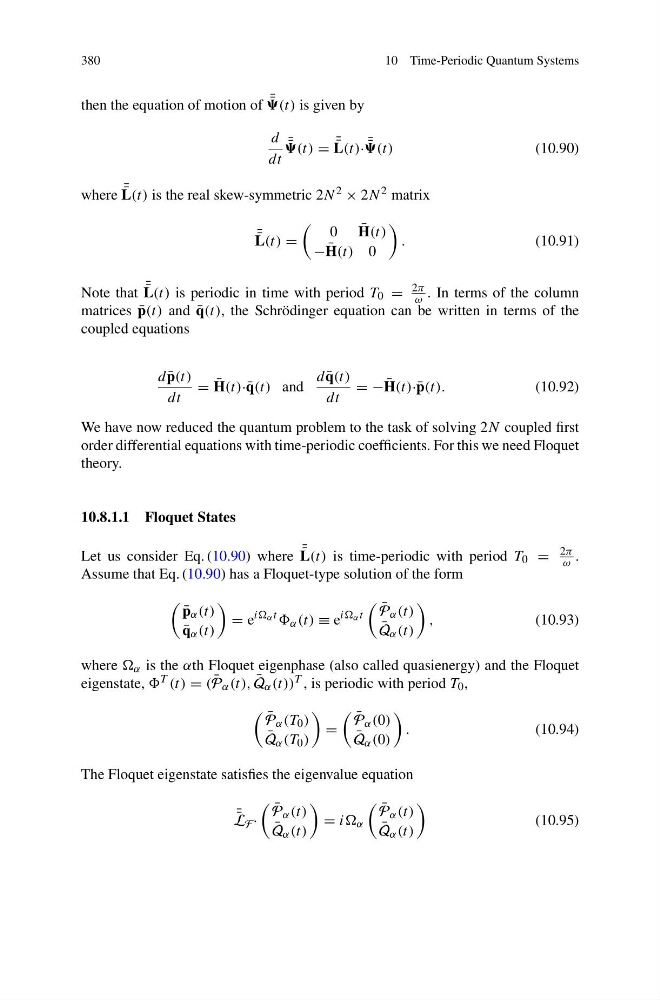
then the equation of motion of ¯ ¯
(t) is given by
d
dt
¯ ¯
(t) = ¯ ¯
L(t)· ¯ ¯
(t)
(10.90)
where ¯ ¯
L(t) is the real skew-symmetric 2N 2 × 2N 2 matrix
¯ ¯
L(t) =
0
¯
H(t)
− ¯
H(t) 0
.
(10.91)
Note that ¯ ¯
L(t) is periodic in time with period T 0 =
2π
ω . In terms of the column
matrices ¯
p(t) and ¯
q(t), the Schrödinger equation can be written in terms of the
coupled equations
d ¯
p(t)
dt
= ¯
H(t)· ¯
q(t) and
d ¯
q(t)
dt
= − ¯
H(t)· ¯
p(t).
(10.92)
We have now reduced the quantum problem to the task of solving 2N coupled first
order differential equations with time-periodic coefficients. For this we need Floquet
theory.
10.8.1.1 Floquet States
Let us consider Eq. (10.90) where ¯ ¯
L(t) is time-periodic with period T 0 =
2π
ω .
Assume that Eq. (10.90) has a Floquet-type solution of the form
¯
p α (t)
¯
q α (t)
= e
ii α t α (t) ≡ e
ii α t
¯
P α (t)
¯
Q α (t)
,
(10.93)
where α is the αth Floquet eigenphase (also called quasienergy) and the Floquet
eigenstate, T (t) = ( ¯
P α (t), ¯
Q α (t)) T , is periodic with period T 0 ,
¯
P α (T 0 )
¯
Q α (T 0 )
=
¯
P α (0)
¯
Q α (0)
.
(10.94)
The Floquet eigenstate satisfies the eigenvalue equation
¯ ¯
L F ·
¯
P α (t)
¯
Q α (t)
= ii α
¯
P α (t)
¯
Q α (t)
(10.95)
10 Time-Periodic Quantum Systems
then the equation of motion of ¯ ¯
(t) is given by
d
dt
¯ ¯
(t) = ¯ ¯
L(t)· ¯ ¯
(t)
(10.90)
where ¯ ¯
L(t) is the real skew-symmetric 2N 2 × 2N 2 matrix
¯ ¯
L(t) =
0
¯
H(t)
− ¯
H(t) 0
.
(10.91)
Note that ¯ ¯
L(t) is periodic in time with period T 0 =
2π
ω . In terms of the column
matrices ¯
p(t) and ¯
q(t), the Schrödinger equation can be written in terms of the
coupled equations
d ¯
p(t)
dt
= ¯
H(t)· ¯
q(t) and
d ¯
q(t)
dt
= − ¯
H(t)· ¯
p(t).
(10.92)
We have now reduced the quantum problem to the task of solving 2N coupled first
order differential equations with time-periodic coefficients. For this we need Floquet
theory.
10.8.1.1 Floquet States
Let us consider Eq. (10.90) where ¯ ¯
L(t) is time-periodic with period T 0 =
2π
ω .
Assume that Eq. (10.90) has a Floquet-type solution of the form
¯
p α (t)
¯
q α (t)
= e
ii α t α (t) ≡ e
ii α t
¯
P α (t)
¯
Q α (t)
,
(10.93)
where α is the αth Floquet eigenphase (also called quasienergy) and the Floquet
eigenstate, T (t) = ( ¯
P α (t), ¯
Q α (t)) T , is periodic with period T 0 ,
¯
P α (T 0 )
¯
Q α (T 0 )
=
¯
P α (0)
¯
Q α (0)
.
(10.94)
The Floquet eigenstate satisfies the eigenvalue equation
¯ ¯
L F ·
¯
P α (t)
¯
Q α (t)
= ii α
¯
P α (t)
¯
Q α (t)
(10.95)