

10.8 Arnol’d Diffusion in Quantum Systems
381
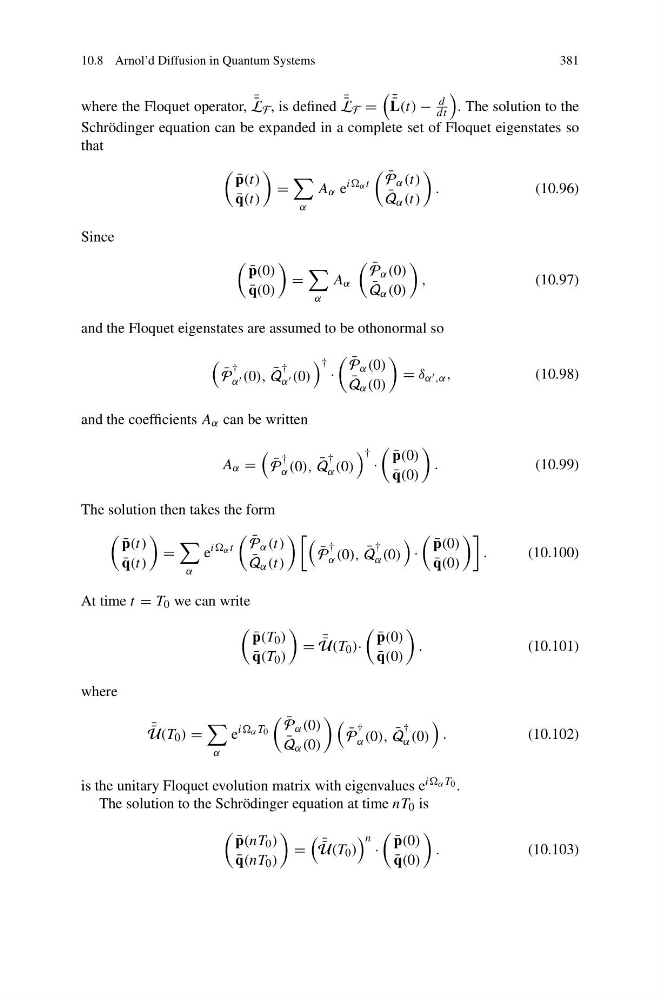
where the Floquet operator, ¯ ¯
L F , is defined ¯ ¯
L F =
¯ ¯
L(t) −
d
dt
. The solution to the
Schrödinger equation can be expanded in a complete set of Floquet eigenstates so
that
¯
p(t)
¯
q(t)
=
α
A α e
ii α t
¯
P α (t)
¯
Q α (t)
.
(10.96)
Since
¯
p(0)
¯
q(0)
=
α
A α
¯
P α (0)
¯
Q α (0)
,
(10.97)
and the Floquet eigenstates are assumed to be othonormal so
¯
P
†
α (0), ¯
Q
†
α (0)
† ·
¯
P α (0)
¯
Q α (0)
= δ α ,α ,
(10.98)
and the coefficients A α can be written
A α =
¯
P
†
α (0), ¯
Q
†
α (0)
† ·
¯
p(0)
¯
q(0)
.
(10.99)
The solution then takes the form
¯
p(t)
¯
q(t)
=
α
e
ii α t
¯
P α (t)
¯
Q α (t)
¯
P
†
α (0), ¯
Q
†
α (0)
·
¯
p(0)
¯
q(0)
.
(10.100)
At time t = T 0 we can write
¯
p(T 0 )
¯
q(T 0 )
= ¯ ¯
U(T 0 )·
¯
p(0)
¯
q(0)
.
(10.101)
where
¯ ¯
U(T 0 ) =
α
e
ii α T 0
¯
P α (0)
¯
Q α (0)
¯
P
†
α (0), ¯
Q
†
α (0)
.
(10.102)
is the unitary Floquet evolution matrix with eigenvalues e ii α T 0 .
The solution to the Schrödinger equation at time nT 0 is
¯
p(nT 0 )
¯
q(nT 0 )
=
¯ ¯
U(T 0 )
n ·
¯
p(0)
¯
q(0)
.
(10.103)
381
where the Floquet operator, ¯ ¯
L F , is defined ¯ ¯
L F =
¯ ¯
L(t) −
d
dt
. The solution to the
Schrödinger equation can be expanded in a complete set of Floquet eigenstates so
that
¯
p(t)
¯
q(t)
=
α
A α e
ii α t
¯
P α (t)
¯
Q α (t)
.
(10.96)
Since
¯
p(0)
¯
q(0)
=
α
A α
¯
P α (0)
¯
Q α (0)
,
(10.97)
and the Floquet eigenstates are assumed to be othonormal so
¯
P
†
α (0), ¯
Q
†
α (0)
† ·
¯
P α (0)
¯
Q α (0)
= δ α ,α ,
(10.98)
and the coefficients A α can be written
A α =
¯
P
†
α (0), ¯
Q
†
α (0)
† ·
¯
p(0)
¯
q(0)
.
(10.99)
The solution then takes the form
¯
p(t)
¯
q(t)
=
α
e
ii α t
¯
P α (t)
¯
Q α (t)
¯
P
†
α (0), ¯
Q
†
α (0)
·
¯
p(0)
¯
q(0)
.
(10.100)
At time t = T 0 we can write
¯
p(T 0 )
¯
q(T 0 )
= ¯ ¯
U(T 0 )·
¯
p(0)
¯
q(0)
.
(10.101)
where
¯ ¯
U(T 0 ) =
α
e
ii α T 0
¯
P α (0)
¯
Q α (0)
¯
P
†
α (0), ¯
Q
†
α (0)
.
(10.102)
is the unitary Floquet evolution matrix with eigenvalues e ii α T 0 .
The solution to the Schrödinger equation at time nT 0 is
¯
p(nT 0 )
¯
q(nT 0 )
=
¯ ¯
U(T 0 )
n ·
¯
p(0)
¯
q(0)
.
(10.103)