

374
10 Time-Periodic Quantum Systems
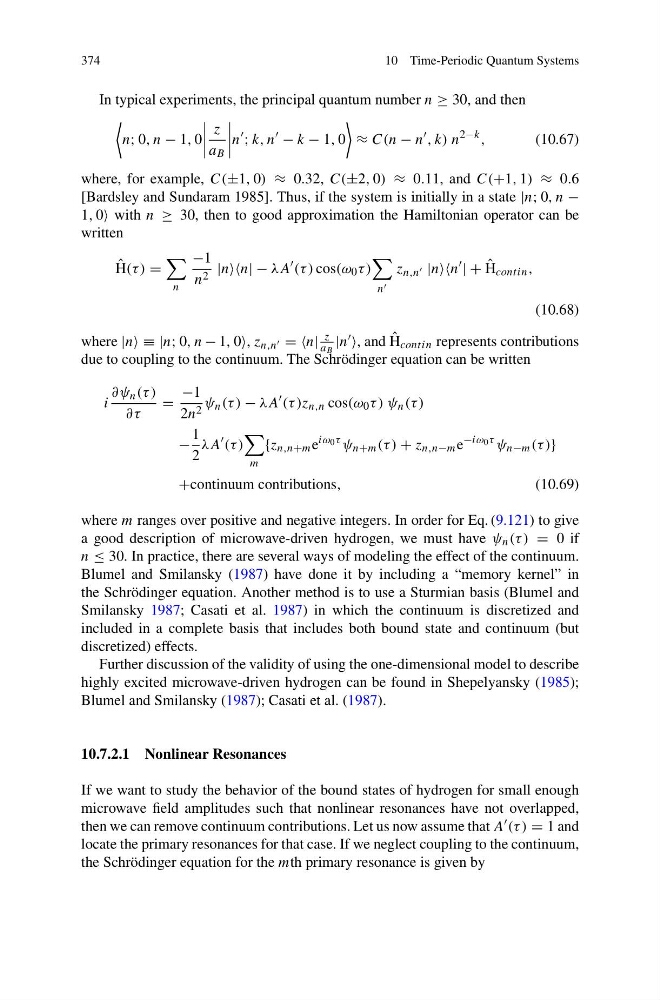
In typical experiments, the principal quantum number n ≥ 30, and then
n; 0, n − 1, 0
z
a B
n
; k, n
− k − 1, 0
≈ C(n − n
, k) n
2−k ,
(10.67)
where, for example, C(±1, 0) ≈ 0.32, C(±2, 0) ≈ 0.11, and C(+1, 1) ≈ 0.6
[Bardsley and Sundaram 1985]. Thus, if the system is initially in a state |n; 0, n −
1, 0 with n ≥ 30, then to good approximation the Hamiltonian operator can be
written
ˆ
H(τ ) =
n
−1
n 2 |nn| − λA
(τ ) cos(ω 0 τ )
n
z n,n |nn
| + ˆ
H contin ,
(10.68)
where |n ≡ |n; 0, n − 1, 0, z n,n = =n|
z
a B
|n , and ˆ
H contin represents contributions
due to coupling to the continuum. The Schrödinger equation can be written
i
∂ψ n (τ )
∂τ
=
−1
2n 2 ψ n (τ ) − λA
(τ )z n,n cos(ω 0 τ ) ψ n (τ )
−
1
2
λA
(τ )
m
{z n,n+m e
iω 0 τ ψ n+m (τ ) + z n,n−m e
−iω 0 τ ψ n−m (τ )}
+continuum contributions,
(10.69)
where m ranges over positive and negative integers. In order for Eq. (9.121) to give
a good description of microwave-driven hydrogen, we must have ψ n (τ ) = 0 if
n ≤ 30. In practice, there are several ways of modeling the effect of the continuum.
Blumel and Smilansky (1987) have done it by including a “memory kernel” in
the Schrödinger equation. Another method is to use a Sturmian basis (Blumel and
Smilansky 1987; Casati et al. 1987) in which the continuum is discretized and
included in a complete basis that includes both bound state and continuum (but
discretized) effects.
Further discussion of the validity of using the one-dimensional model to describe
highly excited microwave-driven hydrogen can be found in Shepelyansky (1985);
Blumel and Smilansky (1987); Casati et al. (1987).
10.7.2.1 Nonlinear Resonances
If we want to study the behavior of the bound states of hydrogen for small enough
microwave field amplitudes such that nonlinear resonances have not overlapped,
then we can remove continuum contributions. Let us now assume that A (τ ) = 1 and
locate the primary resonances for that case. If we neglect coupling to the continuum,
the Schrödinger equation for the mth primary resonance is given by
10 Time-Periodic Quantum Systems
In typical experiments, the principal quantum number n ≥ 30, and then
n; 0, n − 1, 0
z
a B
n
; k, n
− k − 1, 0
≈ C(n − n
, k) n
2−k ,
(10.67)
where, for example, C(±1, 0) ≈ 0.32, C(±2, 0) ≈ 0.11, and C(+1, 1) ≈ 0.6
[Bardsley and Sundaram 1985]. Thus, if the system is initially in a state |n; 0, n −
1, 0 with n ≥ 30, then to good approximation the Hamiltonian operator can be
written
ˆ
H(τ ) =
n
−1
n 2 |nn| − λA
(τ ) cos(ω 0 τ )
n
z n,n |nn
| + ˆ
H contin ,
(10.68)
where |n ≡ |n; 0, n − 1, 0, z n,n = =n|
z
a B
|n , and ˆ
H contin represents contributions
due to coupling to the continuum. The Schrödinger equation can be written
i
∂ψ n (τ )
∂τ
=
−1
2n 2 ψ n (τ ) − λA
(τ )z n,n cos(ω 0 τ ) ψ n (τ )
−
1
2
λA
(τ )
m
{z n,n+m e
iω 0 τ ψ n+m (τ ) + z n,n−m e
−iω 0 τ ψ n−m (τ )}
+continuum contributions,
(10.69)
where m ranges over positive and negative integers. In order for Eq. (9.121) to give
a good description of microwave-driven hydrogen, we must have ψ n (τ ) = 0 if
n ≤ 30. In practice, there are several ways of modeling the effect of the continuum.
Blumel and Smilansky (1987) have done it by including a “memory kernel” in
the Schrödinger equation. Another method is to use a Sturmian basis (Blumel and
Smilansky 1987; Casati et al. 1987) in which the continuum is discretized and
included in a complete basis that includes both bound state and continuum (but
discretized) effects.
Further discussion of the validity of using the one-dimensional model to describe
highly excited microwave-driven hydrogen can be found in Shepelyansky (1985);
Blumel and Smilansky (1987); Casati et al. (1987).
10.7.2.1 Nonlinear Resonances
If we want to study the behavior of the bound states of hydrogen for small enough
microwave field amplitudes such that nonlinear resonances have not overlapped,
then we can remove continuum contributions. Let us now assume that A (τ ) = 1 and
locate the primary resonances for that case. If we neglect coupling to the continuum,
the Schrödinger equation for the mth primary resonance is given by