

10.7 Microwave-Driven Hydrogen
373
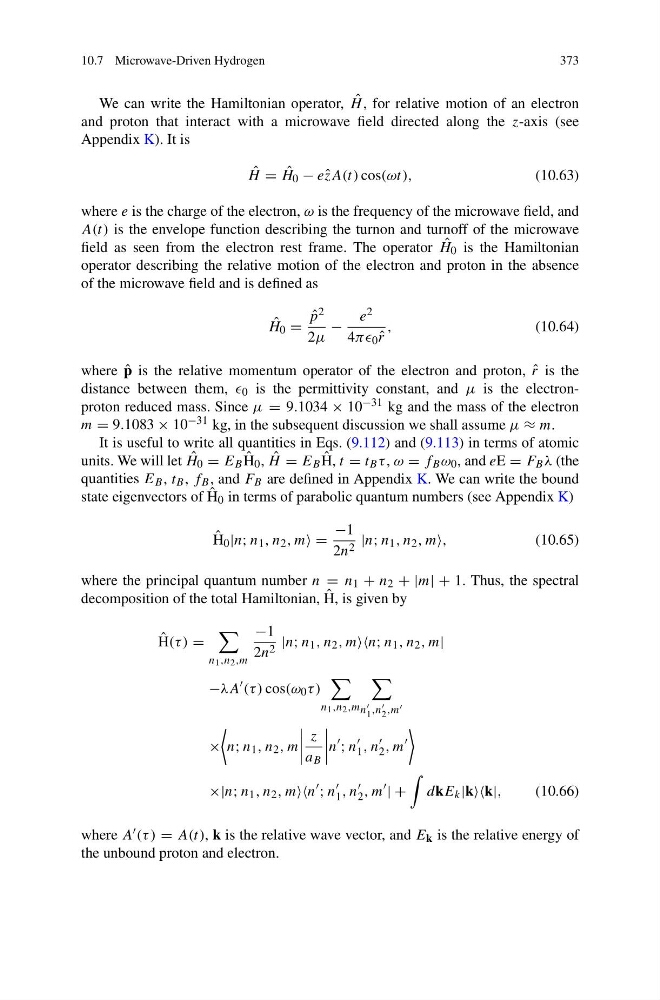
We can write the Hamiltonian operator, ˆ
H , for relative motion of an electron
and proton that interact with a microwave field directed along the z-axis (see
Appendix K). It is
ˆ
H = ˆ
H 0 − eˆ zA(t) cos(ωt),
(10.63)
where e is the charge of the electron, ω is the frequency of the microwave field, and
A(t) is the envelope function describing the turnon and turnoff of the microwave
field as seen from the electron rest frame. The operator ˆ
H 0 is the Hamiltonian
operator describing the relative motion of the electron and proton in the absence
of the microwave field and is defined as
ˆ
H 0 =
ˆ
p 2
2μ
−
e 2
4ππ 0 ˆ
r
,
(10.64)
where ˆ
p is the relative momentum operator of the electron and proton, ˆ
r is the
distance between them, 0 is the permittivity constant, and μ is the electronproton reduced mass. Since μ = 9.1034 × 10 −31 kg and the mass of the electron
m = 9.1083 × 10 −31 kg, in the subsequent discussion we shall assume μ ≈ m.
It is useful to write all quantities in Eqs. (9.112) and (9.113) in terms of atomic
units. We will let ˆ
H 0 = E B ˆ
H 0 , ˆ
H = E B ˆ
H, t = t B τ , ω = f B ω 0 , and eE = F B λ (the
quantities E B , t B , f B , and F B are defined in Appendix K. We can write the bound
state eigenvectors of ˆ
H 0 in terms of parabolic quantum numbers (see Appendix K)
ˆ
H 0 |n; n 1 , n 2 , m =
−1
2n 2 |n; n 1 , n 2 , m,
(10.65)
where the principal quantum number n = n 1 + n 2 + |m| + 1. Thus, the spectral
decomposition of the total Hamiltonian, ˆ
H, is given by
ˆ
H(τ ) =
n 1 ,n 2 ,m
−1
2n 2 |n; n 1 , n 2 , mn; n 1 , n 2 , m|
−λA
(τ ) cos(ω 0 τ )
n 1 ,n 2 ,m
n
1 ,n
2 ,m
×
n; n 1 , n 2 , m
z
a B
n
; n
1 , n
2 , m
×|n; n 1 , n 2 , mn
; n
1 , n
2 , m
| +
dkE k |kk|,
(10.66)
where A (τ ) = A(t), k is the relative wave vector, and E k is the relative energy of
the unbound proton and electron.
373
We can write the Hamiltonian operator, ˆ
H , for relative motion of an electron
and proton that interact with a microwave field directed along the z-axis (see
Appendix K). It is
ˆ
H = ˆ
H 0 − eˆ zA(t) cos(ωt),
(10.63)
where e is the charge of the electron, ω is the frequency of the microwave field, and
A(t) is the envelope function describing the turnon and turnoff of the microwave
field as seen from the electron rest frame. The operator ˆ
H 0 is the Hamiltonian
operator describing the relative motion of the electron and proton in the absence
of the microwave field and is defined as
ˆ
H 0 =
ˆ
p 2
2μ
−
e 2
4ππ 0 ˆ
r
,
(10.64)
where ˆ
p is the relative momentum operator of the electron and proton, ˆ
r is the
distance between them, 0 is the permittivity constant, and μ is the electronproton reduced mass. Since μ = 9.1034 × 10 −31 kg and the mass of the electron
m = 9.1083 × 10 −31 kg, in the subsequent discussion we shall assume μ ≈ m.
It is useful to write all quantities in Eqs. (9.112) and (9.113) in terms of atomic
units. We will let ˆ
H 0 = E B ˆ
H 0 , ˆ
H = E B ˆ
H, t = t B τ , ω = f B ω 0 , and eE = F B λ (the
quantities E B , t B , f B , and F B are defined in Appendix K. We can write the bound
state eigenvectors of ˆ
H 0 in terms of parabolic quantum numbers (see Appendix K)
ˆ
H 0 |n; n 1 , n 2 , m =
−1
2n 2 |n; n 1 , n 2 , m,
(10.65)
where the principal quantum number n = n 1 + n 2 + |m| + 1. Thus, the spectral
decomposition of the total Hamiltonian, ˆ
H, is given by
ˆ
H(τ ) =
n 1 ,n 2 ,m
−1
2n 2 |n; n 1 , n 2 , mn; n 1 , n 2 , m|
−λA
(τ ) cos(ω 0 τ )
n 1 ,n 2 ,m
n
1 ,n
2 ,m
×
n; n 1 , n 2 , m
z
a B
n
; n
1 , n
2 , m
×|n; n 1 , n 2 , mn
; n
1 , n
2 , m
| +
dkE k |kk|,
(10.66)
where A (τ ) = A(t), k is the relative wave vector, and E k is the relative energy of
the unbound proton and electron.