

10.6 Quantum Delta-Kicked Rotor
367
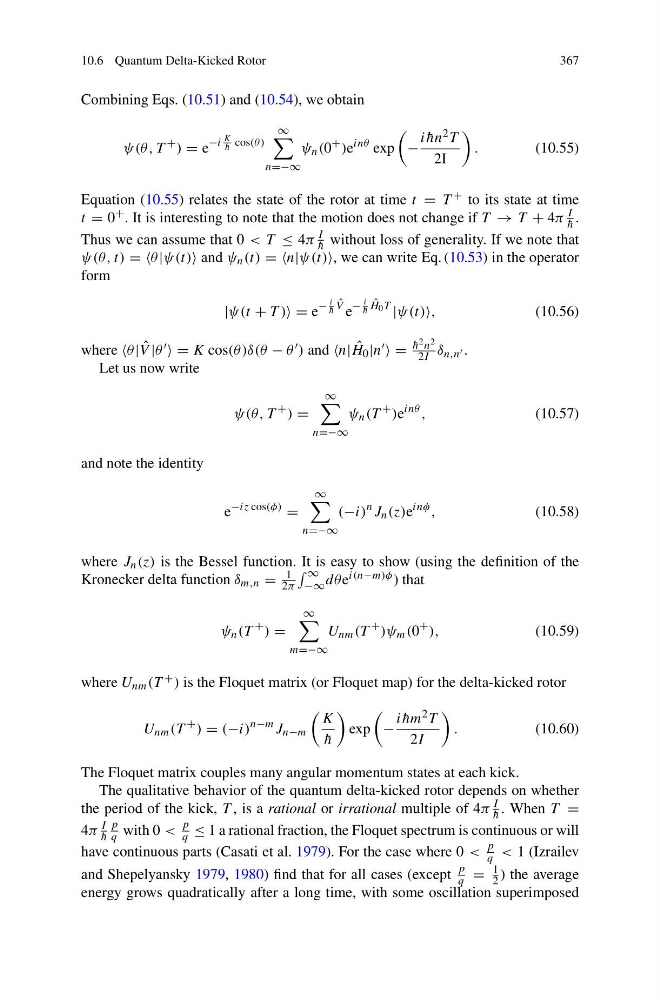
Combining Eqs. (10.51) and (10.54), we obtain
ψ(θ, T
+ ) = e
−i
K
¯
h cos(θ)
∞
n=−∞
ψ n (0
+ )e
inθ exp
−
i ¯
hn 2 T
2I
.
(10.55)
Equation (10.55) relates the state of the rotor at time t = T + to its state at time
t = 0 + . It is interesting to note that the motion does not change if T → T + 4π
I
¯
h .
Thus we can assume that 0 < T ≤ 4π
I
¯
h without loss of generality. If we note that
ψ(θ, t) = =θ |ψ(t) and ψ n (t) = =n|ψ(t), we can write Eq. (10.53) in the operator
form
|ψ(t + T ) = e
−
i
¯
h
ˆ
V e
−
i
¯
h
ˆ
H 0 T |ψ(t),
(10.56)
where θ | ˆ
V |θ = K cos(θ )δ(θ − θ ) and n| ˆ
H 0 |n = ¯
h 2 n 2
2I δ n,n .
Let us now write
ψ(θ, T
+ ) =
∞
n=−∞
ψ n (T
+ )e
inθ ,
(10.57)
and note the identity
e
−iz cos(φ)
=
∞
n=−∞
(−i)
n J n (z)e
inφ ,
(10.58)
where J n (z) is the Bessel function. It is easy to show (using the definition of the
Kronecker delta function δ m,n =
1
2π
∞
−∞ dθe i(n−m)φ ) that
ψ n (T
+ ) =
∞
m=−∞
U nm (T
+ )ψ m (0
+ ),
(10.59)
where U nm (T + ) is the Floquet matrix (or Floquet map) for the delta-kicked rotor
U nm (T
+ ) = (−i)
n−m J n−m
K
¯
h
exp
−
i ¯
hm 2 T
2I
.
(10.60)
The Floquet matrix couples many angular momentum states at each kick.
The qualitative behavior of the quantum delta-kicked rotor depends on whether
the period of the kick, T , is a rational or irrational multiple of 4π
I
¯
h . When T =
4π
I
¯
h
p
q with 0 <
p
q ≤ 1 a rational fraction, the Floquet spectrum is continuous or will
have continuous parts (Casati et al. 1979). For the case where 0 <
p
q < 1 (Izrailev
and Shepelyansky 1979, 1980) find that for all cases (except
p
q =
1
2 ) the average
energy grows quadratically after a long time, with some oscillation superimposed
367
Combining Eqs. (10.51) and (10.54), we obtain
ψ(θ, T
+ ) = e
−i
K
¯
h cos(θ)
∞
n=−∞
ψ n (0
+ )e
inθ exp
−
i ¯
hn 2 T
2I
.
(10.55)
Equation (10.55) relates the state of the rotor at time t = T + to its state at time
t = 0 + . It is interesting to note that the motion does not change if T → T + 4π
I
¯
h .
Thus we can assume that 0 < T ≤ 4π
I
¯
h without loss of generality. If we note that
ψ(θ, t) = =θ |ψ(t) and ψ n (t) = =n|ψ(t), we can write Eq. (10.53) in the operator
form
|ψ(t + T ) = e
−
i
¯
h
ˆ
V e
−
i
¯
h
ˆ
H 0 T |ψ(t),
(10.56)
where θ | ˆ
V |θ = K cos(θ )δ(θ − θ ) and n| ˆ
H 0 |n = ¯
h 2 n 2
2I δ n,n .
Let us now write
ψ(θ, T
+ ) =
∞
n=−∞
ψ n (T
+ )e
inθ ,
(10.57)
and note the identity
e
−iz cos(φ)
=
∞
n=−∞
(−i)
n J n (z)e
inφ ,
(10.58)
where J n (z) is the Bessel function. It is easy to show (using the definition of the
Kronecker delta function δ m,n =
1
2π
∞
−∞ dθe i(n−m)φ ) that
ψ n (T
+ ) =
∞
m=−∞
U nm (T
+ )ψ m (0
+ ),
(10.59)
where U nm (T + ) is the Floquet matrix (or Floquet map) for the delta-kicked rotor
U nm (T
+ ) = (−i)
n−m J n−m
K
¯
h
exp
−
i ¯
hm 2 T
2I
.
(10.60)
The Floquet matrix couples many angular momentum states at each kick.
The qualitative behavior of the quantum delta-kicked rotor depends on whether
the period of the kick, T , is a rational or irrational multiple of 4π
I
¯
h . When T =
4π
I
¯
h
p
q with 0 <
p
q ≤ 1 a rational fraction, the Floquet spectrum is continuous or will
have continuous parts (Casati et al. 1979). For the case where 0 <
p
q < 1 (Izrailev
and Shepelyansky 1979, 1980) find that for all cases (except
p
q =
1
2 ) the average
energy grows quadratically after a long time, with some oscillation superimposed