

368
10 Time-Periodic Quantum Systems
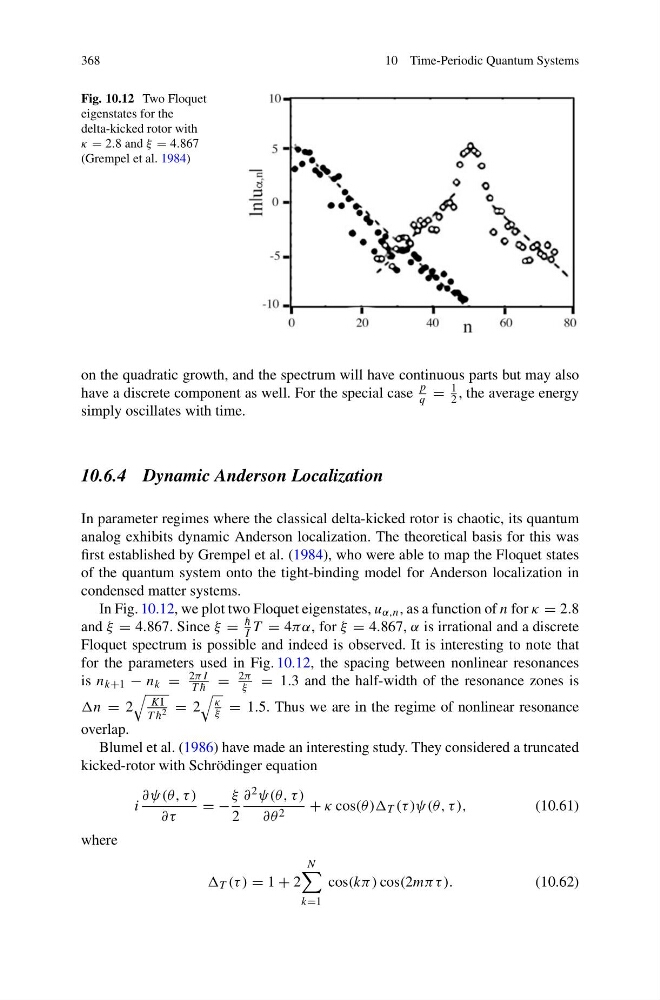
Fig. 10.12 Two Floquet
eigenstates for the
delta-kicked rotor with
κ = 2.8 and ξ = 4.867
(Grempel et al. 1984)
on the quadratic growth, and the spectrum will have continuous parts but may also
have a discrete component as well. For the special case
p
q =
1
2 , the average energy
simply oscillates with time.
10.6.4 Dynamic Anderson Localization
In parameter regimes where the classical delta-kicked rotor is chaotic, its quantum
analog exhibits dynamic Anderson localization. The theoretical basis for this was
first established by Grempel et al. (1984), who were able to map the Floquet states
of the quantum system onto the tight-binding model for Anderson localization in
condensed matter systems.
In Fig. 10.12, we plot two Floquet eigenstates, u α,n , as a function of n for κ = 2.8
and ξ = 4.867. Since ξ = ¯
h
I T = 4πα, for ξ = 4.867, α is irrational and a discrete
Floquet spectrum is possible and indeed is observed. It is interesting to note that
for the parameters used in Fig. 10.12, the spacing between nonlinear resonances
is n k+1 − n k =
2πI
T ¯
h =
2π
ξ = 1.3 and the half-width of the resonance zones is
= 2
KI
T ¯
h 2 = 2
κ
ξ = 1.5. Thus we are in the regime of nonlinear resonance
overlap.
Blumel et al. (1986) have made an interesting study. They considered a truncated
kicked-rotor with Schrödinger equation
i
∂ψ(θ, τ )
∂τ
= −
ξ
2
∂ 2 ψ(θ, τ )
∂θ 2
+ κ cos(θ )) T (τ )ψ(θ, τ ),
(10.61)
where
T (τ ) = 1 + 2
N
k=1
cos(kπ ) cos(2mπ τ ).
(10.62)
10 Time-Periodic Quantum Systems
Fig. 10.12 Two Floquet
eigenstates for the
delta-kicked rotor with
κ = 2.8 and ξ = 4.867
(Grempel et al. 1984)
on the quadratic growth, and the spectrum will have continuous parts but may also
have a discrete component as well. For the special case
p
q =
1
2 , the average energy
simply oscillates with time.
10.6.4 Dynamic Anderson Localization
In parameter regimes where the classical delta-kicked rotor is chaotic, its quantum
analog exhibits dynamic Anderson localization. The theoretical basis for this was
first established by Grempel et al. (1984), who were able to map the Floquet states
of the quantum system onto the tight-binding model for Anderson localization in
condensed matter systems.
In Fig. 10.12, we plot two Floquet eigenstates, u α,n , as a function of n for κ = 2.8
and ξ = 4.867. Since ξ = ¯
h
I T = 4πα, for ξ = 4.867, α is irrational and a discrete
Floquet spectrum is possible and indeed is observed. It is interesting to note that
for the parameters used in Fig. 10.12, the spacing between nonlinear resonances
is n k+1 − n k =
2πI
T ¯
h =
2π
ξ = 1.3 and the half-width of the resonance zones is
= 2
KI
T ¯
h 2 = 2
κ
ξ = 1.5. Thus we are in the regime of nonlinear resonance
overlap.
Blumel et al. (1986) have made an interesting study. They considered a truncated
kicked-rotor with Schrödinger equation
i
∂ψ(θ, τ )
∂τ
= −
ξ
2
∂ 2 ψ(θ, τ )
∂θ 2
+ κ cos(θ )) T (τ )ψ(θ, τ ),
(10.61)
where
T (τ ) = 1 + 2
N
k=1
cos(kπ ) cos(2mπ τ ).
(10.62)