

366
10 Time-Periodic Quantum Systems
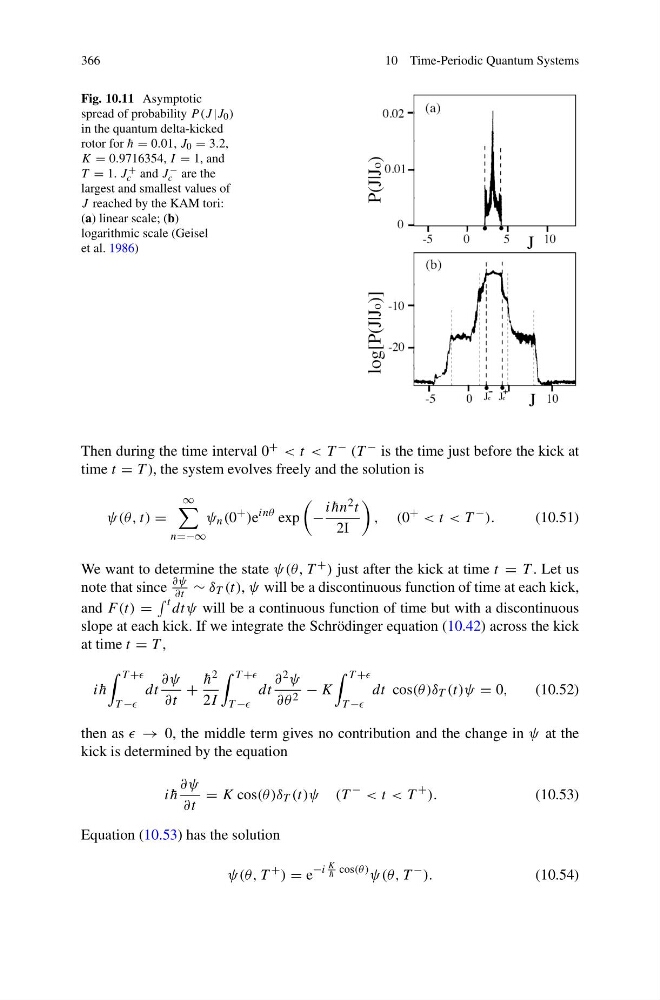
Fig. 10.11 Asymptotic
spread of probability P (J |J 0 )
in the quantum delta-kicked
rotor for ¯
h = 0.01, J 0 = 3.2,
K = 0.9716354, I = 1, and
T = 1. J +
c and J −
c are the
largest and smallest values of
J reached by the KAM tori:
(a) linear scale; (b)
logarithmic scale (Geisel
et al. 1986)
Then during the time interval 0 + < t < T − (T − is the time just before the kick at
time t = T ), the system evolves freely and the solution is
ψ(θ, t) =
∞
n=−∞
ψ n (0
+ )e
inθ exp
−
i ¯
hn 2 t
2I
, (0
+ < t < T
− ).
(10.51)
We want to determine the state ψ(θ, T + ) just after the kick at time t = T . Let us
note that since
∂ψ
∂t ∼ δ T (t), ψ will be a discontinuous function of time at each kick,
and F (t) =
t dtψ will be a continuous function of time but with a discontinuous
slope at each kick. If we integrate the Schrödinger equation (10.42) across the kick
at time t = T ,
i ¯
h
T +
T −
dt
∂ψ
∂t
+
¯
h 2
2I
T +
T −
dt
∂ 2 ψ
∂θ 2 − K
T +
T −
dt cos(θ )δ T (t)ψ = 0,
(10.52)
then as → 0, the middle term gives no contribution and the change in ψ at the
kick is determined by the equation
i ¯
h
∂ψ
∂t
= K cos(θ )δ T (t)ψ (T
− < t < T
+ ).
(10.53)
Equation (10.53) has the solution
ψ(θ, T
+ ) = e
−i
K
¯
h cos(θ) ψ(θ, T
− ).
(10.54)
10 Time-Periodic Quantum Systems
Fig. 10.11 Asymptotic
spread of probability P (J |J 0 )
in the quantum delta-kicked
rotor for ¯
h = 0.01, J 0 = 3.2,
K = 0.9716354, I = 1, and
T = 1. J +
c and J −
c are the
largest and smallest values of
J reached by the KAM tori:
(a) linear scale; (b)
logarithmic scale (Geisel
et al. 1986)
Then during the time interval 0 + < t < T − (T − is the time just before the kick at
time t = T ), the system evolves freely and the solution is
ψ(θ, t) =
∞
n=−∞
ψ n (0
+ )e
inθ exp
−
i ¯
hn 2 t
2I
, (0
+ < t < T
− ).
(10.51)
We want to determine the state ψ(θ, T + ) just after the kick at time t = T . Let us
note that since
∂ψ
∂t ∼ δ T (t), ψ will be a discontinuous function of time at each kick,
and F (t) =
t dtψ will be a continuous function of time but with a discontinuous
slope at each kick. If we integrate the Schrödinger equation (10.42) across the kick
at time t = T ,
i ¯
h
T +
T −
dt
∂ψ
∂t
+
¯
h 2
2I
T +
T −
dt
∂ 2 ψ
∂θ 2 − K
T +
T −
dt cos(θ )δ T (t)ψ = 0,
(10.52)
then as → 0, the middle term gives no contribution and the change in ψ at the
kick is determined by the equation
i ¯
h
∂ψ
∂t
= K cos(θ )δ T (t)ψ (T
− < t < T
+ ).
(10.53)
Equation (10.53) has the solution
ψ(θ, T
+ ) = e
−i
K
¯
h cos(θ) ψ(θ, T
− ).
(10.54)