

2.4 Poincaré Surface of Section
23
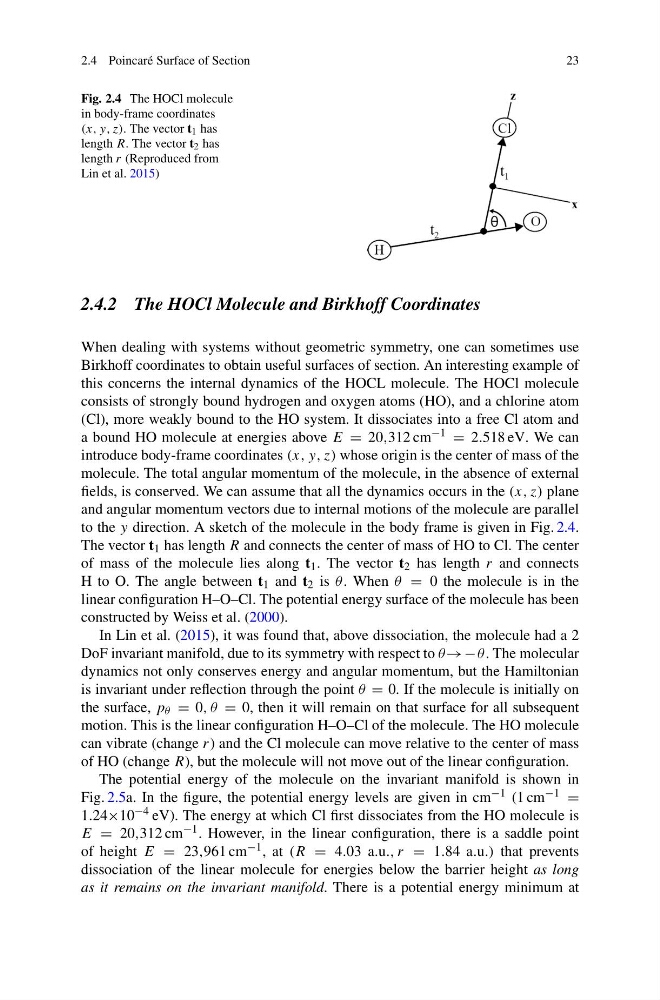
Fig. 2.4 The HOCl molecule
in body-frame coordinates
(x, y, z). The vector t 1 has
length R. The vector t 2 has
length r (Reproduced from
Lin et al. 2015)
2.4.2 The HOCl Molecule and Birkhoff Coordinates
When dealing with systems without geometric symmetry, one can sometimes use
Birkhoff coordinates to obtain useful surfaces of section. An interesting example of
this concerns the internal dynamics of the HOCL molecule. The HOCl molecule
consists of strongly bound hydrogen and oxygen atoms (HO), and a chlorine atom
(Cl), more weakly bound to the HO system. It dissociates into a free Cl atom and
a bound HO molecule at energies above E = 20,312 cm −1 = 2.518 eV. We can
introduce body-frame coordinates (x, y, z) whose origin is the center of mass of the
molecule. The total angular momentum of the molecule, in the absence of external
fields, is conserved. We can assume that all the dynamics occurs in the (x, z) plane
and angular momentum vectors due to internal motions of the molecule are parallel
to the y direction. A sketch of the molecule in the body frame is given in Fig. 2.4.
The vector t 1 has length R and connects the center of mass of HO to Cl. The center
of mass of the molecule lies along t 1 . The vector t 2 has length r and connects
H to O. The angle between t 1 and t 2 is θ . When θ = 0 the molecule is in the
linear configuration H–O–Cl. The potential energy surface of the molecule has been
constructed by Weiss et al. (2000).
In Lin et al. (2015), it was found that, above dissociation, the molecule had a 2
DoF invariant manifold, due to its symmetry with respect to θ →−θ . The molecular
dynamics not only conserves energy and angular momentum, but the Hamiltonian
is invariant under reflection through the point θ = 0. If the molecule is initially on
the surface, p θ = 0, θ = 0, then it will remain on that surface for all subsequent
motion. This is the linear configuration H–O–Cl of the molecule. The HO molecule
can vibrate (change r) and the Cl molecule can move relative to the center of mass
of HO (change R), but the molecule will not move out of the linear configuration.
The potential energy of the molecule on the invariant manifold is shown in
Fig. 2.5a. In the figure, the potential energy levels are given in cm −1 (1 cm −1 =
1.24×10 −4 eV). The energy at which Cl first dissociates from the HO molecule is
E = 20,312 cm −1 . However, in the linear configuration, there is a saddle point
of height E = 23,961 cm −1 , at (R = 4.03 a.u., r = 1.84 a.u.) that prevents
dissociation of the linear molecule for energies below the barrier height as long
as it remains on the invariant manifold. There is a potential energy minimum at
23
Fig. 2.4 The HOCl molecule
in body-frame coordinates
(x, y, z). The vector t 1 has
length R. The vector t 2 has
length r (Reproduced from
Lin et al. 2015)
2.4.2 The HOCl Molecule and Birkhoff Coordinates
When dealing with systems without geometric symmetry, one can sometimes use
Birkhoff coordinates to obtain useful surfaces of section. An interesting example of
this concerns the internal dynamics of the HOCL molecule. The HOCl molecule
consists of strongly bound hydrogen and oxygen atoms (HO), and a chlorine atom
(Cl), more weakly bound to the HO system. It dissociates into a free Cl atom and
a bound HO molecule at energies above E = 20,312 cm −1 = 2.518 eV. We can
introduce body-frame coordinates (x, y, z) whose origin is the center of mass of the
molecule. The total angular momentum of the molecule, in the absence of external
fields, is conserved. We can assume that all the dynamics occurs in the (x, z) plane
and angular momentum vectors due to internal motions of the molecule are parallel
to the y direction. A sketch of the molecule in the body frame is given in Fig. 2.4.
The vector t 1 has length R and connects the center of mass of HO to Cl. The center
of mass of the molecule lies along t 1 . The vector t 2 has length r and connects
H to O. The angle between t 1 and t 2 is θ . When θ = 0 the molecule is in the
linear configuration H–O–Cl. The potential energy surface of the molecule has been
constructed by Weiss et al. (2000).
In Lin et al. (2015), it was found that, above dissociation, the molecule had a 2
DoF invariant manifold, due to its symmetry with respect to θ →−θ . The molecular
dynamics not only conserves energy and angular momentum, but the Hamiltonian
is invariant under reflection through the point θ = 0. If the molecule is initially on
the surface, p θ = 0, θ = 0, then it will remain on that surface for all subsequent
motion. This is the linear configuration H–O–Cl of the molecule. The HO molecule
can vibrate (change r) and the Cl molecule can move relative to the center of mass
of HO (change R), but the molecule will not move out of the linear configuration.
The potential energy of the molecule on the invariant manifold is shown in
Fig. 2.5a. In the figure, the potential energy levels are given in cm −1 (1 cm −1 =
1.24×10 −4 eV). The energy at which Cl first dissociates from the HO molecule is
E = 20,312 cm −1 . However, in the linear configuration, there is a saddle point
of height E = 23,961 cm −1 , at (R = 4.03 a.u., r = 1.84 a.u.) that prevents
dissociation of the linear molecule for energies below the barrier height as long
as it remains on the invariant manifold. There is a potential energy minimum at