

24
2 Fundamental Concepts
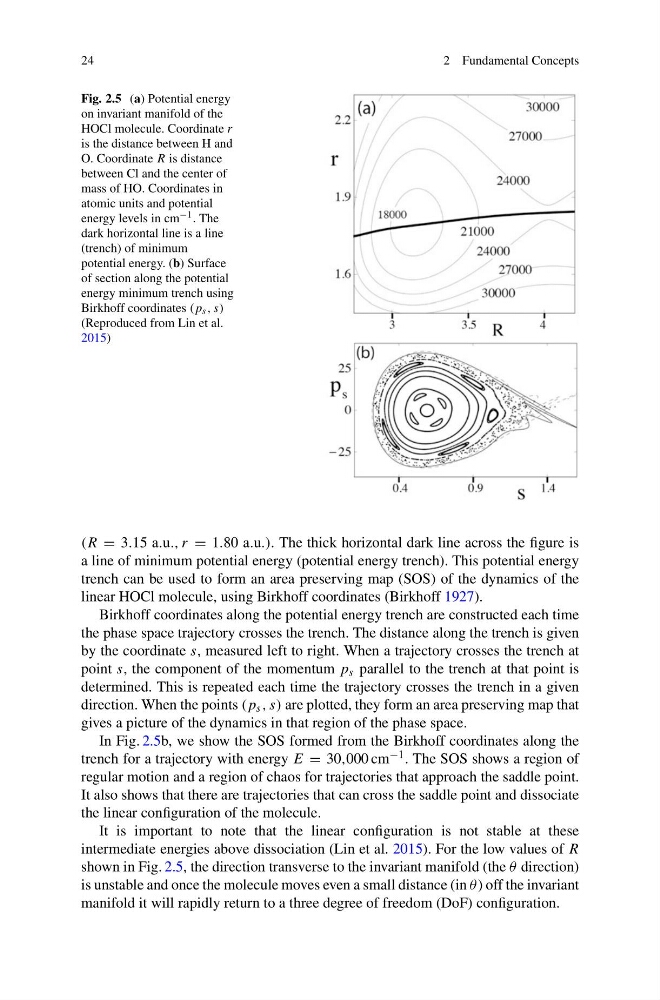
Fig. 2.5 (a) Potential energy
on invariant manifold of the
HOCl molecule. Coordinate r
is the distance between H and
O. Coordinate R is distance
between Cl and the center of
mass of HO. Coordinates in
atomic units and potential
energy levels in cm −1 . The
dark horizontal line is a line
(trench) of minimum
potential energy. (b) Surface
of section along the potential
energy minimum trench using
Birkhoff coordinates (p s , s)
(Reproduced from Lin et al.
2015)
(R = 3.15 a.u., r = 1.80 a.u.). The thick horizontal dark line across the figure is
a line of minimum potential energy (potential energy trench). This potential energy
trench can be used to form an area preserving map (SOS) of the dynamics of the
linear HOCl molecule, using Birkhoff coordinates (Birkhoff 1927).
Birkhoff coordinates along the potential energy trench are constructed each time
the phase space trajectory crosses the trench. The distance along the trench is given
by the coordinate s, measured left to right. When a trajectory crosses the trench at
point s, the component of the momentum p s parallel to the trench at that point is
determined. This is repeated each time the trajectory crosses the trench in a given
direction. When the points (p s , s) are plotted, they form an area preserving map that
gives a picture of the dynamics in that region of the phase space.
In Fig. 2.5b, we show the SOS formed from the Birkhoff coordinates along the
trench for a trajectory with energy E = 30,000 cm −1 . The SOS shows a region of
regular motion and a region of chaos for trajectories that approach the saddle point.
It also shows that there are trajectories that can cross the saddle point and dissociate
the linear configuration of the molecule.
It is important to note that the linear configuration is not stable at these
intermediate energies above dissociation (Lin et al. 2015). For the low values of R
shown in Fig. 2.5, the direction transverse to the invariant manifold (the θ direction)
is unstable and once the molecule moves even a small distance (in θ ) off the invariant
manifold it will rapidly return to a three degree of freedom (DoF) configuration.
2 Fundamental Concepts
Fig. 2.5 (a) Potential energy
on invariant manifold of the
HOCl molecule. Coordinate r
is the distance between H and
O. Coordinate R is distance
between Cl and the center of
mass of HO. Coordinates in
atomic units and potential
energy levels in cm −1 . The
dark horizontal line is a line
(trench) of minimum
potential energy. (b) Surface
of section along the potential
energy minimum trench using
Birkhoff coordinates (p s , s)
(Reproduced from Lin et al.
2015)
(R = 3.15 a.u., r = 1.80 a.u.). The thick horizontal dark line across the figure is
a line of minimum potential energy (potential energy trench). This potential energy
trench can be used to form an area preserving map (SOS) of the dynamics of the
linear HOCl molecule, using Birkhoff coordinates (Birkhoff 1927).
Birkhoff coordinates along the potential energy trench are constructed each time
the phase space trajectory crosses the trench. The distance along the trench is given
by the coordinate s, measured left to right. When a trajectory crosses the trench at
point s, the component of the momentum p s parallel to the trench at that point is
determined. This is repeated each time the trajectory crosses the trench in a given
direction. When the points (p s , s) are plotted, they form an area preserving map that
gives a picture of the dynamics in that region of the phase space.
In Fig. 2.5b, we show the SOS formed from the Birkhoff coordinates along the
trench for a trajectory with energy E = 30,000 cm −1 . The SOS shows a region of
regular motion and a region of chaos for trajectories that approach the saddle point.
It also shows that there are trajectories that can cross the saddle point and dissociate
the linear configuration of the molecule.
It is important to note that the linear configuration is not stable at these
intermediate energies above dissociation (Lin et al. 2015). For the low values of R
shown in Fig. 2.5, the direction transverse to the invariant manifold (the θ direction)
is unstable and once the molecule moves even a small distance (in θ ) off the invariant
manifold it will rapidly return to a three degree of freedom (DoF) configuration.