

22
2 Fundamental Concepts
been found analytically. However, the nonexistence of a third integral implies that
the dispersion of velocities of stellar objects in the direction of the galactic center is
the same as that perpendicular to the galactic plane. What was observed, however,
was a 2:1 ratio in these dispersions. Henon and Heiles constructed the following
Hamiltonian (with no known symmetries that can give rise to a third integral) to
model the essential features of the problem,
H =
1
2
(p
2
1 + p
2
2 ) +
1
2
(q
2
1 + q
2
2 + 2q
2
1 q 2 −
2
3
q
3
2 ) = E.
(2.31)
They then studied its behavior numerically. Hamilton’s equations for this system are
dp 1
dt
= −q 1 − 2q 1 q 2 ,
dp 2
dt
= −q 2 − q
2
1 + q
2
2 , and
dq i
dt
= p i (2.32)
(for i = 1, 2). Note that the anharmonic terms in the potential energy give rise to
nonlinear terms in the equation of motion.
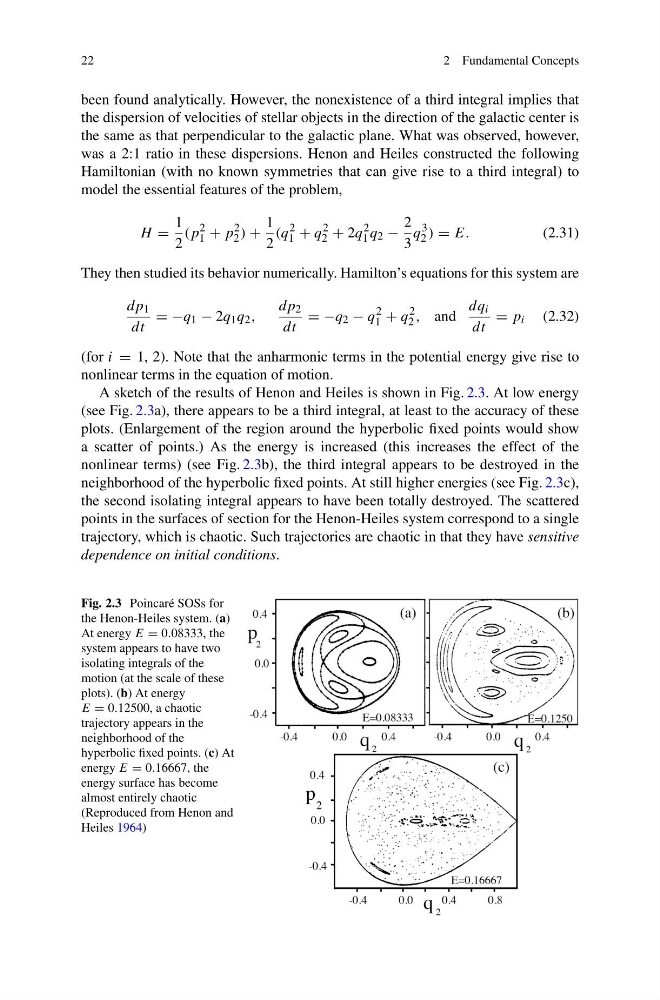
A sketch of the results of Henon and Heiles is shown in Fig. 2.3. At low energy
(see Fig. 2.3a), there appears to be a third integral, at least to the accuracy of these
plots. (Enlargement of the region around the hyperbolic fixed points would show
a scatter of points.) As the energy is increased (this increases the effect of the
nonlinear terms) (see Fig. 2.3b), the third integral appears to be destroyed in the
neighborhood of the hyperbolic fixed points. At still higher energies (see Fig. 2.3c),
the second isolating integral appears to have been totally destroyed. The scattered
points in the surfaces of section for the Henon-Heiles system correspond to a single
trajectory, which is chaotic. Such trajectories are chaotic in that they have sensitive
dependence on initial conditions.
Fig. 2.3 Poincaré SOSs for
the Henon-Heiles system. (a)
At energy E = 0.08333, the
system appears to have two
isolating integrals of the
motion (at the scale of these
plots). (b) At energy
E = 0.12500, a chaotic
trajectory appears in the
neighborhood of the
hyperbolic fixed points. (c) At
energy E = 0.16667, the
energy surface has become
almost entirely chaotic
(Reproduced from Henon and
Heiles 1964)
2 Fundamental Concepts
been found analytically. However, the nonexistence of a third integral implies that
the dispersion of velocities of stellar objects in the direction of the galactic center is
the same as that perpendicular to the galactic plane. What was observed, however,
was a 2:1 ratio in these dispersions. Henon and Heiles constructed the following
Hamiltonian (with no known symmetries that can give rise to a third integral) to
model the essential features of the problem,
H =
1
2
(p
2
1 + p
2
2 ) +
1
2
(q
2
1 + q
2
2 + 2q
2
1 q 2 −
2
3
q
3
2 ) = E.
(2.31)
They then studied its behavior numerically. Hamilton’s equations for this system are
dp 1
dt
= −q 1 − 2q 1 q 2 ,
dp 2
dt
= −q 2 − q
2
1 + q
2
2 , and
dq i
dt
= p i (2.32)
(for i = 1, 2). Note that the anharmonic terms in the potential energy give rise to
nonlinear terms in the equation of motion.
A sketch of the results of Henon and Heiles is shown in Fig. 2.3. At low energy
(see Fig. 2.3a), there appears to be a third integral, at least to the accuracy of these
plots. (Enlargement of the region around the hyperbolic fixed points would show
a scatter of points.) As the energy is increased (this increases the effect of the
nonlinear terms) (see Fig. 2.3b), the third integral appears to be destroyed in the
neighborhood of the hyperbolic fixed points. At still higher energies (see Fig. 2.3c),
the second isolating integral appears to have been totally destroyed. The scattered
points in the surfaces of section for the Henon-Heiles system correspond to a single
trajectory, which is chaotic. Such trajectories are chaotic in that they have sensitive
dependence on initial conditions.
Fig. 2.3 Poincaré SOSs for
the Henon-Heiles system. (a)
At energy E = 0.08333, the
system appears to have two
isolating integrals of the
motion (at the scale of these
plots). (b) At energy
E = 0.12500, a chaotic
trajectory appears in the
neighborhood of the
hyperbolic fixed points. (c) At
energy E = 0.16667, the
energy surface has become
almost entirely chaotic
(Reproduced from Henon and
Heiles 1964)