

326
9 Semiclassical Theory: Path Integrals
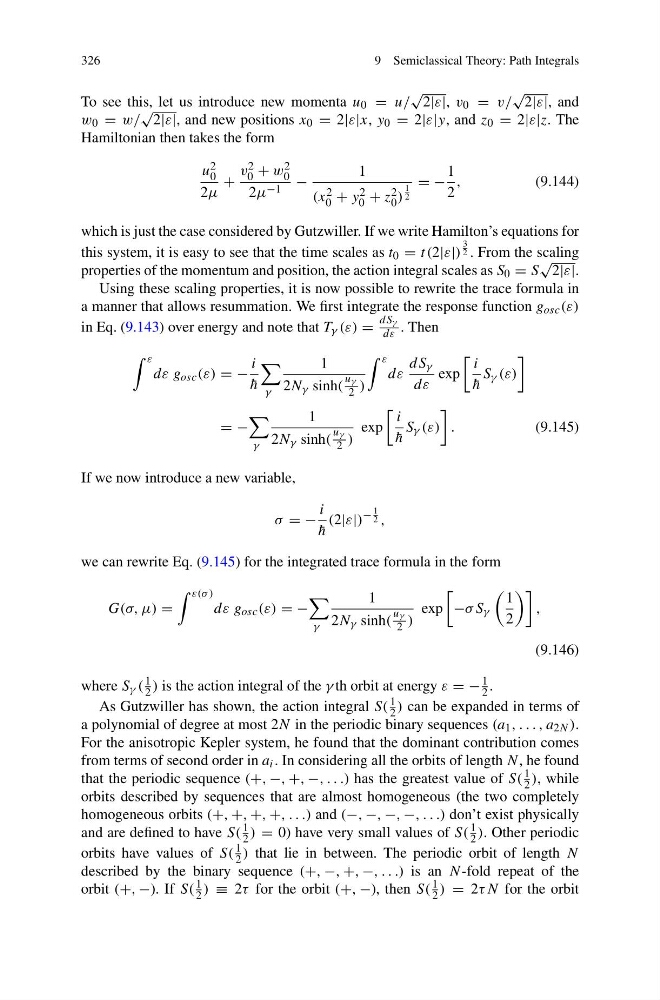
To see this, let us introduce new momenta u 0 = u/
√
2|ε|, v 0 = v/
√
2|ε|, and
w 0 = w/
√
2|ε|, and new positions x 0 = 2|ε|x, y 0 = 2|ε|y, and z 0 = 2|ε|z. The
Hamiltonian then takes the form
u 2
0
2μ
+
v 2
0 + w 2
0
2μ −1 −
1
(x 2
0 + y 2
0 + z 2
0 )
1
2
= −
1
2
,
(9.144)
which is just the case considered by Gutzwiller. If we write Hamilton’s equations for
this system, it is easy to see that the time scales as t 0 = t (2|ε|)
3
2 . From the scaling
properties of the momentum and position, the action integral scales as S 0 = S
√
2|ε|.
Using these scaling properties, it is now possible to rewrite the trace formula in
a manner that allows resummation. We first integrate the response function g osc (ε)
in Eq. (9.143) over energy and note that T γ (ε) =
dS γ
dε . Then
ε
dε g osc (ε) = −
i
¯
h
γ
1
2N γ sinh(
u γ
2 )
ε
dε
dS γ
dε
exp
i
¯
h
S γ (ε)
= −
γ
1
2N γ sinh(
u γ
2 )
exp
i
¯
h
S γ (ε)
.
(9.145)
If we now introduce a new variable,
σ = −
i
¯
h
(2|ε|)
−
1
2 ,
we can rewrite Eq. (9.145) for the integrated trace formula in the form
G(σ, μ) =
ε(σ )
dε g osc (ε) = −
γ
1
2N γ sinh(
u γ
2 )
exp
−σ S γ
1
2
,
(9.146)
where S γ (
1
2 ) is the action integral of the γ th orbit at energy ε = −
1
2 .
As Gutzwiller has shown, the action integral S(
1
2 ) can be expanded in terms of
a polynomial of degree at most 2N in the periodic binary sequences (a 1 , . . . , a 2N ).
For the anisotropic Kepler system, he found that the dominant contribution comes
from terms of second order in a i . In considering all the orbits of length N, he found
that the periodic sequence (+, −, +, −, . . .) has the greatest value of S(
1
2 ), while
orbits described by sequences that are almost homogeneous (the two completely
homogeneous orbits (+, +, +, +, . . .) and (−, −, −, −, . . .) don’t exist physically
and are defined to have S(
1
2 ) = 0) have very small values of S(
1
2 ). Other periodic
orbits have values of S(
1
2 ) that lie in between. The periodic orbit of length N
described by the binary sequence (+, −, +, −, . . .) is an N -fold repeat of the
orbit (+, −). If S(
1
2 ) ≡ 2τ for the orbit (+, −), then S(
1
2 ) = 2τ N for the orbit
9 Semiclassical Theory: Path Integrals
To see this, let us introduce new momenta u 0 = u/
√
2|ε|, v 0 = v/
√
2|ε|, and
w 0 = w/
√
2|ε|, and new positions x 0 = 2|ε|x, y 0 = 2|ε|y, and z 0 = 2|ε|z. The
Hamiltonian then takes the form
u 2
0
2μ
+
v 2
0 + w 2
0
2μ −1 −
1
(x 2
0 + y 2
0 + z 2
0 )
1
2
= −
1
2
,
(9.144)
which is just the case considered by Gutzwiller. If we write Hamilton’s equations for
this system, it is easy to see that the time scales as t 0 = t (2|ε|)
3
2 . From the scaling
properties of the momentum and position, the action integral scales as S 0 = S
√
2|ε|.
Using these scaling properties, it is now possible to rewrite the trace formula in
a manner that allows resummation. We first integrate the response function g osc (ε)
in Eq. (9.143) over energy and note that T γ (ε) =
dS γ
dε . Then
ε
dε g osc (ε) = −
i
¯
h
γ
1
2N γ sinh(
u γ
2 )
ε
dε
dS γ
dε
exp
i
¯
h
S γ (ε)
= −
γ
1
2N γ sinh(
u γ
2 )
exp
i
¯
h
S γ (ε)
.
(9.145)
If we now introduce a new variable,
σ = −
i
¯
h
(2|ε|)
−
1
2 ,
we can rewrite Eq. (9.145) for the integrated trace formula in the form
G(σ, μ) =
ε(σ )
dε g osc (ε) = −
γ
1
2N γ sinh(
u γ
2 )
exp
−σ S γ
1
2
,
(9.146)
where S γ (
1
2 ) is the action integral of the γ th orbit at energy ε = −
1
2 .
As Gutzwiller has shown, the action integral S(
1
2 ) can be expanded in terms of
a polynomial of degree at most 2N in the periodic binary sequences (a 1 , . . . , a 2N ).
For the anisotropic Kepler system, he found that the dominant contribution comes
from terms of second order in a i . In considering all the orbits of length N, he found
that the periodic sequence (+, −, +, −, . . .) has the greatest value of S(
1
2 ), while
orbits described by sequences that are almost homogeneous (the two completely
homogeneous orbits (+, +, +, +, . . .) and (−, −, −, −, . . .) don’t exist physically
and are defined to have S(
1
2 ) = 0) have very small values of S(
1
2 ). Other periodic
orbits have values of S(
1
2 ) that lie in between. The periodic orbit of length N
described by the binary sequence (+, −, +, −, . . .) is an N -fold repeat of the
orbit (+, −). If S(
1
2 ) ≡ 2τ for the orbit (+, −), then S(
1
2 ) = 2τ N for the orbit