

9.8 Diamagnetic Hydrogen
327
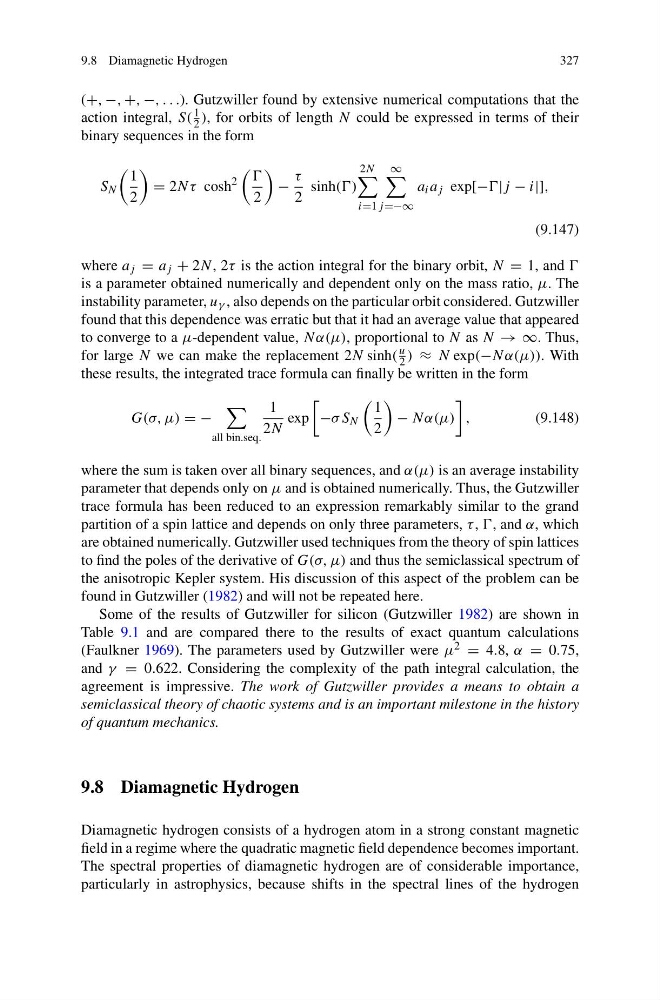
(+, −, +, −, . . .). Gutzwiller found by extensive numerical computations that the
action integral, S(
1
2 ), for orbits of length N could be expressed in terms of their
binary sequences in the form
S N
1
2
= 2Nτ cosh
2
2
−
τ
2
sinh(()
2N
i=1
∞
j =−∞
a i a j exp[−|j − i|],
(9.147)
where a j = a j + 2N, 2τ is the action integral for the binary orbit, N = 1, and
is a parameter obtained numerically and dependent only on the mass ratio, μ. The
instability parameter, u γ , also depends on the particular orbit considered. Gutzwiller
found that this dependence was erratic but that it had an average value that appeared
to converge to a μ-dependent value, Nα(μ), proportional to N as N → ∞. Thus,
for large N we can make the replacement 2N sinh(
u
2 ) ≈ N exp(−Nα(μ)). With
these results, the integrated trace formula can finally be written in the form
G(σ, μ) = −
all bin.seq.
1
2N
exp
−σ S N
1
2
− Nα(μ)
,
(9.148)
where the sum is taken over all binary sequences, and α(μ) is an average instability
parameter that depends only on μ and is obtained numerically. Thus, the Gutzwiller
trace formula has been reduced to an expression remarkably similar to the grand
partition of a spin lattice and depends on only three parameters, τ , , and α, which
are obtained numerically. Gutzwiller used techniques from the theory of spin lattices
to find the poles of the derivative of G(σ, μ) and thus the semiclassical spectrum of
the anisotropic Kepler system. His discussion of this aspect of the problem can be
found in Gutzwiller (1982) and will not be repeated here.
Some of the results of Gutzwiller for silicon (Gutzwiller 1982) are shown in
Table 9.1 and are compared there to the results of exact quantum calculations
(Faulkner 1969). The parameters used by Gutzwiller were μ 2 = 4.8, α = 0.75,
and γ = 0.622. Considering the complexity of the path integral calculation, the
agreement is impressive. The work of Gutzwiller provides a means to obtain a
semiclassical theory of chaotic systems and is an important milestone in the history
of quantum mechanics.
9.8 Diamagnetic Hydrogen
Diamagnetic hydrogen consists of a hydrogen atom in a strong constant magnetic
field in a regime where the quadratic magnetic field dependence becomes important.
The spectral properties of diamagnetic hydrogen are of considerable importance,
particularly in astrophysics, because shifts in the spectral lines of the hydrogen
327
(+, −, +, −, . . .). Gutzwiller found by extensive numerical computations that the
action integral, S(
1
2 ), for orbits of length N could be expressed in terms of their
binary sequences in the form
S N
1
2
= 2Nτ cosh
2
2
−
τ
2
sinh(()
2N
i=1
∞
j =−∞
a i a j exp[−|j − i|],
(9.147)
where a j = a j + 2N, 2τ is the action integral for the binary orbit, N = 1, and
is a parameter obtained numerically and dependent only on the mass ratio, μ. The
instability parameter, u γ , also depends on the particular orbit considered. Gutzwiller
found that this dependence was erratic but that it had an average value that appeared
to converge to a μ-dependent value, Nα(μ), proportional to N as N → ∞. Thus,
for large N we can make the replacement 2N sinh(
u
2 ) ≈ N exp(−Nα(μ)). With
these results, the integrated trace formula can finally be written in the form
G(σ, μ) = −
all bin.seq.
1
2N
exp
−σ S N
1
2
− Nα(μ)
,
(9.148)
where the sum is taken over all binary sequences, and α(μ) is an average instability
parameter that depends only on μ and is obtained numerically. Thus, the Gutzwiller
trace formula has been reduced to an expression remarkably similar to the grand
partition of a spin lattice and depends on only three parameters, τ , , and α, which
are obtained numerically. Gutzwiller used techniques from the theory of spin lattices
to find the poles of the derivative of G(σ, μ) and thus the semiclassical spectrum of
the anisotropic Kepler system. His discussion of this aspect of the problem can be
found in Gutzwiller (1982) and will not be repeated here.
Some of the results of Gutzwiller for silicon (Gutzwiller 1982) are shown in
Table 9.1 and are compared there to the results of exact quantum calculations
(Faulkner 1969). The parameters used by Gutzwiller were μ 2 = 4.8, α = 0.75,
and γ = 0.622. Considering the complexity of the path integral calculation, the
agreement is impressive. The work of Gutzwiller provides a means to obtain a
semiclassical theory of chaotic systems and is an important milestone in the history
of quantum mechanics.
9.8 Diamagnetic Hydrogen
Diamagnetic hydrogen consists of a hydrogen atom in a strong constant magnetic
field in a regime where the quadratic magnetic field dependence becomes important.
The spectral properties of diamagnetic hydrogen are of considerable importance,
particularly in astrophysics, because shifts in the spectral lines of the hydrogen