

9.7 Anisotropic Kepler System
325
to each trajectory, where x i is the ith crossing point of the trajectory on the x-axis.
The sequence is ordered according to the crossing times, . . . t −2 < t −1 < t 0 < t 1 <
t 2 . . .. The point x 0 corresponds to the crossing point at time t 0 . Periodic orbits must
have an even number of crossings since the sign of the momentum, u, changes after
each crossing. A periodic orbit of the anisotropic Kepler system defines a binary
sequence a 1 , a 2 , . . . , a 2N of finite length, which can be made into an infinitely long
periodic sequence by setting a i = a i+2N . The number N is called the length of
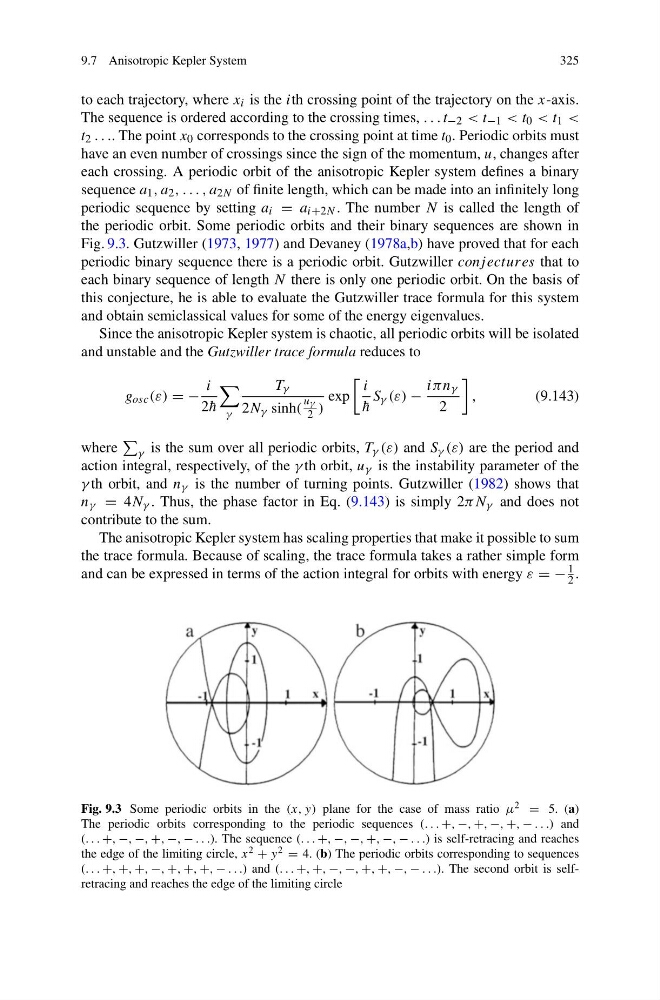
the periodic orbit. Some periodic orbits and their binary sequences are shown in
Fig. 9.3. Gutzwiller (1973, 1977) and Devaney (1978a,b) have proved that for each
periodic binary sequence there is a periodic orbit. Gutzwiller conj ectures that to
each binary sequence of length N there is only one periodic orbit. On the basis of
this conjecture, he is able to evaluate the Gutzwiller trace formula for this system
and obtain semiclassical values for some of the energy eigenvalues.
Since the anisotropic Kepler system is chaotic, all periodic orbits will be isolated
and unstable and the Gutzwiller trace formula reduces to
g osc (ε) = −
i
2 ¯
h
γ
T γ
2N γ sinh(
u γ
2 )
exp
i
¯
h
S γ (ε) −
iπn γ
2
,
(9.143)
where
γ is the sum over all periodic orbits, T γ (ε) and S γ (ε) are the period and
action integral, respectively, of the γ th orbit, u γ is the instability parameter of the
γ th orbit, and n γ is the number of turning points. Gutzwiller (1982) shows that
n γ = 4N γ . Thus, the phase factor in Eq. (9.143) is simply 2πN γ and does not
contribute to the sum.
The anisotropic Kepler system has scaling properties that make it possible to sum
the trace formula. Because of scaling, the trace formula takes a rather simple form
and can be expressed in terms of the action integral for orbits with energy ε = −
1
2 .
Fig. 9.3 Some periodic orbits in the (x, y) plane for the case of mass ratio μ 2 = 5. (a)
The periodic orbits corresponding to the periodic sequences (. . . +, −, +, −, +, − . . .) and
(. . . +, −, −, +, −, − . . .). The sequence (. . . +, −, −, +, −, − . . .) is self-retracing and reaches
the edge of the limiting circle, x 2 + y 2 = 4. (b) The periodic orbits corresponding to sequences
(. . . +, +, +, −, +, +, +, − . . .) and (. . . +, +, −, −, +, +, −, − . . .). The second orbit is selfretracing and reaches the edge of the limiting circle
325
to each trajectory, where x i is the ith crossing point of the trajectory on the x-axis.
The sequence is ordered according to the crossing times, . . . t −2 < t −1 < t 0 < t 1 <
t 2 . . .. The point x 0 corresponds to the crossing point at time t 0 . Periodic orbits must
have an even number of crossings since the sign of the momentum, u, changes after
each crossing. A periodic orbit of the anisotropic Kepler system defines a binary
sequence a 1 , a 2 , . . . , a 2N of finite length, which can be made into an infinitely long
periodic sequence by setting a i = a i+2N . The number N is called the length of
the periodic orbit. Some periodic orbits and their binary sequences are shown in
Fig. 9.3. Gutzwiller (1973, 1977) and Devaney (1978a,b) have proved that for each
periodic binary sequence there is a periodic orbit. Gutzwiller conj ectures that to
each binary sequence of length N there is only one periodic orbit. On the basis of
this conjecture, he is able to evaluate the Gutzwiller trace formula for this system
and obtain semiclassical values for some of the energy eigenvalues.
Since the anisotropic Kepler system is chaotic, all periodic orbits will be isolated
and unstable and the Gutzwiller trace formula reduces to
g osc (ε) = −
i
2 ¯
h
γ
T γ
2N γ sinh(
u γ
2 )
exp
i
¯
h
S γ (ε) −
iπn γ
2
,
(9.143)
where
γ is the sum over all periodic orbits, T γ (ε) and S γ (ε) are the period and
action integral, respectively, of the γ th orbit, u γ is the instability parameter of the
γ th orbit, and n γ is the number of turning points. Gutzwiller (1982) shows that
n γ = 4N γ . Thus, the phase factor in Eq. (9.143) is simply 2πN γ and does not
contribute to the sum.
The anisotropic Kepler system has scaling properties that make it possible to sum
the trace formula. Because of scaling, the trace formula takes a rather simple form
and can be expressed in terms of the action integral for orbits with energy ε = −
1
2 .
Fig. 9.3 Some periodic orbits in the (x, y) plane for the case of mass ratio μ 2 = 5. (a)
The periodic orbits corresponding to the periodic sequences (. . . +, −, +, −, +, − . . .) and
(. . . +, −, −, +, −, − . . .). The sequence (. . . +, −, −, +, −, − . . .) is self-retracing and reaches
the edge of the limiting circle, x 2 + y 2 = 4. (b) The periodic orbits corresponding to sequences
(. . . +, +, +, −, +, +, +, − . . .) and (. . . +, +, −, −, +, +, −, − . . .). The second orbit is selfretracing and reaches the edge of the limiting circle