

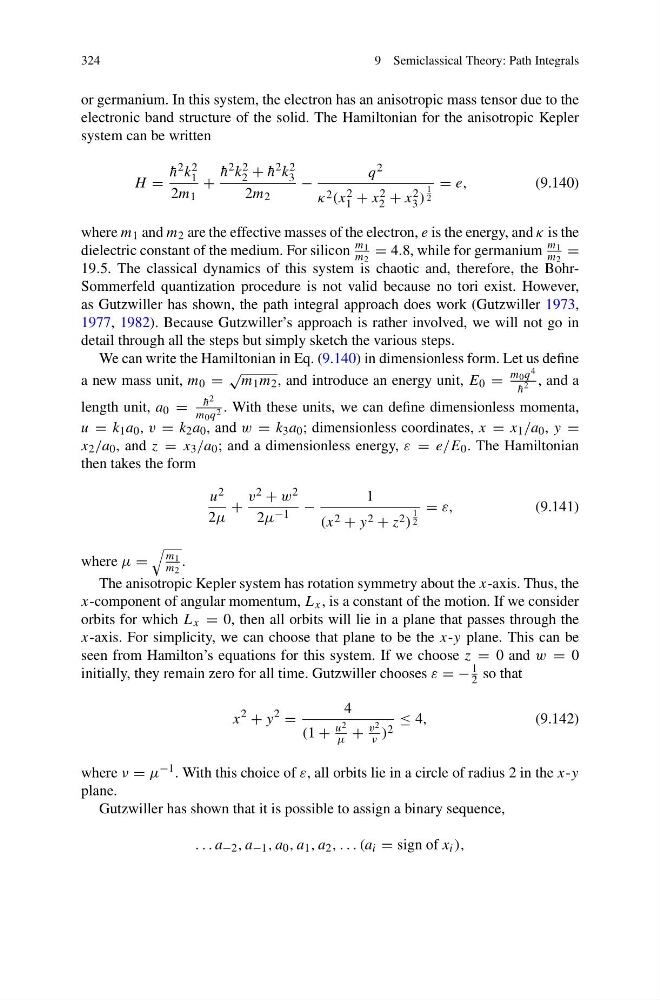
324
9 Semiclassical Theory: Path Integrals
or germanium. In this system, the electron has an anisotropic mass tensor due to the
electronic band structure of the solid. The Hamiltonian for the anisotropic Kepler
system can be written
H =
¯
h 2 k 2
1
2m 1
+
¯
h 2 k 2
2 + ¯
h 2 k 2
3
2m 2
−
q 2
κ 2 (x 2
1 + x 2
2 + x 2
3 )
1
2
= e,
(9.140)
where m 1 and m 2 are the effective masses of the electron, e is the energy, and κ is the
dielectric constant of the medium. For silicon
m 1
m 2
= 4.8, while for germanium
m 1
m 2
=
19.5. The classical dynamics of this system is chaotic and, therefore, the BohrSommerfeld quantization procedure is not valid because no tori exist. However,
as Gutzwiller has shown, the path integral approach does work (Gutzwiller 1973,
1977, 1982). Because Gutzwiller’s approach is rather involved, we will not go in
detail through all the steps but simply sketch the various steps.
We can write the Hamiltonian in Eq. (9.140) in dimensionless form. Let us define
a new mass unit, m 0 =
√ m 1 m 2 , and introduce an energy unit, E 0 =
m 0 q 4
¯
h 2 , and a
length unit, a 0 = ¯
h 2
m 0 q 2 . With these units, we can define dimensionless momenta,
u = k 1 a 0 , v = k 2 a 0 , and w = k 3 a 0 ; dimensionless coordinates, x = x 1 /a 0 , y =
x 2 /a 0 , and z = x 3 /a 0 ; and a dimensionless energy, ε = e/E 0 . The Hamiltonian
then takes the form
u 2
2μ
+
v 2 + w 2
2μ −1 −
1
(x 2 + y 2 + z 2 )
1
2
= ε,
(9.141)
where μ =
m 1
m 2
.
The anisotropic Kepler system has rotation symmetry about the x-axis. Thus, the
x-component of angular momentum, L x , is a constant of the motion. If we consider
orbits for which L x = 0, then all orbits will lie in a plane that passes through the
x-axis. For simplicity, we can choose that plane to be the x-y plane. This can be
seen from Hamilton’s equations for this system. If we choose z = 0 and w = 0
initially, they remain zero for all time. Gutzwiller chooses ε = −
1
2 so that
x
2
+ y
2
=
4
(1 +
u 2
μ +
v 2
ν ) 2
≤ 4,
(9.142)
where ν = μ −1 . With this choice of ε, all orbits lie in a circle of radius 2 in the x-y
plane.
Gutzwiller has shown that it is possible to assign a binary sequence,
. . . a −2 , a −1 , a 0 , a 1 , a 2 , . . . (a i = sign of x i ),
9 Semiclassical Theory: Path Integrals
or germanium. In this system, the electron has an anisotropic mass tensor due to the
electronic band structure of the solid. The Hamiltonian for the anisotropic Kepler
system can be written
H =
¯
h 2 k 2
1
2m 1
+
¯
h 2 k 2
2 + ¯
h 2 k 2
3
2m 2
−
q 2
κ 2 (x 2
1 + x 2
2 + x 2
3 )
1
2
= e,
(9.140)
where m 1 and m 2 are the effective masses of the electron, e is the energy, and κ is the
dielectric constant of the medium. For silicon
m 1
m 2
= 4.8, while for germanium
m 1
m 2
=
19.5. The classical dynamics of this system is chaotic and, therefore, the BohrSommerfeld quantization procedure is not valid because no tori exist. However,
as Gutzwiller has shown, the path integral approach does work (Gutzwiller 1973,
1977, 1982). Because Gutzwiller’s approach is rather involved, we will not go in
detail through all the steps but simply sketch the various steps.
We can write the Hamiltonian in Eq. (9.140) in dimensionless form. Let us define
a new mass unit, m 0 =
√ m 1 m 2 , and introduce an energy unit, E 0 =
m 0 q 4
¯
h 2 , and a
length unit, a 0 = ¯
h 2
m 0 q 2 . With these units, we can define dimensionless momenta,
u = k 1 a 0 , v = k 2 a 0 , and w = k 3 a 0 ; dimensionless coordinates, x = x 1 /a 0 , y =
x 2 /a 0 , and z = x 3 /a 0 ; and a dimensionless energy, ε = e/E 0 . The Hamiltonian
then takes the form
u 2
2μ
+
v 2 + w 2
2μ −1 −
1
(x 2 + y 2 + z 2 )
1
2
= ε,
(9.141)
where μ =
m 1
m 2
.
The anisotropic Kepler system has rotation symmetry about the x-axis. Thus, the
x-component of angular momentum, L x , is a constant of the motion. If we consider
orbits for which L x = 0, then all orbits will lie in a plane that passes through the
x-axis. For simplicity, we can choose that plane to be the x-y plane. This can be
seen from Hamilton’s equations for this system. If we choose z = 0 and w = 0
initially, they remain zero for all time. Gutzwiller chooses ε = −
1
2 so that
x
2
+ y
2
=
4
(1 +
u 2
μ +
v 2
ν ) 2
≤ 4,
(9.142)
where ν = μ −1 . With this choice of ε, all orbits lie in a circle of radius 2 in the x-y
plane.
Gutzwiller has shown that it is possible to assign a binary sequence,
. . . a −2 , a −1 , a 0 , a 1 , a 2 , . . . (a i = sign of x i ),