

20
2 Fundamental Concepts
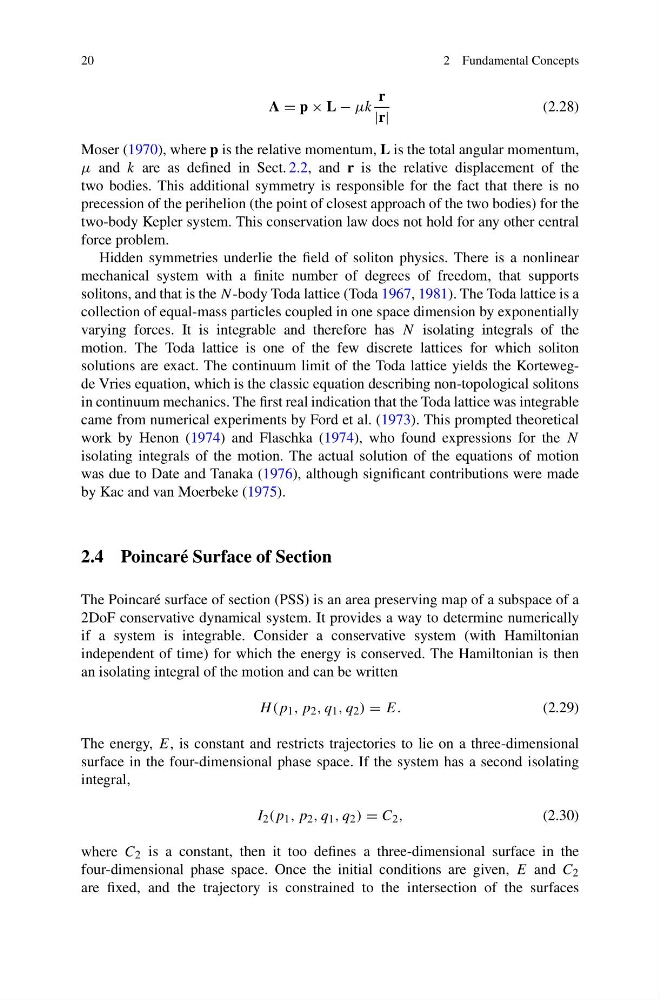
A = p × L − μk
r
|r|
(2.28)
Moser (1970), where p is the relative momentum, L is the total angular momentum,
μ and k are as defined in Sect. 2.2, and r is the relative displacement of the
two bodies. This additional symmetry is responsible for the fact that there is no
precession of the perihelion (the point of closest approach of the two bodies) for the
two-body Kepler system. This conservation law does not hold for any other central
force problem.
Hidden symmetries underlie the field of soliton physics. There is a nonlinear
mechanical system with a finite number of degrees of freedom, that supports
solitons, and that is the N-body Toda lattice (Toda 1967, 1981). The Toda lattice is a
collection of equal-mass particles coupled in one space dimension by exponentially
varying forces. It is integrable and therefore has N isolating integrals of the
motion. The Toda lattice is one of the few discrete lattices for which soliton
solutions are exact. The continuum limit of the Toda lattice yields the Kortewegde Vries equation, which is the classic equation describing non-topological solitons
in continuum mechanics. The first real indication that the Toda lattice was integrable
came from numerical experiments by Ford et al. (1973). This prompted theoretical
work by Henon (1974) and Flaschka (1974), who found expressions for the N
isolating integrals of the motion. The actual solution of the equations of motion
was due to Date and Tanaka (1976), although significant contributions were made
by Kac and van Moerbeke (1975).
2.4 Poincaré Surface of Section
The Poincaré surface of section (PSS) is an area preserving map of a subspace of a
2DoF conservative dynamical system. It provides a way to determine numerically
if a system is integrable. Consider a conservative system (with Hamiltonian
independent of time) for which the energy is conserved. The Hamiltonian is then
an isolating integral of the motion and can be written
H (p 1 , p 2 , q 1 , q 2 ) = E.
(2.29)
The energy, E, is constant and restricts trajectories to lie on a three-dimensional
surface in the four-dimensional phase space. If the system has a second isolating
integral,
I 2 (p 1 , p 2 , q 1 , q 2 ) = C 2 ,
(2.30)
where C 2 is a constant, then it too defines a three-dimensional surface in the
four-dimensional phase space. Once the initial conditions are given, E and C 2
are fixed, and the trajectory is constrained to the intersection of the surfaces
2 Fundamental Concepts
A = p × L − μk
r
|r|
(2.28)
Moser (1970), where p is the relative momentum, L is the total angular momentum,
μ and k are as defined in Sect. 2.2, and r is the relative displacement of the
two bodies. This additional symmetry is responsible for the fact that there is no
precession of the perihelion (the point of closest approach of the two bodies) for the
two-body Kepler system. This conservation law does not hold for any other central
force problem.
Hidden symmetries underlie the field of soliton physics. There is a nonlinear
mechanical system with a finite number of degrees of freedom, that supports
solitons, and that is the N-body Toda lattice (Toda 1967, 1981). The Toda lattice is a
collection of equal-mass particles coupled in one space dimension by exponentially
varying forces. It is integrable and therefore has N isolating integrals of the
motion. The Toda lattice is one of the few discrete lattices for which soliton
solutions are exact. The continuum limit of the Toda lattice yields the Kortewegde Vries equation, which is the classic equation describing non-topological solitons
in continuum mechanics. The first real indication that the Toda lattice was integrable
came from numerical experiments by Ford et al. (1973). This prompted theoretical
work by Henon (1974) and Flaschka (1974), who found expressions for the N
isolating integrals of the motion. The actual solution of the equations of motion
was due to Date and Tanaka (1976), although significant contributions were made
by Kac and van Moerbeke (1975).
2.4 Poincaré Surface of Section
The Poincaré surface of section (PSS) is an area preserving map of a subspace of a
2DoF conservative dynamical system. It provides a way to determine numerically
if a system is integrable. Consider a conservative system (with Hamiltonian
independent of time) for which the energy is conserved. The Hamiltonian is then
an isolating integral of the motion and can be written
H (p 1 , p 2 , q 1 , q 2 ) = E.
(2.29)
The energy, E, is constant and restricts trajectories to lie on a three-dimensional
surface in the four-dimensional phase space. If the system has a second isolating
integral,
I 2 (p 1 , p 2 , q 1 , q 2 ) = C 2 ,
(2.30)
where C 2 is a constant, then it too defines a three-dimensional surface in the
four-dimensional phase space. Once the initial conditions are given, E and C 2
are fixed, and the trajectory is constrained to the intersection of the surfaces