

2.3 Integrable Systems
19
Thus
d
dt
L −
N
i=1
˙
q i
∂L
∂ ˙
q i
δt +
N
i=1
∂L
∂ ˙
q i
δq i
= 0,
(2.25)
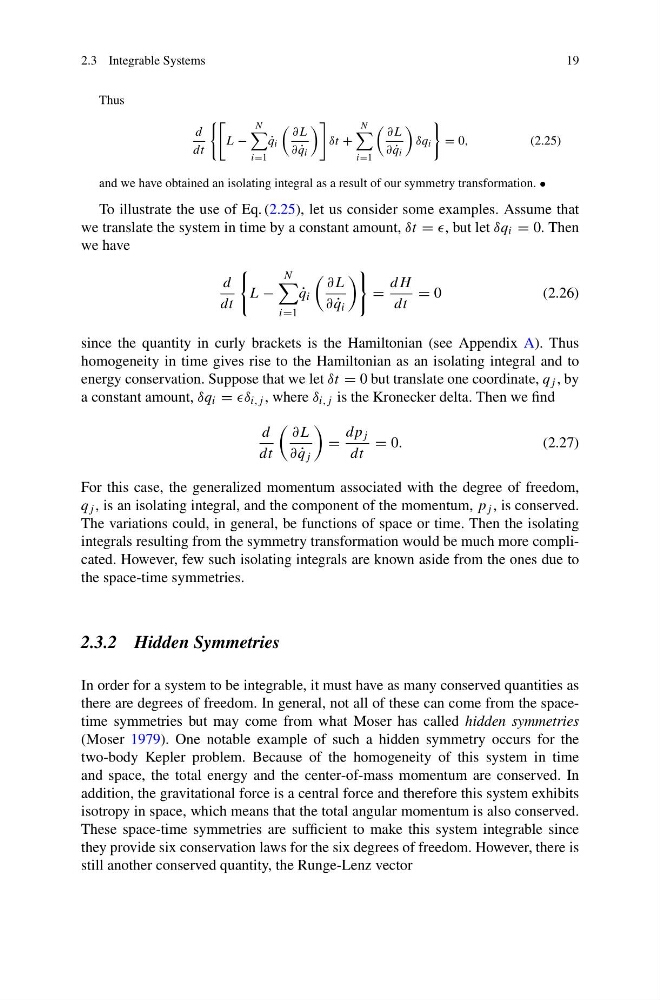
and we have obtained an isolating integral as a result of our symmetry transformation. •
To illustrate the use of Eq. (2.25), let us consider some examples. Assume that
we translate the system in time by a constant amount, δt = , but let δq i = 0. Then
we have
d
dt
L −
N
i=1
˙
q i
∂L
∂ ˙
q i
=
dH
dt
= 0
(2.26)
since the quantity in curly brackets is the Hamiltonian (see Appendix A). Thus
homogeneity in time gives rise to the Hamiltonian as an isolating integral and to
energy conservation. Suppose that we let δt = 0 but translate one coordinate, q j , by
a constant amount, δq i = δ i,j , where δ i,j is the Kronecker delta. Then we find
d
dt
∂L
∂ ˙
q j
=
dp j
dt
= 0.
(2.27)
For this case, the generalized momentum associated with the degree of freedom,
q j , is an isolating integral, and the component of the momentum, p j , is conserved.
The variations could, in general, be functions of space or time. Then the isolating
integrals resulting from the symmetry transformation would be much more complicated. However, few such isolating integrals are known aside from the ones due to
the space-time symmetries.
2.3.2 Hidden Symmetries
In order for a system to be integrable, it must have as many conserved quantities as
there are degrees of freedom. In general, not all of these can come from the spacetime symmetries but may come from what Moser has called hidden symmetries
(Moser 1979). One notable example of such a hidden symmetry occurs for the
two-body Kepler problem. Because of the homogeneity of this system in time
and space, the total energy and the center-of-mass momentum are conserved. In
addition, the gravitational force is a central force and therefore this system exhibits
isotropy in space, which means that the total angular momentum is also conserved.
These space-time symmetries are sufficient to make this system integrable since
they provide six conservation laws for the six degrees of freedom. However, there is
still another conserved quantity, the Runge-Lenz vector
19
Thus
d
dt
L −
N
i=1
˙
q i
∂L
∂ ˙
q i
δt +
N
i=1
∂L
∂ ˙
q i
δq i
= 0,
(2.25)
and we have obtained an isolating integral as a result of our symmetry transformation. •
To illustrate the use of Eq. (2.25), let us consider some examples. Assume that
we translate the system in time by a constant amount, δt = , but let δq i = 0. Then
we have
d
dt
L −
N
i=1
˙
q i
∂L
∂ ˙
q i
=
dH
dt
= 0
(2.26)
since the quantity in curly brackets is the Hamiltonian (see Appendix A). Thus
homogeneity in time gives rise to the Hamiltonian as an isolating integral and to
energy conservation. Suppose that we let δt = 0 but translate one coordinate, q j , by
a constant amount, δq i = δ i,j , where δ i,j is the Kronecker delta. Then we find
d
dt
∂L
∂ ˙
q j
=
dp j
dt
= 0.
(2.27)
For this case, the generalized momentum associated with the degree of freedom,
q j , is an isolating integral, and the component of the momentum, p j , is conserved.
The variations could, in general, be functions of space or time. Then the isolating
integrals resulting from the symmetry transformation would be much more complicated. However, few such isolating integrals are known aside from the ones due to
the space-time symmetries.
2.3.2 Hidden Symmetries
In order for a system to be integrable, it must have as many conserved quantities as
there are degrees of freedom. In general, not all of these can come from the spacetime symmetries but may come from what Moser has called hidden symmetries
(Moser 1979). One notable example of such a hidden symmetry occurs for the
two-body Kepler problem. Because of the homogeneity of this system in time
and space, the total energy and the center-of-mass momentum are conserved. In
addition, the gravitational force is a central force and therefore this system exhibits
isotropy in space, which means that the total angular momentum is also conserved.
These space-time symmetries are sufficient to make this system integrable since
they provide six conservation laws for the six degrees of freedom. However, there is
still another conserved quantity, the Runge-Lenz vector