

18
2 Fundamental Concepts
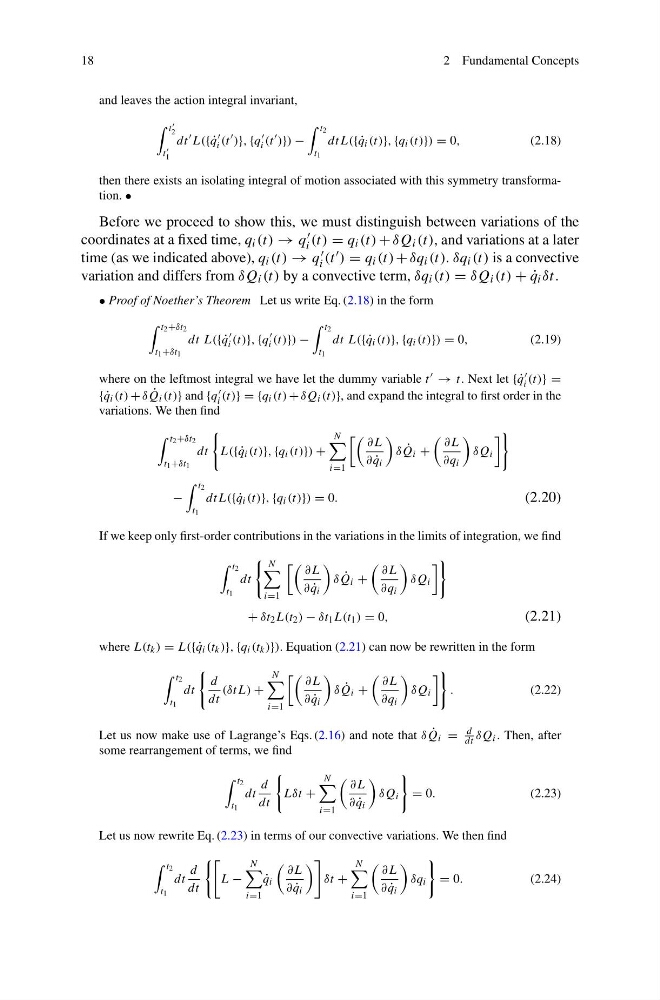
and leaves the action integral invariant,
t
2
t
1
dt
L({ ˙
q
i (t
)}, {q
i (t
)}) −
t 2
t 1
dtL({ ˙
q i (t)}, {q i (t)}) = 0,
(2.18)
then there exists an isolating integral of motion associated with this symmetry transformation. •
Before we proceed to show this, we must distinguish between variations of the
coordinates at a fixed time, q i (t) → q
i (t) = q i (t) + δQ i (t), and variations at a later
time (as we indicated above), q i (t) → q
i (t ) = q i (t) + δq i (t). δq i (t) is a convective
variation and differs from δQ i (t) by a convective term, δq i (t) = δQ i (t) + ˙
q i δt.
• Proof of Noether’s Theorem Let us write Eq. (2.18) in the form
t 2 +δt 2
t 1 +δt 1
dt L({ ˙
q
i (t)}, {q
i (t)}) −
t 2
t 1
dt L({ ˙
q i (t)}, {q i (t)}) = 0,
(2.19)
where on the leftmost integral we have let the dummy variable t → t. Next let { ˙
q
i (t)} =
{ ˙
q i (t) + δ ˙
Q i (t)} and {q
i (t)} = {q i (t) + δQ i (t)}, and expand the integral to first order in the
variations. We then find
t 2 +δt 2
t 1 +δt 1
dt
L({ ˙
q i (t)}, {q i (t)}) +
N
i=1
∂L
∂ ˙
q i
δ ˙
Q i +
∂L
∂q i
δQ i
−
t 2
t 1
dtL({ ˙
q i (t)}, {q i (t)}) = 0.
(2.20)
If we keep only first-order contributions in the variations in the limits of integration, we find
t 2
t 1
dt
N
i=1
∂L
∂ ˙
q i
δ ˙
Q i +
∂L
∂q i
δQ i
+ δt 2 L(t 2 ) − δt 1 L(t 1 ) = 0,
(2.21)
where L(t k ) = L({ ˙
q i (t k )}, {q i (t k )}). Equation (2.21) can now be rewritten in the form
t 2
t 1
dt
d
dt
(δtL) +
N
i=1
∂L
∂ ˙
q i
δ ˙
Q i +
∂L
∂q i
δQ i
.
(2.22)
Let us now make use of Lagrange’s Eqs. (2.16) and note that δ ˙
Q i =
d
dt δQ i . Then, after
some rearrangement of terms, we find
t 2
t 1
dt
d
dt
Lδt +
N
i=1
∂L
∂ ˙
q i
δQ i
= 0.
(2.23)
Let us now rewrite Eq. (2.23) in terms of our convective variations. We then find
t 2
t 1
dt
d
dt
L −
N
i=1
˙
q i
∂L
∂ ˙
q i
δt +
N
i=1
∂L
∂ ˙
q i
δq i
= 0.
(2.24)
2 Fundamental Concepts
and leaves the action integral invariant,
t
2
t
1
dt
L({ ˙
q
i (t
)}, {q
i (t
)}) −
t 2
t 1
dtL({ ˙
q i (t)}, {q i (t)}) = 0,
(2.18)
then there exists an isolating integral of motion associated with this symmetry transformation. •
Before we proceed to show this, we must distinguish between variations of the
coordinates at a fixed time, q i (t) → q
i (t) = q i (t) + δQ i (t), and variations at a later
time (as we indicated above), q i (t) → q
i (t ) = q i (t) + δq i (t). δq i (t) is a convective
variation and differs from δQ i (t) by a convective term, δq i (t) = δQ i (t) + ˙
q i δt.
• Proof of Noether’s Theorem Let us write Eq. (2.18) in the form
t 2 +δt 2
t 1 +δt 1
dt L({ ˙
q
i (t)}, {q
i (t)}) −
t 2
t 1
dt L({ ˙
q i (t)}, {q i (t)}) = 0,
(2.19)
where on the leftmost integral we have let the dummy variable t → t. Next let { ˙
q
i (t)} =
{ ˙
q i (t) + δ ˙
Q i (t)} and {q
i (t)} = {q i (t) + δQ i (t)}, and expand the integral to first order in the
variations. We then find
t 2 +δt 2
t 1 +δt 1
dt
L({ ˙
q i (t)}, {q i (t)}) +
N
i=1
∂L
∂ ˙
q i
δ ˙
Q i +
∂L
∂q i
δQ i
−
t 2
t 1
dtL({ ˙
q i (t)}, {q i (t)}) = 0.
(2.20)
If we keep only first-order contributions in the variations in the limits of integration, we find
t 2
t 1
dt
N
i=1
∂L
∂ ˙
q i
δ ˙
Q i +
∂L
∂q i
δQ i
+ δt 2 L(t 2 ) − δt 1 L(t 1 ) = 0,
(2.21)
where L(t k ) = L({ ˙
q i (t k )}, {q i (t k )}). Equation (2.21) can now be rewritten in the form
t 2
t 1
dt
d
dt
(δtL) +
N
i=1
∂L
∂ ˙
q i
δ ˙
Q i +
∂L
∂q i
δQ i
.
(2.22)
Let us now make use of Lagrange’s Eqs. (2.16) and note that δ ˙
Q i =
d
dt δQ i . Then, after
some rearrangement of terms, we find
t 2
t 1
dt
d
dt
Lδt +
N
i=1
∂L
∂ ˙
q i
δQ i
= 0.
(2.23)
Let us now rewrite Eq. (2.23) in terms of our convective variations. We then find
t 2
t 1
dt
d
dt
L −
N
i=1
˙
q i
∂L
∂ ˙
q i
δt +
N
i=1
∂L
∂ ˙
q i
δq i
= 0.
(2.24)