

316
9 Semiclassical Theory: Path Integrals
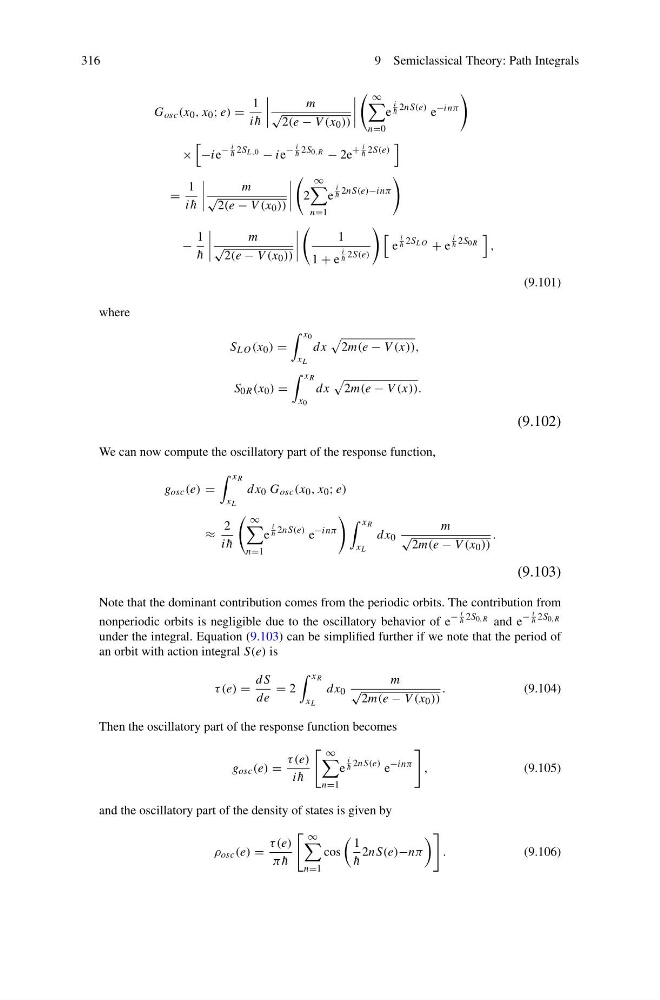
G osc (x 0 , x 0 ; e) =
1
i ¯
h
m
√
2(e − V (x 0 ))
∞
n=0
e
i
¯
h 2nS(e) e
−inπ
×
−ie
−
i
¯
h 2S L,0 − ie
−
i
¯
h 2S 0,R − 2e
+
i
¯
h 2S(e)
=
1
i ¯
h
m
√
2(e − V (x 0 ))
2
∞
n=1
e
i
¯
h 2nS(e)−inπ
−
1
¯
h
m
√
2(e − V (x 0 ))
1
1 + e
i
¯
h 2S(e)
e
i
¯
h 2S LO + e
i
¯
h 2S 0R
,
(9.101)
where
S LO (x 0 ) =
x 0
x L
dx
2m(e − V (x)),
S 0R (x 0 ) =
x R
x 0
dx
2m(e − V (x)).
(9.102)
We can now compute the oscillatory part of the response function,
g osc (e) =
x R
x L
dx 0 G osc (x 0 , x 0 ; e)
≈
2
i ¯
h
∞
n=1
e
i
¯
h 2nS(e) e
−inπ
x R
x L
dx 0
m
√
2m(e − V (x 0 ))
.
(9.103)
Note that the dominant contribution comes from the periodic orbits. The contribution from
nonperiodic orbits is negligible due to the oscillatory behavior of e
−
i
¯
h 2S 0,R and e
−
i
¯
h 2S 0,R
under the integral. Equation (9.103) can be simplified further if we note that the period of
an orbit with action integral S(e) is
τ (e) =
dS
de
= 2
x R
x L
dx 0
m
√
2m(e − V (x 0 ))
.
(9.104)
Then the oscillatory part of the response function becomes
g osc (e) =
τ (e)
i ¯
h
∞
n=1
e
i
¯
h 2nS(e) e
−inπ
,
(9.105)
and the oscillatory part of the density of states is given by
ρ osc (e) =
τ (e)
π ¯
h
∞
n=1
cos
1
¯
h
2nS(e)−nπ
.
(9.106)
9 Semiclassical Theory: Path Integrals
G osc (x 0 , x 0 ; e) =
1
i ¯
h
m
√
2(e − V (x 0 ))
∞
n=0
e
i
¯
h 2nS(e) e
−inπ
×
−ie
−
i
¯
h 2S L,0 − ie
−
i
¯
h 2S 0,R − 2e
+
i
¯
h 2S(e)
=
1
i ¯
h
m
√
2(e − V (x 0 ))
2
∞
n=1
e
i
¯
h 2nS(e)−inπ
−
1
¯
h
m
√
2(e − V (x 0 ))
1
1 + e
i
¯
h 2S(e)
e
i
¯
h 2S LO + e
i
¯
h 2S 0R
,
(9.101)
where
S LO (x 0 ) =
x 0
x L
dx
2m(e − V (x)),
S 0R (x 0 ) =
x R
x 0
dx
2m(e − V (x)).
(9.102)
We can now compute the oscillatory part of the response function,
g osc (e) =
x R
x L
dx 0 G osc (x 0 , x 0 ; e)
≈
2
i ¯
h
∞
n=1
e
i
¯
h 2nS(e) e
−inπ
x R
x L
dx 0
m
√
2m(e − V (x 0 ))
.
(9.103)
Note that the dominant contribution comes from the periodic orbits. The contribution from
nonperiodic orbits is negligible due to the oscillatory behavior of e
−
i
¯
h 2S 0,R and e
−
i
¯
h 2S 0,R
under the integral. Equation (9.103) can be simplified further if we note that the period of
an orbit with action integral S(e) is
τ (e) =
dS
de
= 2
x R
x L
dx 0
m
√
2m(e − V (x 0 ))
.
(9.104)
Then the oscillatory part of the response function becomes
g osc (e) =
τ (e)
i ¯
h
∞
n=1
e
i
¯
h 2nS(e) e
−inπ
,
(9.105)
and the oscillatory part of the density of states is given by
ρ osc (e) =
τ (e)
π ¯
h
∞
n=1
cos
1
¯
h
2nS(e)−nπ
.
(9.106)