

9.6 Gutzwiller Trace Formula
317
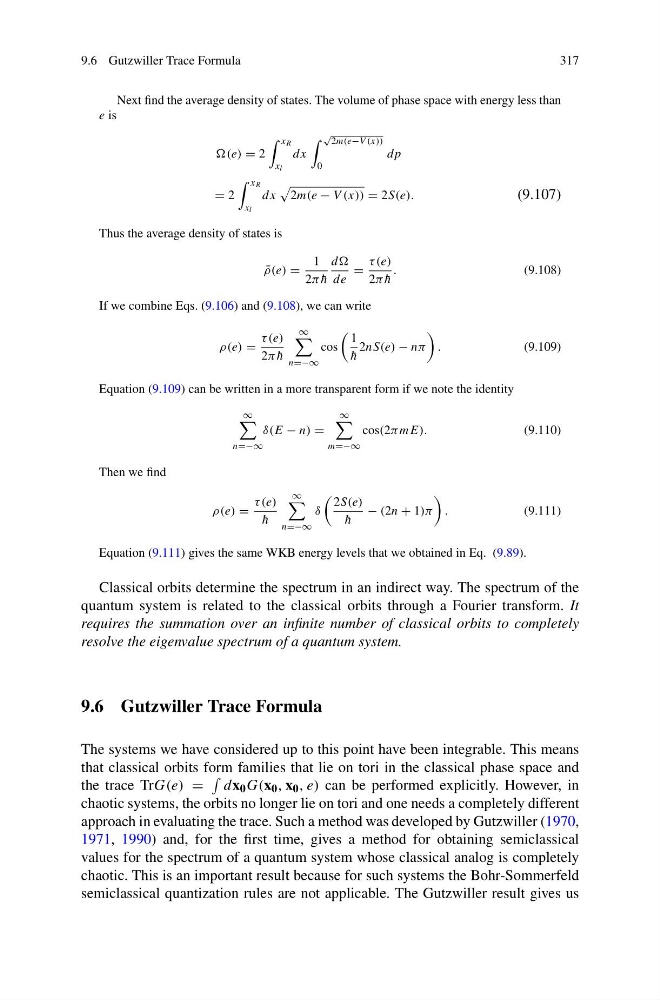
Next find the average density of states. The volume of phase space with energy less than
e is
= 2
x R
x l
dx
√
2m(e−V (x))
0
dp
= 2
x R
x l
dx
2m(e − V (x)) = 2S(e).
(9.107)
Thus the average density of states is
¯
ρ(e) =
1
2π ¯
h
dd
de
=
τ (e)
2π ¯
h
.
(9.108)
If we combine Eqs. (9.106) and (9.108), we can write
ρ(e) =
τ (e)
2π ¯
h
∞
n=−∞
cos
1
¯
h
2nS(e) − nπ
.
(9.109)
Equation (9.109) can be written in a more transparent form if we note the identity
∞
n=−∞
δ(E − n) =
∞
m=−∞
cos(2πmE).
(9.110)
Then we find
ρ(e) =
τ (e)
¯
h
∞
n=−∞
δ
2S(e)
¯
h
− (2n + 1)π
.
(9.111)
Equation (9.111) gives the same WKB energy levels that we obtained in Eq. (9.89).
Classical orbits determine the spectrum in an indirect way. The spectrum of the
quantum system is related to the classical orbits through a Fourier transform. It
requires the summation over an infinite number of classical orbits to completely
resolve the eigenvalue spectrum of a quantum system.
9.6 Gutzwiller Trace Formula
The systems we have considered up to this point have been integrable. This means
that classical orbits form families that lie on tori in the classical phase space and
the trace TrG(e) =
dx 0 G(x 0 , x 0 , e) can be performed explicitly. However, in
chaotic systems, the orbits no longer lie on tori and one needs a completely different
approach in evaluating the trace. Such a method was developed by Gutzwiller (1970,
1971, 1990) and, for the first time, gives a method for obtaining semiclassical
values for the spectrum of a quantum system whose classical analog is completely
chaotic. This is an important result because for such systems the Bohr-Sommerfeld
semiclassical quantization rules are not applicable. The Gutzwiller result gives us
317
Next find the average density of states. The volume of phase space with energy less than
e is
= 2
x R
x l
dx
√
2m(e−V (x))
0
dp
= 2
x R
x l
dx
2m(e − V (x)) = 2S(e).
(9.107)
Thus the average density of states is
¯
ρ(e) =
1
2π ¯
h
dd
de
=
τ (e)
2π ¯
h
.
(9.108)
If we combine Eqs. (9.106) and (9.108), we can write
ρ(e) =
τ (e)
2π ¯
h
∞
n=−∞
cos
1
¯
h
2nS(e) − nπ
.
(9.109)
Equation (9.109) can be written in a more transparent form if we note the identity
∞
n=−∞
δ(E − n) =
∞
m=−∞
cos(2πmE).
(9.110)
Then we find
ρ(e) =
τ (e)
¯
h
∞
n=−∞
δ
2S(e)
¯
h
− (2n + 1)π
.
(9.111)
Equation (9.111) gives the same WKB energy levels that we obtained in Eq. (9.89).
Classical orbits determine the spectrum in an indirect way. The spectrum of the
quantum system is related to the classical orbits through a Fourier transform. It
requires the summation over an infinite number of classical orbits to completely
resolve the eigenvalue spectrum of a quantum system.
9.6 Gutzwiller Trace Formula
The systems we have considered up to this point have been integrable. This means
that classical orbits form families that lie on tori in the classical phase space and
the trace TrG(e) =
dx 0 G(x 0 , x 0 , e) can be performed explicitly. However, in
chaotic systems, the orbits no longer lie on tori and one needs a completely different
approach in evaluating the trace. Such a method was developed by Gutzwiller (1970,
1971, 1990) and, for the first time, gives a method for obtaining semiclassical
values for the spectrum of a quantum system whose classical analog is completely
chaotic. This is an important result because for such systems the Bohr-Sommerfeld
semiclassical quantization rules are not applicable. The Gutzwiller result gives us