

312
9 Semiclassical Theory: Path Integrals
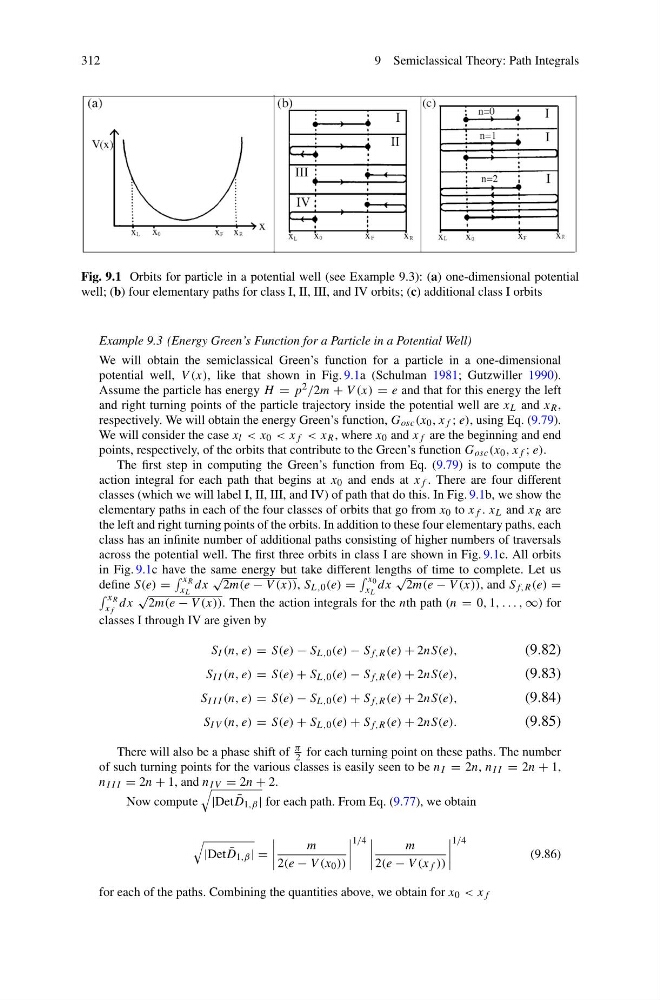
Fig. 9.1 Orbits for particle in a potential well (see Example 9.3): (a) one-dimensional potential
well; (b) four elementary paths for class I, II, III, and IV orbits; (c) additional class I orbits
Example 9.3 (Energy Green’s Function for a Particle in a Potential Well)
We will obtain the semiclassical Green’s function for a particle in a one-dimensional
potential well, V (x), like that shown in Fig. 9.1a (Schulman 1981; Gutzwiller 1990).
Assume the particle has energy H = p 2 /2m + V (x) = e and that for this energy the left
and right turning points of the particle trajectory inside the potential well are x L and x R ,
respectively. We will obtain the energy Green’s function, G osc (x 0 , x f ; e), using Eq. (9.79).
We will consider the case x l < x 0 < x f < x R , where x 0 and x f are the beginning and end
points, respectively, of the orbits that contribute to the Green’s function G osc (x 0 , x f ; e).
The first step in computing the Green’s function from Eq. (9.79) is to compute the
action integral for each path that begins at x 0 and ends at x f . There are four different
classes (which we will label I, II, III, and IV) of path that do this. In Fig. 9.1b, we show the
elementary paths in each of the four classes of orbits that go from x 0 to x f . x L and x R are
the left and right turning points of the orbits. In addition to these four elementary paths, each
class has an infinite number of additional paths consisting of higher numbers of traversals
across the potential well. The first three orbits in class I are shown in Fig. 9.1c. All orbits
in Fig. 9.1c have the same energy but take different lengths of time to complete. Let us
define S(e) =
x R
x L
dx
√
2m(e − V (x)), S L,0 (e) =
x 0
x L
dx
√
2m(e − V (x)), and S f,R (e) =
x R
x f
dx
√
2m(e − V (x)). Then the action integrals for the nth path (n = 0, 1, . . . , ∞) for
classes I through IV are given by
S I (n, e) = S(e) − S L,0 (e) − S f,R (e) + 2nS(e),
(9.82)
S I I (n, e) = S(e) + S L,0 (e) − S f,R (e) + 2nS(e),
(9.83)
S I I I (n, e) = S(e) − S L,0 (e) + S f,R (e) + 2nS(e),
(9.84)
S I V (n, e) = S(e) + S L,0 (e) + S f,R (e) + 2nS(e).
(9.85)
There will also be a phase shift of
π
2 for each turning point on these paths. The number
of such turning points for the various classes is easily seen to be n I = 2n, n I I = 2n + 1,
n I I I = 2n + 1, and n I V = 2n + 2.
Now compute
|Det ¯
D 1,β | for each path. From Eq. (9.77), we obtain
|Det ¯
D 1,β | =
m
2(e − V (x 0 ))
1/4
m
2(e − V (x f ))
1/4
(9.86)
for each of the paths. Combining the quantities above, we obtain for x 0 < x f
9 Semiclassical Theory: Path Integrals
Fig. 9.1 Orbits for particle in a potential well (see Example 9.3): (a) one-dimensional potential
well; (b) four elementary paths for class I, II, III, and IV orbits; (c) additional class I orbits
Example 9.3 (Energy Green’s Function for a Particle in a Potential Well)
We will obtain the semiclassical Green’s function for a particle in a one-dimensional
potential well, V (x), like that shown in Fig. 9.1a (Schulman 1981; Gutzwiller 1990).
Assume the particle has energy H = p 2 /2m + V (x) = e and that for this energy the left
and right turning points of the particle trajectory inside the potential well are x L and x R ,
respectively. We will obtain the energy Green’s function, G osc (x 0 , x f ; e), using Eq. (9.79).
We will consider the case x l < x 0 < x f < x R , where x 0 and x f are the beginning and end
points, respectively, of the orbits that contribute to the Green’s function G osc (x 0 , x f ; e).
The first step in computing the Green’s function from Eq. (9.79) is to compute the
action integral for each path that begins at x 0 and ends at x f . There are four different
classes (which we will label I, II, III, and IV) of path that do this. In Fig. 9.1b, we show the
elementary paths in each of the four classes of orbits that go from x 0 to x f . x L and x R are
the left and right turning points of the orbits. In addition to these four elementary paths, each
class has an infinite number of additional paths consisting of higher numbers of traversals
across the potential well. The first three orbits in class I are shown in Fig. 9.1c. All orbits
in Fig. 9.1c have the same energy but take different lengths of time to complete. Let us
define S(e) =
x R
x L
dx
√
2m(e − V (x)), S L,0 (e) =
x 0
x L
dx
√
2m(e − V (x)), and S f,R (e) =
x R
x f
dx
√
2m(e − V (x)). Then the action integrals for the nth path (n = 0, 1, . . . , ∞) for
classes I through IV are given by
S I (n, e) = S(e) − S L,0 (e) − S f,R (e) + 2nS(e),
(9.82)
S I I (n, e) = S(e) + S L,0 (e) − S f,R (e) + 2nS(e),
(9.83)
S I I I (n, e) = S(e) − S L,0 (e) + S f,R (e) + 2nS(e),
(9.84)
S I V (n, e) = S(e) + S L,0 (e) + S f,R (e) + 2nS(e).
(9.85)
There will also be a phase shift of
π
2 for each turning point on these paths. The number
of such turning points for the various classes is easily seen to be n I = 2n, n I I = 2n + 1,
n I I I = 2n + 1, and n I V = 2n + 2.
Now compute
|Det ¯
D 1,β | for each path. From Eq. (9.77), we obtain
|Det ¯
D 1,β | =
m
2(e − V (x 0 ))
1/4
m
2(e − V (x f ))
1/4
(9.86)
for each of the paths. Combining the quantities above, we obtain for x 0 < x f