

9.3 The Path Integral
299
Example 9.1 (Spatial Green’s Function for a Free Particle)
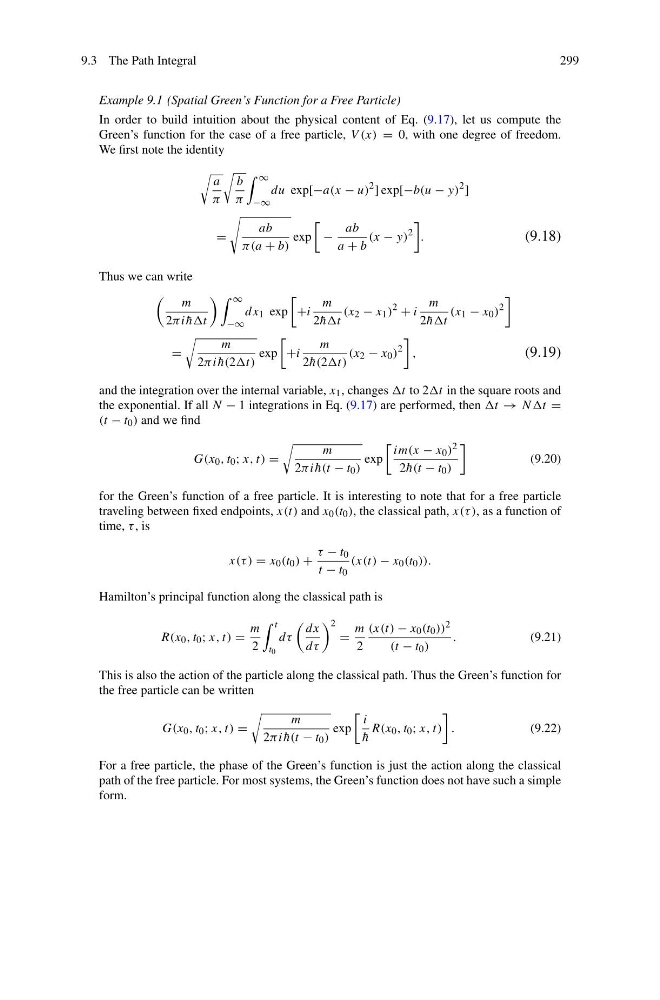
In order to build intuition about the physical content of Eq. (9.17), let us compute the
Green’s function for the case of a free particle, V (x) = 0, with one degree of freedom.
We first note the identity
a
π
b
π
∞
−∞
du exp[−a(x − u)
2 ] exp[−b(u − y)
2 ]
=
ab
π(a + b)
exp
−
ab
a + b
(x − y)
2
.
(9.18)
Thus we can write
m
2πi ¯
hht
∞
−∞
dx 1 exp
+i
m
2 ¯
hht
(x 2 − x 1 )
2 + i
m
2 ¯
hht
(x 1 − x 0 )
2
=
m
2πi ¯
h(2t)
exp
+i
m
2 ¯
h(2t)
(x 2 − x 0 )
2
,
(9.19)
and the integration over the internal variable, x 1 , changes t to 2t in the square roots and
the exponential. If all N − 1 integrations in Eq. (9.17) are performed, then t → NNt =
(t − t 0 ) and we find
G(x 0 , t 0 ; x, t) =
m
2πi ¯
h(t − t 0 )
exp
im(x − x 0 ) 2
2 ¯
h(t − t 0 )
(9.20)
for the Green’s function of a free particle. It is interesting to note that for a free particle
traveling between fixed endpoints, x(t) and x 0 (t 0 ), the classical path, x(τ ), as a function of
time, τ , is
x(τ ) = x 0 (t 0 ) +
τ − t 0
t − t 0
(x(t) − x 0 (t 0 )).
Hamilton’s principal function along the classical path is
R(x 0 , t 0 ; x, t) =
m
2
t
t 0
dτ
dx
dτ
2
=
m
2
(x(t) − x 0 (t 0 )) 2
(t − t 0 )
.
(9.21)
This is also the action of the particle along the classical path. Thus the Green’s function for
the free particle can be written
G(x 0 , t 0 ; x, t) =
m
2πi ¯
h(t − t 0 )
exp
i
¯
h
R(x 0 , t 0 ; x, t)
.
(9.22)
For a free particle, the phase of the Green’s function is just the action along the classical
path of the free particle. For most systems, the Green’s function does not have such a simple
form.
299
Example 9.1 (Spatial Green’s Function for a Free Particle)
In order to build intuition about the physical content of Eq. (9.17), let us compute the
Green’s function for the case of a free particle, V (x) = 0, with one degree of freedom.
We first note the identity
a
π
b
π
∞
−∞
du exp[−a(x − u)
2 ] exp[−b(u − y)
2 ]
=
ab
π(a + b)
exp
−
ab
a + b
(x − y)
2
.
(9.18)
Thus we can write
m
2πi ¯
hht
∞
−∞
dx 1 exp
+i
m
2 ¯
hht
(x 2 − x 1 )
2 + i
m
2 ¯
hht
(x 1 − x 0 )
2
=
m
2πi ¯
h(2t)
exp
+i
m
2 ¯
h(2t)
(x 2 − x 0 )
2
,
(9.19)
and the integration over the internal variable, x 1 , changes t to 2t in the square roots and
the exponential. If all N − 1 integrations in Eq. (9.17) are performed, then t → NNt =
(t − t 0 ) and we find
G(x 0 , t 0 ; x, t) =
m
2πi ¯
h(t − t 0 )
exp
im(x − x 0 ) 2
2 ¯
h(t − t 0 )
(9.20)
for the Green’s function of a free particle. It is interesting to note that for a free particle
traveling between fixed endpoints, x(t) and x 0 (t 0 ), the classical path, x(τ ), as a function of
time, τ , is
x(τ ) = x 0 (t 0 ) +
τ − t 0
t − t 0
(x(t) − x 0 (t 0 )).
Hamilton’s principal function along the classical path is
R(x 0 , t 0 ; x, t) =
m
2
t
t 0
dτ
dx
dτ
2
=
m
2
(x(t) − x 0 (t 0 )) 2
(t − t 0 )
.
(9.21)
This is also the action of the particle along the classical path. Thus the Green’s function for
the free particle can be written
G(x 0 , t 0 ; x, t) =
m
2πi ¯
h(t − t 0 )
exp
i
¯
h
R(x 0 , t 0 ; x, t)
.
(9.22)
For a free particle, the phase of the Green’s function is just the action along the classical
path of the free particle. For most systems, the Green’s function does not have such a simple
form.