

298
9 Semiclassical Theory: Path Integrals
Then the Green’s function takes the form
G(x 0 , t 0 ; x, t) = θ(t − t 0 ) lim
N →∞
mN
2πi ¯
h(t − t 0 )
N/2 ∞
−∞
dx 1 . . .
∞
−∞
dx N −1
×
N −1
j =0
exp
+
i
¯
h
mN
2(t − t 0 )
(x j +1 − x j )
2
−
(t − t 0 )
N
V (x j )
.
(9.14)
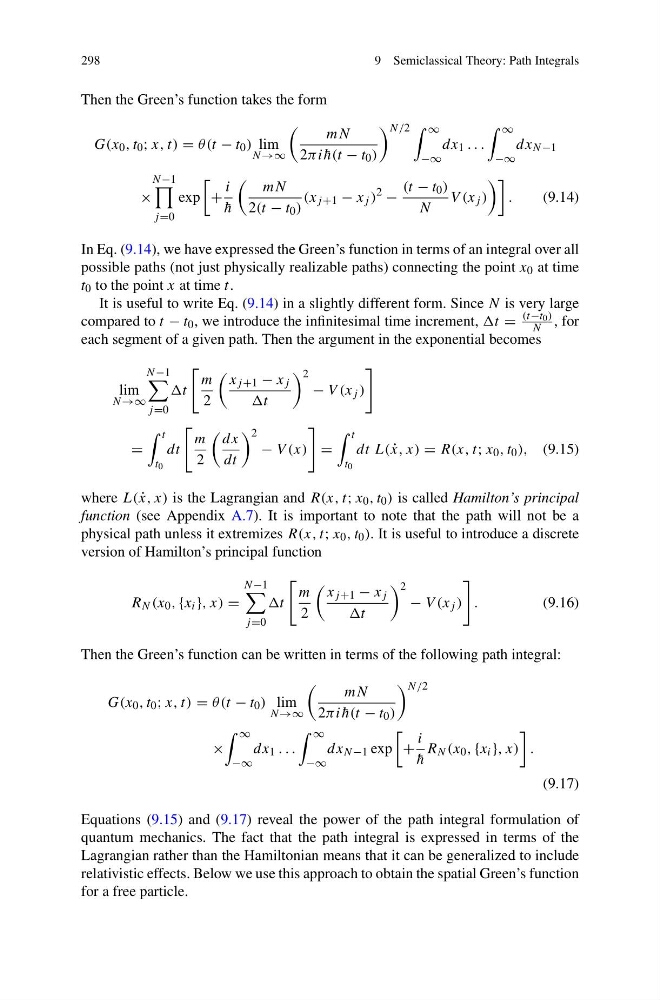
In Eq. (9.14), we have expressed the Green’s function in terms of an integral over all
possible paths (not just physically realizable paths) connecting the point x 0 at time
t 0 to the point x at time t.
It is useful to write Eq. (9.14) in a slightly different form. Since N is very large
compared to t − t 0 , we introduce the infinitesimal time increment, t =
(t−t 0 )
N , for
each segment of a given path. Then the argument in the exponential becomes
lim
N →∞
N −1
j =0
t
m
2
x j +1 − x j
t
2
− V (x j )
=
t
t 0
dt
m
2
dx
dt
2
− V (x)
=
t
t 0
dt L( ˙
x, x) = R(x, t; x 0 , t 0 ), (9.15)
where L( ˙
x, x) is the Lagrangian and R(x, t; x 0 , t 0 ) is called Hamilton’s principal
function (see Appendix A.7). It is important to note that the path will not be a
physical path unless it extremizes R(x, t; x 0 , t 0 ). It is useful to introduce a discrete
version of Hamilton’s principal function
R N (x 0 , {x i }, x) =
N −1
j =0
t
m
2
x j +1 − x j
t
2
− V (x j )
.
(9.16)
Then the Green’s function can be written in terms of the following path integral:
G(x 0 , t 0 ; x, t) = θ(t − t 0 ) lim
N →∞
mN
2πi ¯
h(t − t 0 )
N/2
×
∞
−∞
dx 1 . . .
∞
−∞
dx N −1 exp
+
i
¯
h
R N (x 0 , {x i }, x)
.
(9.17)
Equations (9.15) and (9.17) reveal the power of the path integral formulation of
quantum mechanics. The fact that the path integral is expressed in terms of the
Lagrangian rather than the Hamiltonian means that it can be generalized to include
relativistic effects. Below we use this approach to obtain the spatial Green’s function
for a free particle.
9 Semiclassical Theory: Path Integrals
Then the Green’s function takes the form
G(x 0 , t 0 ; x, t) = θ(t − t 0 ) lim
N →∞
mN
2πi ¯
h(t − t 0 )
N/2 ∞
−∞
dx 1 . . .
∞
−∞
dx N −1
×
N −1
j =0
exp
+
i
¯
h
mN
2(t − t 0 )
(x j +1 − x j )
2
−
(t − t 0 )
N
V (x j )
.
(9.14)
In Eq. (9.14), we have expressed the Green’s function in terms of an integral over all
possible paths (not just physically realizable paths) connecting the point x 0 at time
t 0 to the point x at time t.
It is useful to write Eq. (9.14) in a slightly different form. Since N is very large
compared to t − t 0 , we introduce the infinitesimal time increment, t =
(t−t 0 )
N , for
each segment of a given path. Then the argument in the exponential becomes
lim
N →∞
N −1
j =0
t
m
2
x j +1 − x j
t
2
− V (x j )
=
t
t 0
dt
m
2
dx
dt
2
− V (x)
=
t
t 0
dt L( ˙
x, x) = R(x, t; x 0 , t 0 ), (9.15)
where L( ˙
x, x) is the Lagrangian and R(x, t; x 0 , t 0 ) is called Hamilton’s principal
function (see Appendix A.7). It is important to note that the path will not be a
physical path unless it extremizes R(x, t; x 0 , t 0 ). It is useful to introduce a discrete
version of Hamilton’s principal function
R N (x 0 , {x i }, x) =
N −1
j =0
t
m
2
x j +1 − x j
t
2
− V (x j )
.
(9.16)
Then the Green’s function can be written in terms of the following path integral:
G(x 0 , t 0 ; x, t) = θ(t − t 0 ) lim
N →∞
mN
2πi ¯
h(t − t 0 )
N/2
×
∞
−∞
dx 1 . . .
∞
−∞
dx N −1 exp
+
i
¯
h
R N (x 0 , {x i }, x)
.
(9.17)
Equations (9.15) and (9.17) reveal the power of the path integral formulation of
quantum mechanics. The fact that the path integral is expressed in terms of the
Lagrangian rather than the Hamiltonian means that it can be generalized to include
relativistic effects. Below we use this approach to obtain the spatial Green’s function
for a free particle.