

9.3 The Path Integral
297
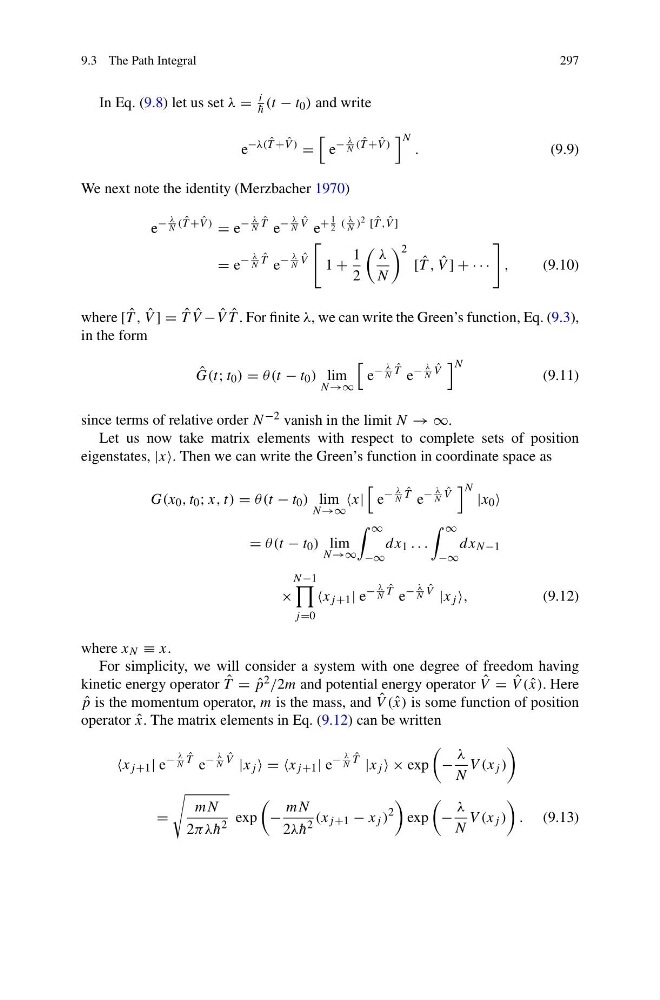
In Eq. (9.8) let us set λ =
i
¯
h (t − t 0 ) and write
e
−λ( ˆ
T + ˆ
V )
=
e
−
λ
N ( ˆ
T + ˆ
V )
N
.
(9.9)
We next note the identity (Merzbacher 1970)
e
−
λ
N ( ˆ
T + ˆ
V )
= e
−
λ
N
ˆ
T e
−
λ
N
ˆ
V e
+
1
2 (
λ
N ) 2 [ ˆ
T , ˆ
V ]
= e
−
λ
N
ˆ
T e
−
λ
N
ˆ
V
1 +
1
2
λ
N
2
[ ˆ
T , ˆ
V ] + · · ·
,
(9.10)
where [ ˆ
T , ˆ
V ] = ˆ
T ˆ
V − ˆ
V ˆ
T . For finite λ, we can write the Green’s function, Eq. (9.3),
in the form
ˆ
G(t; t 0 ) = θ(t − t 0 ) lim
N →∞
e
−
λ
N
ˆ
T e
−
λ
N
ˆ
V
N
(9.11)
since terms of relative order N −2 vanish in the limit N → ∞.
Let us now take matrix elements with respect to complete sets of position
eigenstates, |x. Then we can write the Green’s function in coordinate space as
G(x 0 , t 0 ; x, t) = θ(t − t 0 ) lim
N →∞
x|
e
−
λ
N
ˆ
T e
−
λ
N
ˆ
V
N |x 0
= θ(t − t 0 ) lim
N →∞
∞
−∞
dx 1 . . .
∞
−∞
dx N −1
×
N −1
j =0
x j +1 | e
−
λ
N
ˆ
T e
−
λ
N
ˆ
V
|x j ,
(9.12)
where x N ≡ x.
For simplicity, we will consider a system with one degree of freedom having
kinetic energy operator ˆ
T = ˆ
p 2 /2m and potential energy operator ˆ
V = ˆ
V ( ˆ
x). Here
ˆ
p is the momentum operator, m is the mass, and ˆ
V ( ˆ
x) is some function of position
operator ˆ
x. The matrix elements in Eq. (9.12) can be written
x j +1 | e
−
λ
N
ˆ
T e
−
λ
N
ˆ
V
|x j = =x j +1 | e
−
λ
N
ˆ
T
|x j × exp
−
λ
N
V (x j )
=
mN
2πλ ¯
h 2 exp
−
mN
2λ ¯
h 2 (x j +1 − x j )
2
exp
−
λ
N
V (x j )
. (9.13)
297
In Eq. (9.8) let us set λ =
i
¯
h (t − t 0 ) and write
e
−λ( ˆ
T + ˆ
V )
=
e
−
λ
N ( ˆ
T + ˆ
V )
N
.
(9.9)
We next note the identity (Merzbacher 1970)
e
−
λ
N ( ˆ
T + ˆ
V )
= e
−
λ
N
ˆ
T e
−
λ
N
ˆ
V e
+
1
2 (
λ
N ) 2 [ ˆ
T , ˆ
V ]
= e
−
λ
N
ˆ
T e
−
λ
N
ˆ
V
1 +
1
2
λ
N
2
[ ˆ
T , ˆ
V ] + · · ·
,
(9.10)
where [ ˆ
T , ˆ
V ] = ˆ
T ˆ
V − ˆ
V ˆ
T . For finite λ, we can write the Green’s function, Eq. (9.3),
in the form
ˆ
G(t; t 0 ) = θ(t − t 0 ) lim
N →∞
e
−
λ
N
ˆ
T e
−
λ
N
ˆ
V
N
(9.11)
since terms of relative order N −2 vanish in the limit N → ∞.
Let us now take matrix elements with respect to complete sets of position
eigenstates, |x. Then we can write the Green’s function in coordinate space as
G(x 0 , t 0 ; x, t) = θ(t − t 0 ) lim
N →∞
x|
e
−
λ
N
ˆ
T e
−
λ
N
ˆ
V
N |x 0
= θ(t − t 0 ) lim
N →∞
∞
−∞
dx 1 . . .
∞
−∞
dx N −1
×
N −1
j =0
x j +1 | e
−
λ
N
ˆ
T e
−
λ
N
ˆ
V
|x j ,
(9.12)
where x N ≡ x.
For simplicity, we will consider a system with one degree of freedom having
kinetic energy operator ˆ
T = ˆ
p 2 /2m and potential energy operator ˆ
V = ˆ
V ( ˆ
x). Here
ˆ
p is the momentum operator, m is the mass, and ˆ
V ( ˆ
x) is some function of position
operator ˆ
x. The matrix elements in Eq. (9.12) can be written
x j +1 | e
−
λ
N
ˆ
T e
−
λ
N
ˆ
V
|x j = =x j +1 | e
−
λ
N
ˆ
T
|x j × exp
−
λ
N
V (x j )
=
mN
2πλ ¯
h 2 exp
−
mN
2λ ¯
h 2 (x j +1 − x j )
2
exp
−
λ
N
V (x j )
. (9.13)