

8.6 COE and GOE
275
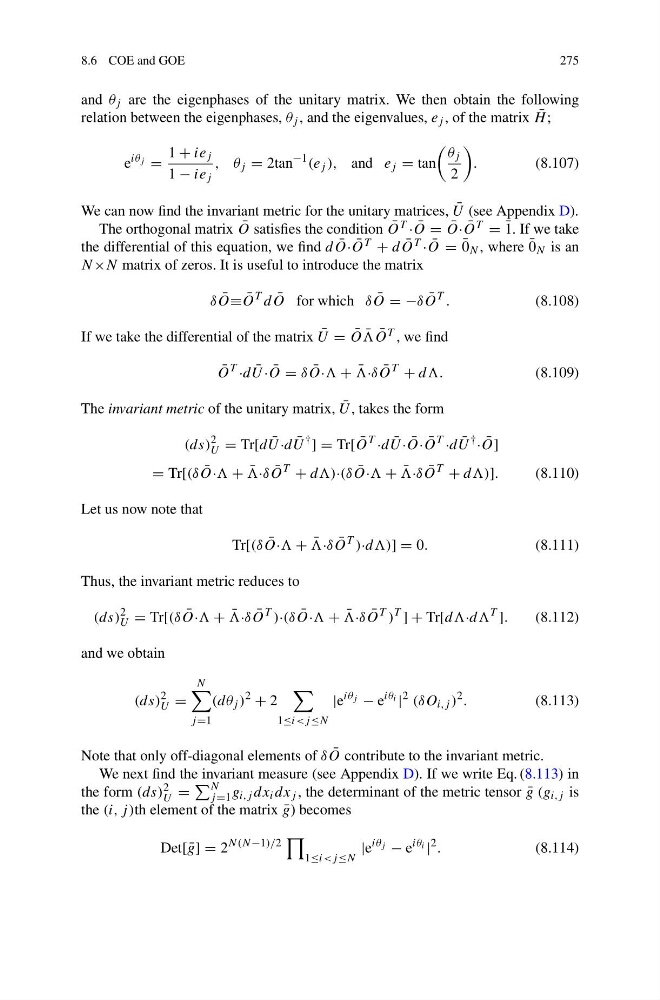
and θ j are the eigenphases of the unitary matrix. We then obtain the following
relation between the eigenphases, θ j , and the eigenvalues, e j , of the matrix ¯
H ;
e
iθ j =
1 + ie j
1 − ie j
, θ j = 2tan
−1 (e j ), and e j = tan
θ j
2
.
(8.107)
We can now find the invariant metric for the unitary matrices, ¯
U (see Appendix D).
The orthogonal matrix ¯
O satisfies the condition ¯
O T · ¯
O = ¯
O· ¯
O T = ¯
1. If we take
the differential of this equation, we find d ¯
O· ¯
O T + d ¯
O T · ¯
O = ¯
0 N , where ¯
0 N is an
N×N matrix of zeros. It is useful to introduce the matrix
δ ¯
O≡ ¯
O
T d ¯
O for which δ ¯
O = −δ ¯
O
T .
(8.108)
If we take the differential of the matrix ¯
U = ¯
O ¯
¯
O T , we find
¯
O
T
·d ¯
U · ¯
O = δ ¯
O· + ¯
·δ ¯
O
T
+ dd.
(8.109)
The invariant metric of the unitary matrix, ¯
U , takes the form
(ds)
2
U = Tr[d ¯
U ·d ¯
U
†
] = Tr[ ¯
O
T
·d ¯
U · ¯
O· ¯
O
T
·d ¯
U
†
· ¯
O]
= Tr[(δ ¯
O· + ¯
·δ ¯
O
T
+ dd)·(δ ¯
O· + ¯
·δ ¯
O
T
+ dd)].
(8.110)
Let us now note that
Tr[(δ ¯
O· + ¯
·δ ¯
O
T )·dd)] = 0.
(8.111)
Thus, the invariant metric reduces to
(ds)
2
U = Tr[(δ ¯
O· + ¯
·δ ¯
O
T )·(δ ¯
O· + ¯
·δ ¯
O
T )
T
] + Tr[dd·dd
T
].
(8.112)
and we obtain
(ds)
2
U =
N
j =1
(dθ j )
2
+ 2
1≤i
iθ j − e
iθ i |
2 (δO i,j )
2 .
(8.113)
Note that only off-diagonal elements of δ ¯
O contribute to the invariant metric.
We next find the invariant measure (see Appendix D). If we write Eq. (8.113) in
the form (ds) 2
U =
N
j =1 g i,j dx i dx j , the determinant of the metric tensor ¯
g (g i,j is
the (i, j )th element of the matrix ¯
g) becomes
Det[ ¯
g] = 2
N(N−1)/2
1≤i
iθ j − e
iθ i |
2 .
(8.114)
275
and θ j are the eigenphases of the unitary matrix. We then obtain the following
relation between the eigenphases, θ j , and the eigenvalues, e j , of the matrix ¯
H ;
e
iθ j =
1 + ie j
1 − ie j
, θ j = 2tan
−1 (e j ), and e j = tan
θ j
2
.
(8.107)
We can now find the invariant metric for the unitary matrices, ¯
U (see Appendix D).
The orthogonal matrix ¯
O satisfies the condition ¯
O T · ¯
O = ¯
O· ¯
O T = ¯
1. If we take
the differential of this equation, we find d ¯
O· ¯
O T + d ¯
O T · ¯
O = ¯
0 N , where ¯
0 N is an
N×N matrix of zeros. It is useful to introduce the matrix
δ ¯
O≡ ¯
O
T d ¯
O for which δ ¯
O = −δ ¯
O
T .
(8.108)
If we take the differential of the matrix ¯
U = ¯
O ¯
¯
O T , we find
¯
O
T
·d ¯
U · ¯
O = δ ¯
O· + ¯
·δ ¯
O
T
+ dd.
(8.109)
The invariant metric of the unitary matrix, ¯
U , takes the form
(ds)
2
U = Tr[d ¯
U ·d ¯
U
†
] = Tr[ ¯
O
T
·d ¯
U · ¯
O· ¯
O
T
·d ¯
U
†
· ¯
O]
= Tr[(δ ¯
O· + ¯
·δ ¯
O
T
+ dd)·(δ ¯
O· + ¯
·δ ¯
O
T
+ dd)].
(8.110)
Let us now note that
Tr[(δ ¯
O· + ¯
·δ ¯
O
T )·dd)] = 0.
(8.111)
Thus, the invariant metric reduces to
(ds)
2
U = Tr[(δ ¯
O· + ¯
·δ ¯
O
T )·(δ ¯
O· + ¯
·δ ¯
O
T )
T
] + Tr[dd·dd
T
].
(8.112)
and we obtain
(ds)
2
U =
N
j =1
(dθ j )
2
+ 2
1≤i
iθ j − e
iθ i |
2 (δO i,j )
2 .
(8.113)
Note that only off-diagonal elements of δ ¯
O contribute to the invariant metric.
We next find the invariant measure (see Appendix D). If we write Eq. (8.113) in
the form (ds) 2
U =
N
j =1 g i,j dx i dx j , the determinant of the metric tensor ¯
g (g i,j is
the (i, j )th element of the matrix ¯
g) becomes
Det[ ¯
g] = 2
N(N−1)/2
1≤i
iθ j − e
iθ i |
2 .
(8.114)