

276
8 Manifestations of Chaos in Quantum Scattering Processes
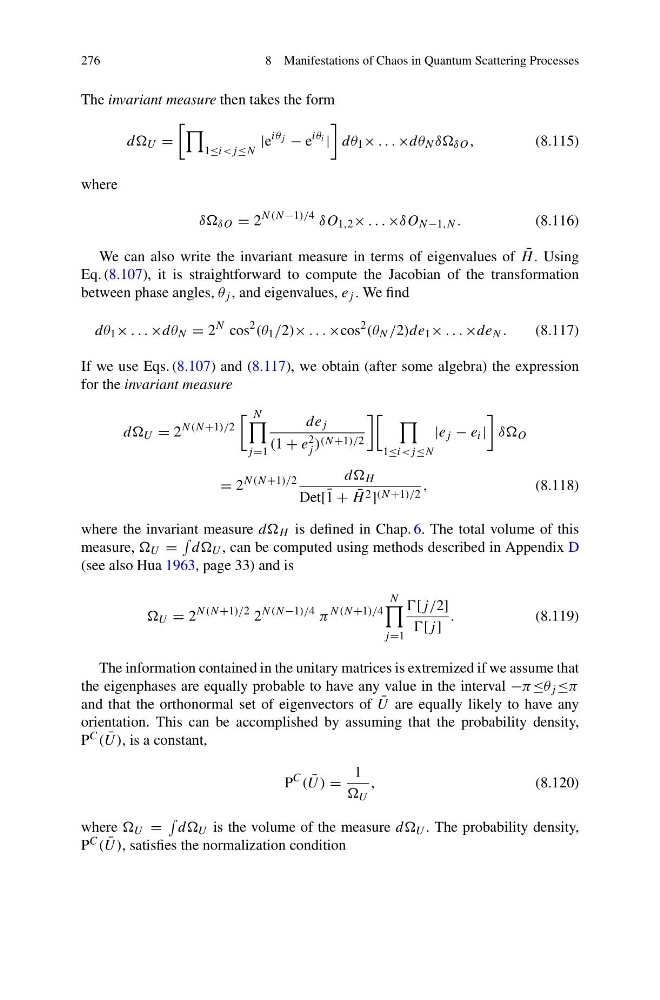
The invariant measure then takes the form
dd U =
1≤i
iθ j − e
iθ i |
dθ 1 × . . . ×dθ N δδ δO ,
(8.115)
where
δδ δO = 2
N(N−1)/4 δO 1,2 × . . . ×δO N −1,N .
(8.116)
We can also write the invariant measure in terms of eigenvalues of ¯
H . Using
Eq. (8.107), it is straightforward to compute the Jacobian of the transformation
between phase angles, θ j , and eigenvalues, e j . We find
dθ 1 × . . . ×dθ N = 2
N cos
2 (θ 1 /2)× . . . ×cos
2 (θ N /2)de 1 × . . . ×de N .
(8.117)
If we use Eqs. (8.107) and (8.117), we obtain (after some algebra) the expression
for the invariant measure
dd U = 2
N(N+1)/2
N
j =1
de j
(1 + e 2
j ) (N +1)/2
1≤i
δδ O
= 2
N(N+1)/2
dd H
Det[ ¯
1 + ¯
H 2 ] (N +1)/2
,
(8.118)
where the invariant measure dd H is defined in Chap. 6. The total volume of this
measure, U =
dd U , can be computed using methods described in Appendix D
(see also Hua 1963, page 33) and is
U = 2
N(N+1)/2 2
N(N−1)/4 π
N(N+1)/4
N
j =1
[j/2]
[j ]
.
(8.119)
The information contained in the unitary matrices is extremized if we assume that
the eigenphases are equally probable to have any value in the interval −π ≤θ j ≤π
and that the orthonormal set of eigenvectors of ¯
U are equally likely to have any
orientation. This can be accomplished by assuming that the probability density,
P C ( ¯
U), is a constant,
P
C ( ¯
U) =
1
U
,
(8.120)
where U =
dd U is the volume of the measure dd U . The probability density,
P C ( ¯
U), satisfies the normalization condition
8 Manifestations of Chaos in Quantum Scattering Processes
The invariant measure then takes the form
dd U =
1≤i
iθ j − e
iθ i |
dθ 1 × . . . ×dθ N δδ δO ,
(8.115)
where
δδ δO = 2
N(N−1)/4 δO 1,2 × . . . ×δO N −1,N .
(8.116)
We can also write the invariant measure in terms of eigenvalues of ¯
H . Using
Eq. (8.107), it is straightforward to compute the Jacobian of the transformation
between phase angles, θ j , and eigenvalues, e j . We find
dθ 1 × . . . ×dθ N = 2
N cos
2 (θ 1 /2)× . . . ×cos
2 (θ N /2)de 1 × . . . ×de N .
(8.117)
If we use Eqs. (8.107) and (8.117), we obtain (after some algebra) the expression
for the invariant measure
dd U = 2
N(N+1)/2
N
j =1
de j
(1 + e 2
j ) (N +1)/2
1≤i
δδ O
= 2
N(N+1)/2
dd H
Det[ ¯
1 + ¯
H 2 ] (N +1)/2
,
(8.118)
where the invariant measure dd H is defined in Chap. 6. The total volume of this
measure, U =
dd U , can be computed using methods described in Appendix D
(see also Hua 1963, page 33) and is
U = 2
N(N+1)/2 2
N(N−1)/4 π
N(N+1)/4
N
j =1
[j/2]
[j ]
.
(8.119)
The information contained in the unitary matrices is extremized if we assume that
the eigenphases are equally probable to have any value in the interval −π ≤θ j ≤π
and that the orthonormal set of eigenvectors of ¯
U are equally likely to have any
orientation. This can be accomplished by assuming that the probability density,
P C ( ¯
U), is a constant,
P
C ( ¯
U) =
1
U
,
(8.120)
where U =
dd U is the volume of the measure dd U . The probability density,
P C ( ¯
U), satisfies the normalization condition