

8.3 Scattering Theory
247
f (x) ˆ
∂
←
x g(x)≡
df (x)
dx
g(x) and f (x) ˆ
∂
→
x g(x)≡f (x)
dg(x)
dx
.
(8.12)
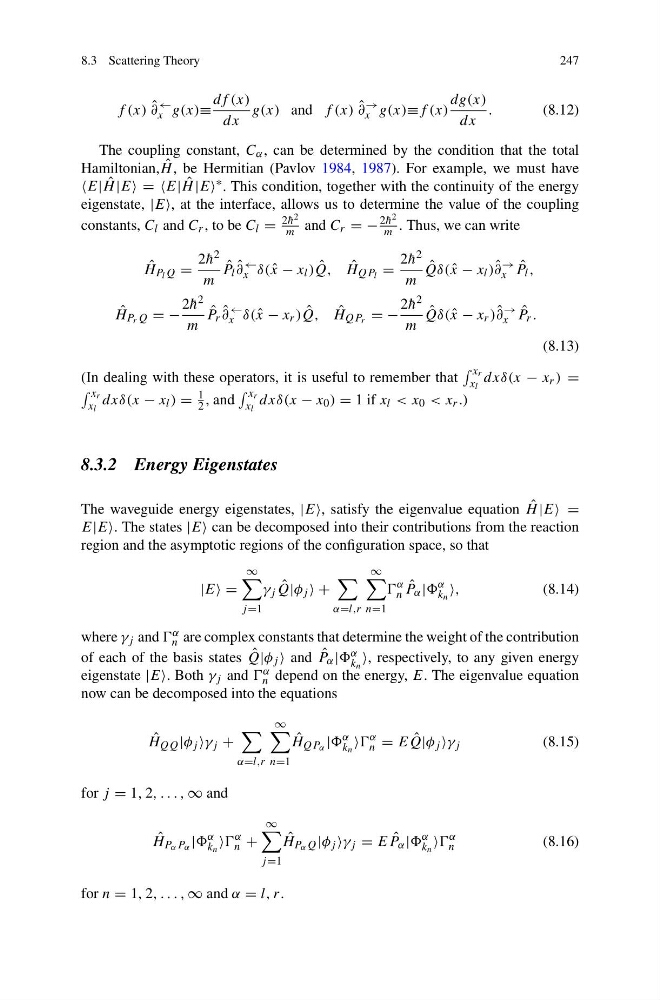
The coupling constant, C α , can be determined by the condition that the total
Hamiltonian, ˆ
H , be Hermitian (Pavlov 1984, 1987). For example, we must have
E| ˆ
H |E = =E| ˆ
H |E ∗ . This condition, together with the continuity of the energy
eigenstate, |E, at the interface, allows us to determine the value of the coupling
constants, C l and C r , to be C l =
2 ¯
h 2
m and C r = −
2 ¯
h 2
m . Thus, we can write
ˆ
H P l Q =
2 ¯
h 2
m
ˆ
P l ˆ
∂
←
x δ( ˆ
x − x l ) ˆ
Q, ˆ
H QP l =
2 ¯
h 2
m
ˆ
Qδ( ˆ
x − x l ) ˆ
∂
→
x
ˆ
P l ,
ˆ
H P r Q = −
2 ¯
h 2
m
ˆ
P r ˆ
∂
←
x δ( ˆ
x − x r ) ˆ
Q, ˆ
H QP r = −
2 ¯
h 2
m
ˆ
Qδ( ˆ
x − x r ) ˆ
∂
→
x
ˆ
P r .
(8.13)
(In dealing with these operators, it is useful to remember that
x r
x l
dxδ(x − x r ) =
x r
x l
dxδ(x − x l ) =
1
2 , and
x r
x l
dxδ(x − x 0 ) = 1 if x l < x 0 < x r .)
8.3.2 Energy Eigenstates
The waveguide energy eigenstates, |E, satisfy the eigenvalue equation ˆ
H |E =
E|E. The states |E can be decomposed into their contributions from the reaction
region and the asymptotic regions of the configuration space, so that
|E =
∞
j =1
γ j ˆ
Q|φ j +
α=l,r
∞
n=1
α
n
ˆ
P α |
α
k n
,
(8.14)
where γ j and α
n are complex constants that determine the weight of the contribution
of each of the basis states ˆ
Q|φ j and ˆ
P α | α
k n
, respectively, to any given energy
eigenstate |E. Both γ j and α
n depend on the energy, E. The eigenvalue equation
now can be decomposed into the equations
ˆ
H QQ |φ j γ j +
α=l,r
∞
n=1
ˆ
H QP α |
α
k n
α
n = E ˆ
Q|φ j γ j
(8.15)
for j = 1, 2, . . . , ∞ and
ˆ
H P α P α |
α
k n
α
n +
∞
j =1
ˆ
H P α Q |φ j γ j = E ˆ
P α |
α
k n
α
n
(8.16)
for n = 1, 2, . . . , ∞ and α = l, r.
247
f (x) ˆ
∂
←
x g(x)≡
df (x)
dx
g(x) and f (x) ˆ
∂
→
x g(x)≡f (x)
dg(x)
dx
.
(8.12)
The coupling constant, C α , can be determined by the condition that the total
Hamiltonian, ˆ
H , be Hermitian (Pavlov 1984, 1987). For example, we must have
E| ˆ
H |E = =E| ˆ
H |E ∗ . This condition, together with the continuity of the energy
eigenstate, |E, at the interface, allows us to determine the value of the coupling
constants, C l and C r , to be C l =
2 ¯
h 2
m and C r = −
2 ¯
h 2
m . Thus, we can write
ˆ
H P l Q =
2 ¯
h 2
m
ˆ
P l ˆ
∂
←
x δ( ˆ
x − x l ) ˆ
Q, ˆ
H QP l =
2 ¯
h 2
m
ˆ
Qδ( ˆ
x − x l ) ˆ
∂
→
x
ˆ
P l ,
ˆ
H P r Q = −
2 ¯
h 2
m
ˆ
P r ˆ
∂
←
x δ( ˆ
x − x r ) ˆ
Q, ˆ
H QP r = −
2 ¯
h 2
m
ˆ
Qδ( ˆ
x − x r ) ˆ
∂
→
x
ˆ
P r .
(8.13)
(In dealing with these operators, it is useful to remember that
x r
x l
dxδ(x − x r ) =
x r
x l
dxδ(x − x l ) =
1
2 , and
x r
x l
dxδ(x − x 0 ) = 1 if x l < x 0 < x r .)
8.3.2 Energy Eigenstates
The waveguide energy eigenstates, |E, satisfy the eigenvalue equation ˆ
H |E =
E|E. The states |E can be decomposed into their contributions from the reaction
region and the asymptotic regions of the configuration space, so that
|E =
∞
j =1
γ j ˆ
Q|φ j +
α=l,r
∞
n=1
α
n
ˆ
P α |
α
k n
,
(8.14)
where γ j and α
n are complex constants that determine the weight of the contribution
of each of the basis states ˆ
Q|φ j and ˆ
P α | α
k n
, respectively, to any given energy
eigenstate |E. Both γ j and α
n depend on the energy, E. The eigenvalue equation
now can be decomposed into the equations
ˆ
H QQ |φ j γ j +
α=l,r
∞
n=1
ˆ
H QP α |
α
k n
α
n = E ˆ
Q|φ j γ j
(8.15)
for j = 1, 2, . . . , ∞ and
ˆ
H P α P α |
α
k n
α
n +
∞
j =1
ˆ
H P α Q |φ j γ j = E ˆ
P α |
α
k n
α
n
(8.16)
for n = 1, 2, . . . , ∞ and α = l, r.