

248
8 Manifestations of Chaos in Quantum Scattering Processes
8.3.3 The Reaction Matrix
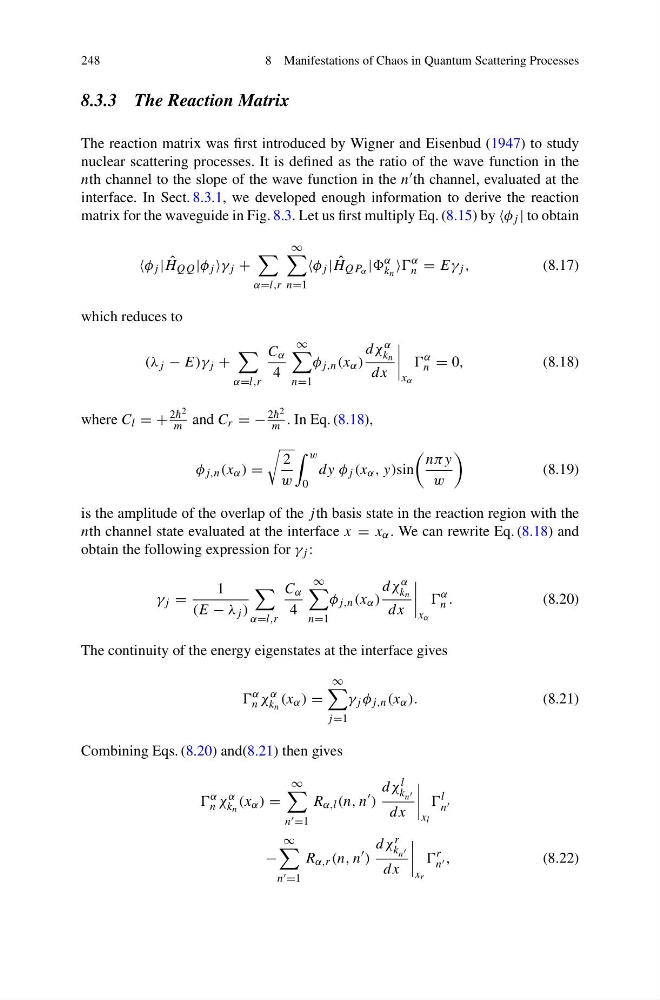
The reaction matrix was first introduced by Wigner and Eisenbud (1947) to study
nuclear scattering processes. It is defined as the ratio of the wave function in the
nth channel to the slope of the wave function in the n th channel, evaluated at the
interface. In Sect. 8.3.1, we developed enough information to derive the reaction
matrix for the waveguide in Fig. 8.3. Let us first multiply Eq. (8.15) by φ j | to obtain
φ j | ˆ
H QQ |φ j γ j +
α=l,r
∞
n=1
φ j | ˆ
H QP α |
α
k n
α
n = Eγ j ,
(8.17)
which reduces to
(λ j − E)γ j +
α=l,r
C α
4
∞
n=1
φ j,n (x α )
dχ α
k n
dx
x α
α
n = 0,
(8.18)
where C l = +
2 ¯
h 2
m and C r = −
2 ¯
h 2
m . In Eq. (8.18),
φ j,n (x α ) =
2
w
w
0
dy φ j (x α , y)sin
nπy
w
(8.19)
is the amplitude of the overlap of the j th basis state in the reaction region with the
nth channel state evaluated at the interface x = x α . We can rewrite Eq. (8.18) and
obtain the following expression for γ j :
γ j =
1
(E − λ j )
α=l,r
C α
4
∞
n=1
φ j,n (x α )
dχ α
k n
dx
x α
α
n .
(8.20)
The continuity of the energy eigenstates at the interface gives
α
n χ
α
k n
(x α ) =
∞
j =1
γ j φ j,n (x α ).
(8.21)
Combining Eqs. (8.20) and(8.21) then gives
α
n χ
α
k n
(x α ) =
∞
n =1
R α,l (n, n
)
dχ l
k n
dx
x l
l
n
−
∞
n =1
R α,r (n, n
)
dχ r
k n
dx
x r
r
n ,
(8.22)
8 Manifestations of Chaos in Quantum Scattering Processes
8.3.3 The Reaction Matrix
The reaction matrix was first introduced by Wigner and Eisenbud (1947) to study
nuclear scattering processes. It is defined as the ratio of the wave function in the
nth channel to the slope of the wave function in the n th channel, evaluated at the
interface. In Sect. 8.3.1, we developed enough information to derive the reaction
matrix for the waveguide in Fig. 8.3. Let us first multiply Eq. (8.15) by φ j | to obtain
φ j | ˆ
H QQ |φ j γ j +
α=l,r
∞
n=1
φ j | ˆ
H QP α |
α
k n
α
n = Eγ j ,
(8.17)
which reduces to
(λ j − E)γ j +
α=l,r
C α
4
∞
n=1
φ j,n (x α )
dχ α
k n
dx
x α
α
n = 0,
(8.18)
where C l = +
2 ¯
h 2
m and C r = −
2 ¯
h 2
m . In Eq. (8.18),
φ j,n (x α ) =
2
w
w
0
dy φ j (x α , y)sin
nπy
w
(8.19)
is the amplitude of the overlap of the j th basis state in the reaction region with the
nth channel state evaluated at the interface x = x α . We can rewrite Eq. (8.18) and
obtain the following expression for γ j :
γ j =
1
(E − λ j )
α=l,r
C α
4
∞
n=1
φ j,n (x α )
dχ α
k n
dx
x α
α
n .
(8.20)
The continuity of the energy eigenstates at the interface gives
α
n χ
α
k n
(x α ) =
∞
j =1
γ j φ j,n (x α ).
(8.21)
Combining Eqs. (8.20) and(8.21) then gives
α
n χ
α
k n
(x α ) =
∞
n =1
R α,l (n, n
)
dχ l
k n
dx
x l
l
n
−
∞
n =1
R α,r (n, n
)
dχ r
k n
dx
x r
r
n ,
(8.22)