

246
8 Manifestations of Chaos in Quantum Scattering Processes
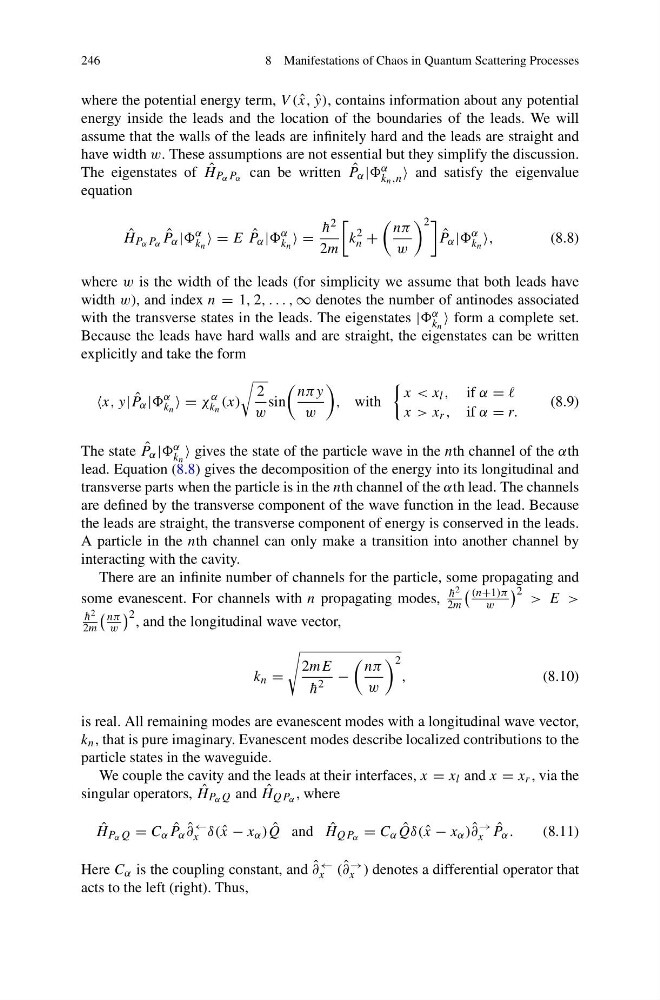
where the potential energy term, V ( ˆ
x, ˆ
y), contains information about any potential
energy inside the leads and the location of the boundaries of the leads. We will
assume that the walls of the leads are infinitely hard and the leads are straight and
have width w. These assumptions are not essential but they simplify the discussion.
The eigenstates of ˆ
H P α P α can be written ˆ
P α | α
k n ,n and satisfy the eigenvalue
equation
ˆ
H P α P α ˆ
P α |
α
k n
= E ˆ
P α |
α
k n
=
¯
h 2
2m
k
2
n +
nπ
w
2
ˆ
P α |
α
k n
,
(8.8)
where w is the width of the leads (for simplicity we assume that both leads have
width w), and index n = 1, 2, . . . , ∞ denotes the number of antinodes associated
with the transverse states in the leads. The eigenstates | α
k n
form a complete set.
Because the leads have hard walls and are straight, the eigenstates can be written
explicitly and take the form
x, y| ˆ
P α |
α
k n
= χ
α
k n
(x)
2
w
sin
nπy
w
, with
x < x l , if α =
x > x r , if α = r.
(8.9)
The state ˆ
P α | α
k n
gives the state of the particle wave in the nth channel of the αth
lead. Equation (8.8) gives the decomposition of the energy into its longitudinal and
transverse parts when the particle is in the nth channel of the αth lead. The channels
are defined by the transverse component of the wave function in the lead. Because
the leads are straight, the transverse component of energy is conserved in the leads.
A particle in the nth channel can only make a transition into another channel by
interacting with the cavity.
There are an infinite number of channels for the particle, some propagating and
some evanescent. For channels with n propagating modes, ¯
h 2
2m
(n+1)π
w
2 > E >
¯
h 2
2m
nπ
w
2 , and the longitudinal wave vector,
k n =
2mE
¯
h 2 −
nπ
w
2
,
(8.10)
is real. All remaining modes are evanescent modes with a longitudinal wave vector,
k n , that is pure imaginary. Evanescent modes describe localized contributions to the
particle states in the waveguide.
We couple the cavity and the leads at their interfaces, x = x l and x = x r , via the
singular operators, ˆ
H P α Q and ˆ
H QP α , where
ˆ
H P α Q = C α ˆ
P α ˆ
∂
←
x δ( ˆ
x − x α ) ˆ
Q and ˆ
H QP α = C α ˆ
Qδ( ˆ
x − x α ) ˆ
∂
→
x
ˆ
P α .
(8.11)
Here C α is the coupling constant, and ˆ
∂ ←
x ( ˆ
∂ →
x ) denotes a differential operator that
acts to the left (right). Thus,
8 Manifestations of Chaos in Quantum Scattering Processes
where the potential energy term, V ( ˆ
x, ˆ
y), contains information about any potential
energy inside the leads and the location of the boundaries of the leads. We will
assume that the walls of the leads are infinitely hard and the leads are straight and
have width w. These assumptions are not essential but they simplify the discussion.
The eigenstates of ˆ
H P α P α can be written ˆ
P α | α
k n ,n and satisfy the eigenvalue
equation
ˆ
H P α P α ˆ
P α |
α
k n
= E ˆ
P α |
α
k n
=
¯
h 2
2m
k
2
n +
nπ
w
2
ˆ
P α |
α
k n
,
(8.8)
where w is the width of the leads (for simplicity we assume that both leads have
width w), and index n = 1, 2, . . . , ∞ denotes the number of antinodes associated
with the transverse states in the leads. The eigenstates | α
k n
form a complete set.
Because the leads have hard walls and are straight, the eigenstates can be written
explicitly and take the form
x, y| ˆ
P α |
α
k n
= χ
α
k n
(x)
2
w
sin
nπy
w
, with
x < x l , if α =
x > x r , if α = r.
(8.9)
The state ˆ
P α | α
k n
gives the state of the particle wave in the nth channel of the αth
lead. Equation (8.8) gives the decomposition of the energy into its longitudinal and
transverse parts when the particle is in the nth channel of the αth lead. The channels
are defined by the transverse component of the wave function in the lead. Because
the leads are straight, the transverse component of energy is conserved in the leads.
A particle in the nth channel can only make a transition into another channel by
interacting with the cavity.
There are an infinite number of channels for the particle, some propagating and
some evanescent. For channels with n propagating modes, ¯
h 2
2m
(n+1)π
w
2 > E >
¯
h 2
2m
nπ
w
2 , and the longitudinal wave vector,
k n =
2mE
¯
h 2 −
nπ
w
2
,
(8.10)
is real. All remaining modes are evanescent modes with a longitudinal wave vector,
k n , that is pure imaginary. Evanescent modes describe localized contributions to the
particle states in the waveguide.
We couple the cavity and the leads at their interfaces, x = x l and x = x r , via the
singular operators, ˆ
H P α Q and ˆ
H QP α , where
ˆ
H P α Q = C α ˆ
P α ˆ
∂
←
x δ( ˆ
x − x α ) ˆ
Q and ˆ
H QP α = C α ˆ
Qδ( ˆ
x − x α ) ˆ
∂
→
x
ˆ
P α .
(8.11)
Here C α is the coupling constant, and ˆ
∂ ←
x ( ˆ
∂ →
x ) denotes a differential operator that
acts to the left (right). Thus,