

8.3 Scattering Theory
245
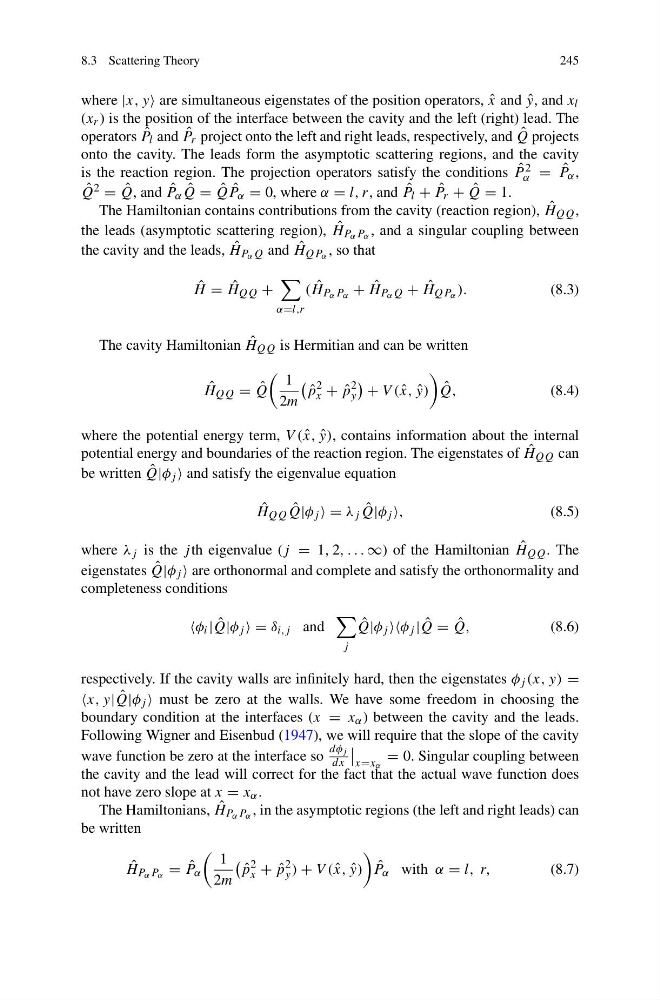
where |x, y are simultaneous eigenstates of the position operators, ˆ
x and ˆ
y, and x l
(x r ) is the position of the interface between the cavity and the left (right) lead. The
operators ˆ
P l and ˆ
P r project onto the left and right leads, respectively, and ˆ
Q projects
onto the cavity. The leads form the asymptotic scattering regions, and the cavity
is the reaction region. The projection operators satisfy the conditions ˆ
P 2
α = ˆ
P α ,
ˆ
Q 2 = ˆ
Q, and ˆ
P α ˆ
Q = ˆ
Q ˆ
P α = 0, where α = l, r, and ˆ
P l + ˆ
P r + ˆ
Q = 1.
The Hamiltonian contains contributions from the cavity (reaction region), ˆ
H QQ ,
the leads (asymptotic scattering region), ˆ
H P α P α , and a singular coupling between
the cavity and the leads, ˆ
H P α Q and ˆ
H QP α , so that
ˆ
H = ˆ
H QQ +
α=l,r
( ˆ
H P α P α + ˆ
H P α Q + ˆ
H QP α ).
(8.3)
The cavity Hamiltonian ˆ
H QQ is Hermitian and can be written
ˆ
H QQ = ˆ
Q
1
2m
ˆ
p
2
x + ˆ
p
2
y
+ V ( ˆ
x, ˆ
y)
ˆ
Q,
(8.4)
where the potential energy term, V ( ˆ
x, ˆ
y), contains information about the internal
potential energy and boundaries of the reaction region. The eigenstates of ˆ
H QQ can
be written ˆ
Q|φ j and satisfy the eigenvalue equation
ˆ
H QQ ˆ
Q|φ j = λ j ˆ
Q|φ j ,
(8.5)
where λ j is the j th eigenvalue (j = 1, 2, . . . ∞) of the Hamiltonian ˆ
H QQ . The
eigenstates ˆ
Q|φ j are orthonormal and complete and satisfy the orthonormality and
completeness conditions
φ i | ˆ
Q|φ j = δ i,j and
j
ˆ
Q|φ j φ j | ˆ
Q = ˆ
Q,
(8.6)
respectively. If the cavity walls are infinitely hard, then the eigenstates φ j (x, y) =
x, y| ˆ
Q|φ j must be zero at the walls. We have some freedom in choosing the
boundary condition at the interfaces (x = x α ) between the cavity and the leads.
Following Wigner and Eisenbud (1947), we will require that the slope of the cavity
wave function be zero at the interface so
dφ j
dx
x=x α
= 0. Singular coupling between
the cavity and the lead will correct for the fact that the actual wave function does
not have zero slope at x = x α .
The Hamiltonians, ˆ
H P α P α , in the asymptotic regions (the left and right leads) can
be written
ˆ
H P α P α = ˆ
P α
1
2m
ˆ
p
2
x + ˆ
p
2
y ) + V ( ˆ
x, ˆ
y)
ˆ
P α with α = l, r,
(8.7)
245
where |x, y are simultaneous eigenstates of the position operators, ˆ
x and ˆ
y, and x l
(x r ) is the position of the interface between the cavity and the left (right) lead. The
operators ˆ
P l and ˆ
P r project onto the left and right leads, respectively, and ˆ
Q projects
onto the cavity. The leads form the asymptotic scattering regions, and the cavity
is the reaction region. The projection operators satisfy the conditions ˆ
P 2
α = ˆ
P α ,
ˆ
Q 2 = ˆ
Q, and ˆ
P α ˆ
Q = ˆ
Q ˆ
P α = 0, where α = l, r, and ˆ
P l + ˆ
P r + ˆ
Q = 1.
The Hamiltonian contains contributions from the cavity (reaction region), ˆ
H QQ ,
the leads (asymptotic scattering region), ˆ
H P α P α , and a singular coupling between
the cavity and the leads, ˆ
H P α Q and ˆ
H QP α , so that
ˆ
H = ˆ
H QQ +
α=l,r
( ˆ
H P α P α + ˆ
H P α Q + ˆ
H QP α ).
(8.3)
The cavity Hamiltonian ˆ
H QQ is Hermitian and can be written
ˆ
H QQ = ˆ
Q
1
2m
ˆ
p
2
x + ˆ
p
2
y
+ V ( ˆ
x, ˆ
y)
ˆ
Q,
(8.4)
where the potential energy term, V ( ˆ
x, ˆ
y), contains information about the internal
potential energy and boundaries of the reaction region. The eigenstates of ˆ
H QQ can
be written ˆ
Q|φ j and satisfy the eigenvalue equation
ˆ
H QQ ˆ
Q|φ j = λ j ˆ
Q|φ j ,
(8.5)
where λ j is the j th eigenvalue (j = 1, 2, . . . ∞) of the Hamiltonian ˆ
H QQ . The
eigenstates ˆ
Q|φ j are orthonormal and complete and satisfy the orthonormality and
completeness conditions
φ i | ˆ
Q|φ j = δ i,j and
j
ˆ
Q|φ j φ j | ˆ
Q = ˆ
Q,
(8.6)
respectively. If the cavity walls are infinitely hard, then the eigenstates φ j (x, y) =
x, y| ˆ
Q|φ j must be zero at the walls. We have some freedom in choosing the
boundary condition at the interfaces (x = x α ) between the cavity and the leads.
Following Wigner and Eisenbud (1947), we will require that the slope of the cavity
wave function be zero at the interface so
dφ j
dx
x=x α
= 0. Singular coupling between
the cavity and the lead will correct for the fact that the actual wave function does
not have zero slope at x = x α .
The Hamiltonians, ˆ
H P α P α , in the asymptotic regions (the left and right leads) can
be written
ˆ
H P α P α = ˆ
P α
1
2m
ˆ
p
2
x + ˆ
p
2
y ) + V ( ˆ
x, ˆ
y)
ˆ
P α with α = l, r,
(8.7)