

230
7 Bounded Quantum Systems
We consider a two-dimensional gas of non-interacting particles of mass m
traversing a spatially periodic potential energy landscape. The single-particle
Hamiltonian, in dimensionless units (with m = 1/2), can be written
H = p
2
x + p
2
y + U o (V (x, y) − V 0 ) = E,
(7.52)
where {p x , p y } and {x, y} are the x− and y−components of momentum and
displacement, respectively, E is the total energy, and V 0 is a constant whose value is
chosen to ensure that the minimum of the potential energy is zero (in dimensionless
units). The spatially periodic potential V (x, y), is given in terms of elliptic theta
functions,
V j (x, y) =
1
4
ϑ 3
πx
2
, e
−
2 π 2
2
ϑ 3
πy
2
, e
−
2 π 2
2
,
(7.53)
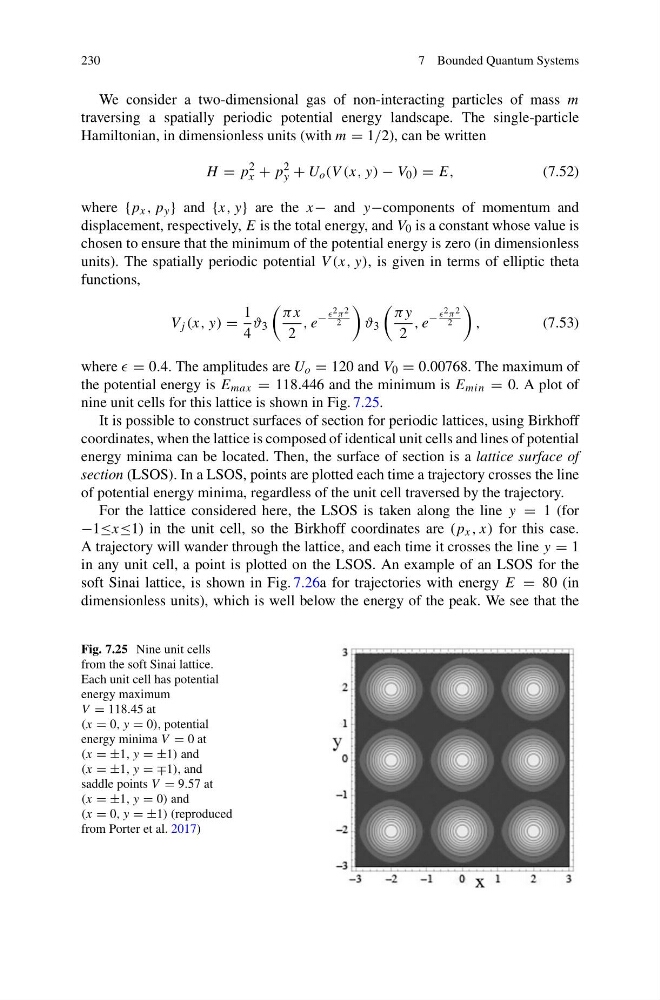
where = 0.4. The amplitudes are U o = 120 and V 0 = 0.00768. The maximum of
the potential energy is E max = 118.446 and the minimum is E min = 0. A plot of
nine unit cells for this lattice is shown in Fig. 7.25.
It is possible to construct surfaces of section for periodic lattices, using Birkhoff
coordinates, when the lattice is composed of identical unit cells and lines of potential
energy minima can be located. Then, the surface of section is a lattice surface of
section (LSOS). In a LSOS, points are plotted each time a trajectory crosses the line
of potential energy minima, regardless of the unit cell traversed by the trajectory.
For the lattice considered here, the LSOS is taken along the line y = 1 (for
−1≤x≤1) in the unit cell, so the Birkhoff coordinates are (p x , x) for this case.
A trajectory will wander through the lattice, and each time it crosses the line y = 1
in any unit cell, a point is plotted on the LSOS. An example of an LSOS for the
soft Sinai lattice, is shown in Fig. 7.26a for trajectories with energy E = 80 (in
dimensionless units), which is well below the energy of the peak. We see that the
Fig. 7.25 Nine unit cells
from the soft Sinai lattice.
Each unit cell has potential
energy maximum
V = 118.45 at
(x = 0, y = 0), potential
energy minima V = 0 at
(x = ±1, y = ±1) and
(x = ±1, y = ∓1), and
saddle points V = 9.57 at
(x = ±1, y = 0) and
(x = 0, y = ±1) (reproduced
from Porter et al. 2017)
7 Bounded Quantum Systems
We consider a two-dimensional gas of non-interacting particles of mass m
traversing a spatially periodic potential energy landscape. The single-particle
Hamiltonian, in dimensionless units (with m = 1/2), can be written
H = p
2
x + p
2
y + U o (V (x, y) − V 0 ) = E,
(7.52)
where {p x , p y } and {x, y} are the x− and y−components of momentum and
displacement, respectively, E is the total energy, and V 0 is a constant whose value is
chosen to ensure that the minimum of the potential energy is zero (in dimensionless
units). The spatially periodic potential V (x, y), is given in terms of elliptic theta
functions,
V j (x, y) =
1
4
ϑ 3
πx
2
, e
−
2 π 2
2
ϑ 3
πy
2
, e
−
2 π 2
2
,
(7.53)
where = 0.4. The amplitudes are U o = 120 and V 0 = 0.00768. The maximum of
the potential energy is E max = 118.446 and the minimum is E min = 0. A plot of
nine unit cells for this lattice is shown in Fig. 7.25.
It is possible to construct surfaces of section for periodic lattices, using Birkhoff
coordinates, when the lattice is composed of identical unit cells and lines of potential
energy minima can be located. Then, the surface of section is a lattice surface of
section (LSOS). In a LSOS, points are plotted each time a trajectory crosses the line
of potential energy minima, regardless of the unit cell traversed by the trajectory.
For the lattice considered here, the LSOS is taken along the line y = 1 (for
−1≤x≤1) in the unit cell, so the Birkhoff coordinates are (p x , x) for this case.
A trajectory will wander through the lattice, and each time it crosses the line y = 1
in any unit cell, a point is plotted on the LSOS. An example of an LSOS for the
soft Sinai lattice, is shown in Fig. 7.26a for trajectories with energy E = 80 (in
dimensionless units), which is well below the energy of the peak. We see that the
Fig. 7.25 Nine unit cells
from the soft Sinai lattice.
Each unit cell has potential
energy maximum
V = 118.45 at
(x = 0, y = 0), potential
energy minima V = 0 at
(x = ±1, y = ±1) and
(x = ±1, y = ∓1), and
saddle points V = 9.57 at
(x = ±1, y = 0) and
(x = 0, y = ±1) (reproduced
from Porter et al. 2017)