

226
7 Bounded Quantum Systems
7.7.2 The XY Model with an Applied Magnetic Field
The Hamiltonian for a version of the XY model with an applied magnetic field can
be written (Robb and Reichl 1998)
ˆ
H = −J ¯
h
2 ( ˆ
σ 1x ˆ
σ 2x + ˆ
σ 1y ˆ
σ 2y ) + λ ¯
h( ˆ
σ 1x + ˆ
σ 2x ).
(7.49)
We assume that each of the two spins has spin quantum number σ = 20. When λ =0,
ˆ
σ z = ˆ
σ 1z + ˆ
σ 2z no longer commutes with the Hamiltonian, and the time average of
ˆ
σ 2
z can be used as a second invariant to construct a quantum web.
As discussed in the previous section, we must select states from a single
symmetry class to construct the web. The Hamiltonian in Eq. (7.49) is invariant
with respect to the operator ˆ
P , which exchanges the two spins, and the operator
ˆ
C x
2 (π ), which rotates the spins by 180 o about the x-axis. We use the class of states
for which ˆ
P and ˆ
C x
2 (π ) have eigenvalues (+1, −1), respectively, to construct the
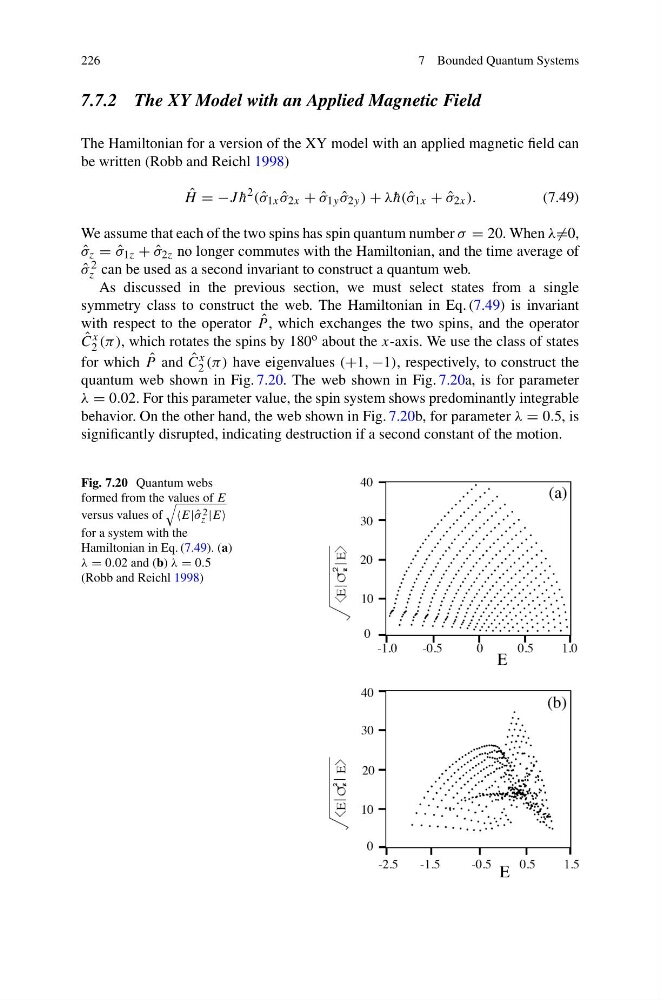
quantum web shown in Fig. 7.20. The web shown in Fig. 7.20a, is for parameter
λ = 0.02. For this parameter value, the spin system shows predominantly integrable
behavior. On the other hand, the web shown in Fig. 7.20b, for parameter λ = 0.5, is
significantly disrupted, indicating destruction if a second constant of the motion.
Fig. 7.20 Quantum webs
formed from the values of E
versus values of
ˆ
σ 2
z |E
for a system with the
Hamiltonian in Eq. (7.49). (a)
λ = 0.02 and (b) λ = 0.5
(Robb and Reichl 1998)
7 Bounded Quantum Systems
7.7.2 The XY Model with an Applied Magnetic Field
The Hamiltonian for a version of the XY model with an applied magnetic field can
be written (Robb and Reichl 1998)
ˆ
H = −J ¯
h
2 ( ˆ
σ 1x ˆ
σ 2x + ˆ
σ 1y ˆ
σ 2y ) + λ ¯
h( ˆ
σ 1x + ˆ
σ 2x ).
(7.49)
We assume that each of the two spins has spin quantum number σ = 20. When λ =0,
ˆ
σ z = ˆ
σ 1z + ˆ
σ 2z no longer commutes with the Hamiltonian, and the time average of
ˆ
σ 2
z can be used as a second invariant to construct a quantum web.
As discussed in the previous section, we must select states from a single
symmetry class to construct the web. The Hamiltonian in Eq. (7.49) is invariant
with respect to the operator ˆ
P , which exchanges the two spins, and the operator
ˆ
C x
2 (π ), which rotates the spins by 180 o about the x-axis. We use the class of states
for which ˆ
P and ˆ
C x
2 (π ) have eigenvalues (+1, −1), respectively, to construct the
quantum web shown in Fig. 7.20. The web shown in Fig. 7.20a, is for parameter
λ = 0.02. For this parameter value, the spin system shows predominantly integrable
behavior. On the other hand, the web shown in Fig. 7.20b, for parameter λ = 0.5, is
significantly disrupted, indicating destruction if a second constant of the motion.
Fig. 7.20 Quantum webs
formed from the values of E
versus values of
ˆ
σ 2
z |E
for a system with the
Hamiltonian in Eq. (7.49). (a)
λ = 0.02 and (b) λ = 0.5
(Robb and Reichl 1998)