

7.6 Peres Test for Quantum Integrability
221
ˆ
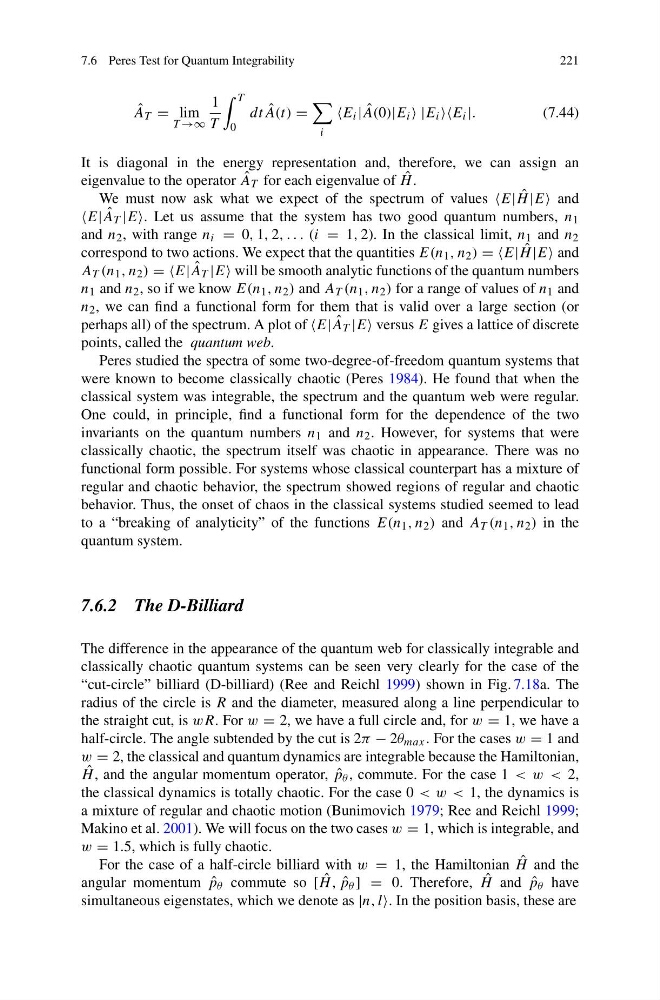
A T = lim
T →∞
1
T
T
0
dt ˆ
A(t) =
i
E i | ˆ
A(0)|E i |E i E i |.
(7.44)
It is diagonal in the energy representation and, therefore, we can assign an
eigenvalue to the operator ˆ
A T for each eigenvalue of ˆ
H .
We must now ask what we expect of the spectrum of values E| ˆ
H |E and
E| ˆ
A T |E. Let us assume that the system has two good quantum numbers, n 1
and n 2 , with range n i = 0, 1, 2, . . . (i = 1, 2). In the classical limit, n 1 and n 2
correspond to two actions. We expect that the quantities E(n 1 , n 2 ) = =E| ˆ
H |E and
A T (n 1 , n 2 ) = =E| ˆ
A T |E will be smooth analytic functions of the quantum numbers
n 1 and n 2 , so if we know E(n 1 , n 2 ) and A T (n 1 , n 2 ) for a range of values of n 1 and
n 2 , we can find a functional form for them that is valid over a large section (or
perhaps all) of the spectrum. A plot of E| ˆ
A T |E versus E gives a lattice of discrete
points, called the quantum web.
Peres studied the spectra of some two-degree-of-freedom quantum systems that
were known to become classically chaotic (Peres 1984). He found that when the
classical system was integrable, the spectrum and the quantum web were regular.
One could, in principle, find a functional form for the dependence of the two
invariants on the quantum numbers n 1 and n 2 . However, for systems that were
classically chaotic, the spectrum itself was chaotic in appearance. There was no
functional form possible. For systems whose classical counterpart has a mixture of
regular and chaotic behavior, the spectrum showed regions of regular and chaotic
behavior. Thus, the onset of chaos in the classical systems studied seemed to lead
to a “breaking of analyticity” of the functions E(n 1 , n 2 ) and A T (n 1 , n 2 ) in the
quantum system.
7.6.2 The D-Billiard
The difference in the appearance of the quantum web for classically integrable and
classically chaotic quantum systems can be seen very clearly for the case of the
“cut-circle” billiard (D-billiard) (Ree and Reichl 1999) shown in Fig. 7.18a. The
radius of the circle is R and the diameter, measured along a line perpendicular to
the straight cut, is wR. For w = 2, we have a full circle and, for w = 1, we have a
half-circle. The angle subtended by the cut is 2π − 2θ max . For the cases w = 1 and
w = 2, the classical and quantum dynamics are integrable because the Hamiltonian,
ˆ
H , and the angular momentum operator, ˆ
p θ , commute. For the case 1 < w < 2,
the classical dynamics is totally chaotic. For the case 0 < w < 1, the dynamics is
a mixture of regular and chaotic motion (Bunimovich 1979; Ree and Reichl 1999;
Makino et al. 2001). We will focus on the two cases w = 1, which is integrable, and
w = 1.5, which is fully chaotic.
For the case of a half-circle billiard with w = 1, the Hamiltonian ˆ
H and the
angular momentum ˆ
p θ commute so [ ˆ
H , ˆ
p θ ] = 0. Therefore, ˆ
H and ˆ
p θ have
simultaneous eigenstates, which we denote as |n, l. In the position basis, these are
221
ˆ
A T = lim
T →∞
1
T
T
0
dt ˆ
A(t) =
i
E i | ˆ
A(0)|E i |E i E i |.
(7.44)
It is diagonal in the energy representation and, therefore, we can assign an
eigenvalue to the operator ˆ
A T for each eigenvalue of ˆ
H .
We must now ask what we expect of the spectrum of values E| ˆ
H |E and
E| ˆ
A T |E. Let us assume that the system has two good quantum numbers, n 1
and n 2 , with range n i = 0, 1, 2, . . . (i = 1, 2). In the classical limit, n 1 and n 2
correspond to two actions. We expect that the quantities E(n 1 , n 2 ) = =E| ˆ
H |E and
A T (n 1 , n 2 ) = =E| ˆ
A T |E will be smooth analytic functions of the quantum numbers
n 1 and n 2 , so if we know E(n 1 , n 2 ) and A T (n 1 , n 2 ) for a range of values of n 1 and
n 2 , we can find a functional form for them that is valid over a large section (or
perhaps all) of the spectrum. A plot of E| ˆ
A T |E versus E gives a lattice of discrete
points, called the quantum web.
Peres studied the spectra of some two-degree-of-freedom quantum systems that
were known to become classically chaotic (Peres 1984). He found that when the
classical system was integrable, the spectrum and the quantum web were regular.
One could, in principle, find a functional form for the dependence of the two
invariants on the quantum numbers n 1 and n 2 . However, for systems that were
classically chaotic, the spectrum itself was chaotic in appearance. There was no
functional form possible. For systems whose classical counterpart has a mixture of
regular and chaotic behavior, the spectrum showed regions of regular and chaotic
behavior. Thus, the onset of chaos in the classical systems studied seemed to lead
to a “breaking of analyticity” of the functions E(n 1 , n 2 ) and A T (n 1 , n 2 ) in the
quantum system.
7.6.2 The D-Billiard
The difference in the appearance of the quantum web for classically integrable and
classically chaotic quantum systems can be seen very clearly for the case of the
“cut-circle” billiard (D-billiard) (Ree and Reichl 1999) shown in Fig. 7.18a. The
radius of the circle is R and the diameter, measured along a line perpendicular to
the straight cut, is wR. For w = 2, we have a full circle and, for w = 1, we have a
half-circle. The angle subtended by the cut is 2π − 2θ max . For the cases w = 1 and
w = 2, the classical and quantum dynamics are integrable because the Hamiltonian,
ˆ
H , and the angular momentum operator, ˆ
p θ , commute. For the case 1 < w < 2,
the classical dynamics is totally chaotic. For the case 0 < w < 1, the dynamics is
a mixture of regular and chaotic motion (Bunimovich 1979; Ree and Reichl 1999;
Makino et al. 2001). We will focus on the two cases w = 1, which is integrable, and
w = 1.5, which is fully chaotic.
For the case of a half-circle billiard with w = 1, the Hamiltonian ˆ
H and the
angular momentum ˆ
p θ commute so [ ˆ
H , ˆ
p θ ] = 0. Therefore, ˆ
H and ˆ
p θ have
simultaneous eigenstates, which we denote as |n, l. In the position basis, these are