

220
7 Bounded Quantum Systems
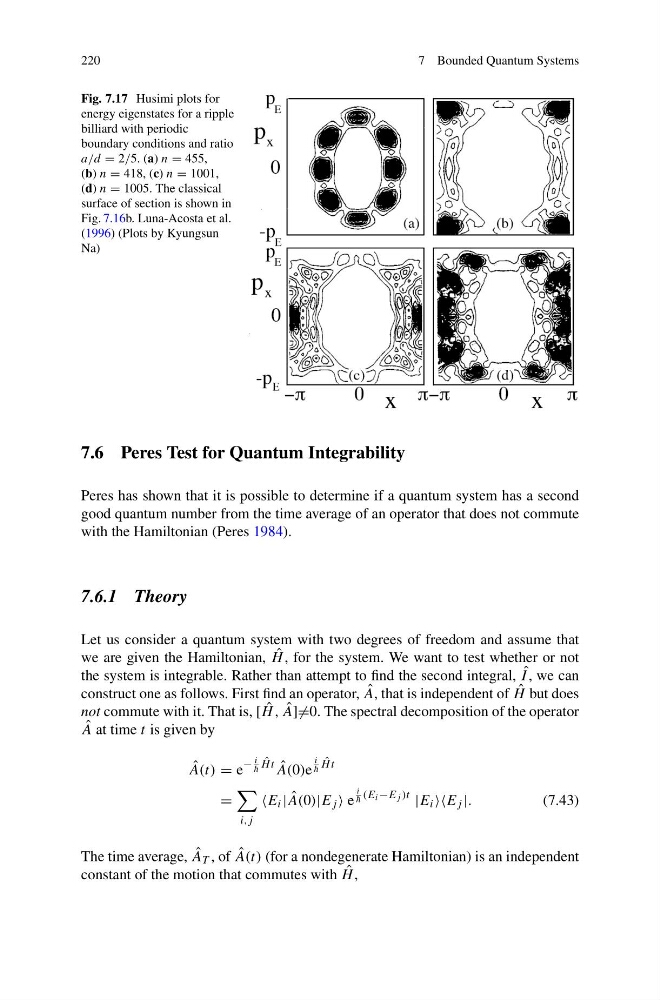
Fig. 7.17 Husimi plots for
energy eigenstates for a ripple
billiard with periodic
boundary conditions and ratio
a/d = 2/5. (a) n = 455,
(b) n = 418, (c) n = 1001,
(d) n = 1005. The classical
surface of section is shown in
Fig. 7.16b. Luna-Acosta et al.
(1996) (Plots by Kyungsun
Na)
7.6 Peres Test for Quantum Integrability
Peres has shown that it is possible to determine if a quantum system has a second
good quantum number from the time average of an operator that does not commute
with the Hamiltonian (Peres 1984).
7.6.1 Theory
Let us consider a quantum system with two degrees of freedom and assume that
we are given the Hamiltonian, ˆ
H , for the system. We want to test whether or not
the system is integrable. Rather than attempt to find the second integral, ˆ
I , we can
construct one as follows. First find an operator, ˆ
A, that is independent of ˆ
H but does
not commute with it. That is, [ ˆ
H , ˆ
A] =0. The spectral decomposition of the operator
ˆ
A at time t is given by
ˆ
A(t) = e
−
i
¯
h
ˆ
H t ˆ
A(0)e
i
¯
h
ˆ
H t
=
i,j
i | ˆ
A(0)|E j e
i
¯
h (E i −E j )t |E i j |.
(7.43)
The time average, ˆ
A T , of ˆ
A(t) (for a nondegenerate Hamiltonian) is an independent
constant of the motion that commutes with ˆ
H ,
7 Bounded Quantum Systems
Fig. 7.17 Husimi plots for
energy eigenstates for a ripple
billiard with periodic
boundary conditions and ratio
a/d = 2/5. (a) n = 455,
(b) n = 418, (c) n = 1001,
(d) n = 1005. The classical
surface of section is shown in
Fig. 7.16b. Luna-Acosta et al.
(1996) (Plots by Kyungsun
Na)
7.6 Peres Test for Quantum Integrability
Peres has shown that it is possible to determine if a quantum system has a second
good quantum number from the time average of an operator that does not commute
with the Hamiltonian (Peres 1984).
7.6.1 Theory
Let us consider a quantum system with two degrees of freedom and assume that
we are given the Hamiltonian, ˆ
H , for the system. We want to test whether or not
the system is integrable. Rather than attempt to find the second integral, ˆ
I , we can
construct one as follows. First find an operator, ˆ
A, that is independent of ˆ
H but does
not commute with it. That is, [ ˆ
H , ˆ
A] =0. The spectral decomposition of the operator
ˆ
A at time t is given by
ˆ
A(t) = e
−
i
¯
h
ˆ
H t ˆ
A(0)e
i
¯
h
ˆ
H t
=
i,j
i | ˆ
A(0)|E j e
i
¯
h (E i −E j )t |E i j |.
(7.43)
The time average, ˆ
A T , of ˆ
A(t) (for a nondegenerate Hamiltonian) is an independent
constant of the motion that commutes with ˆ
H ,