

7.5 Quantum Billiards
215
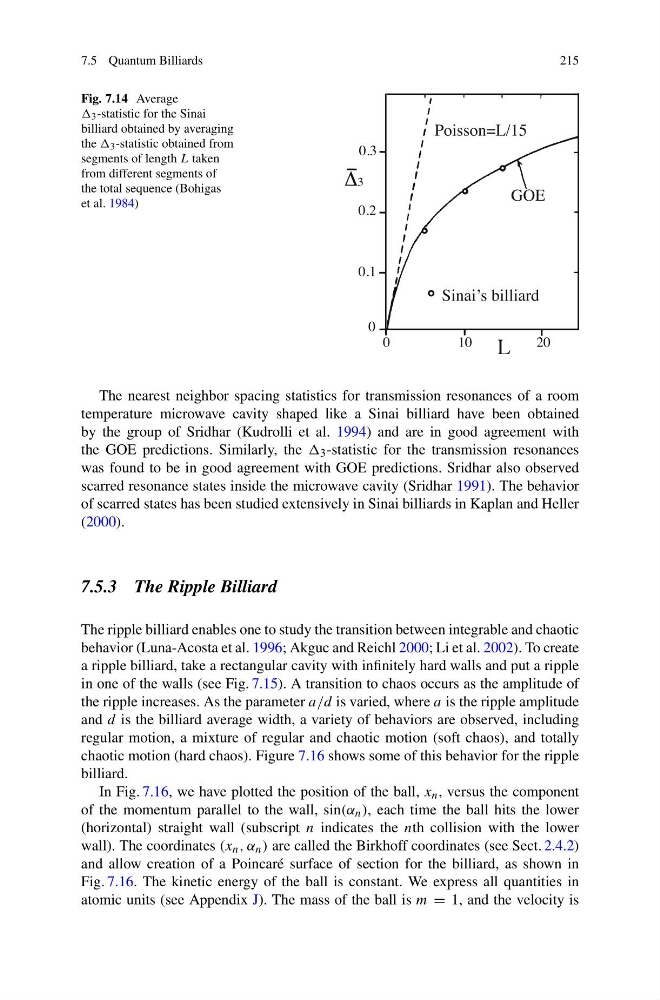
Fig. 7.14 Average
3 -statistic for the Sinai
billiard obtained by averaging
the 3 -statistic obtained from
segments of length L taken
from different segments of
the total sequence (Bohigas
et al. 1984)
The nearest neighbor spacing statistics for transmission resonances of a room
temperature microwave cavity shaped like a Sinai billiard have been obtained
by the group of Sridhar (Kudrolli et al. 1994) and are in good agreement with
the GOE predictions. Similarly, the 3 -statistic for the transmission resonances
was found to be in good agreement with GOE predictions. Sridhar also observed
scarred resonance states inside the microwave cavity (Sridhar 1991). The behavior
of scarred states has been studied extensively in Sinai billiards in Kaplan and Heller
(2000).
7.5.3 The Ripple Billiard
The ripple billiard enables one to study the transition between integrable and chaotic
behavior (Luna-Acosta et al. 1996; Akguc and Reichl 2000; Li et al. 2002). To create
a ripple billiard, take a rectangular cavity with infinitely hard walls and put a ripple
in one of the walls (see Fig. 7.15). A transition to chaos occurs as the amplitude of
the ripple increases. As the parameter a/d is varied, where a is the ripple amplitude
and d is the billiard average width, a variety of behaviors are observed, including
regular motion, a mixture of regular and chaotic motion (soft chaos), and totally
chaotic motion (hard chaos). Figure 7.16 shows some of this behavior for the ripple
billiard.
In Fig. 7.16, we have plotted the position of the ball, x n , versus the component
of the momentum parallel to the wall, sin(α n ), each time the ball hits the lower
(horizontal) straight wall (subscript n indicates the nth collision with the lower
wall). The coordinates (x n , α n ) are called the Birkhoff coordinates (see Sect. 2.4.2)
and allow creation of a Poincaré surface of section for the billiard, as shown in
Fig. 7.16. The kinetic energy of the ball is constant. We express all quantities in
atomic units (see Appendix J). The mass of the ball is m = 1, and the velocity is
215
Fig. 7.14 Average
3 -statistic for the Sinai
billiard obtained by averaging
the 3 -statistic obtained from
segments of length L taken
from different segments of
the total sequence (Bohigas
et al. 1984)
The nearest neighbor spacing statistics for transmission resonances of a room
temperature microwave cavity shaped like a Sinai billiard have been obtained
by the group of Sridhar (Kudrolli et al. 1994) and are in good agreement with
the GOE predictions. Similarly, the 3 -statistic for the transmission resonances
was found to be in good agreement with GOE predictions. Sridhar also observed
scarred resonance states inside the microwave cavity (Sridhar 1991). The behavior
of scarred states has been studied extensively in Sinai billiards in Kaplan and Heller
(2000).
7.5.3 The Ripple Billiard
The ripple billiard enables one to study the transition between integrable and chaotic
behavior (Luna-Acosta et al. 1996; Akguc and Reichl 2000; Li et al. 2002). To create
a ripple billiard, take a rectangular cavity with infinitely hard walls and put a ripple
in one of the walls (see Fig. 7.15). A transition to chaos occurs as the amplitude of
the ripple increases. As the parameter a/d is varied, where a is the ripple amplitude
and d is the billiard average width, a variety of behaviors are observed, including
regular motion, a mixture of regular and chaotic motion (soft chaos), and totally
chaotic motion (hard chaos). Figure 7.16 shows some of this behavior for the ripple
billiard.
In Fig. 7.16, we have plotted the position of the ball, x n , versus the component
of the momentum parallel to the wall, sin(α n ), each time the ball hits the lower
(horizontal) straight wall (subscript n indicates the nth collision with the lower
wall). The coordinates (x n , α n ) are called the Birkhoff coordinates (see Sect. 2.4.2)
and allow creation of a Poincaré surface of section for the billiard, as shown in
Fig. 7.16. The kinetic energy of the ball is constant. We express all quantities in
atomic units (see Appendix J). The mass of the ball is m = 1, and the velocity is