

216
7 Bounded Quantum Systems
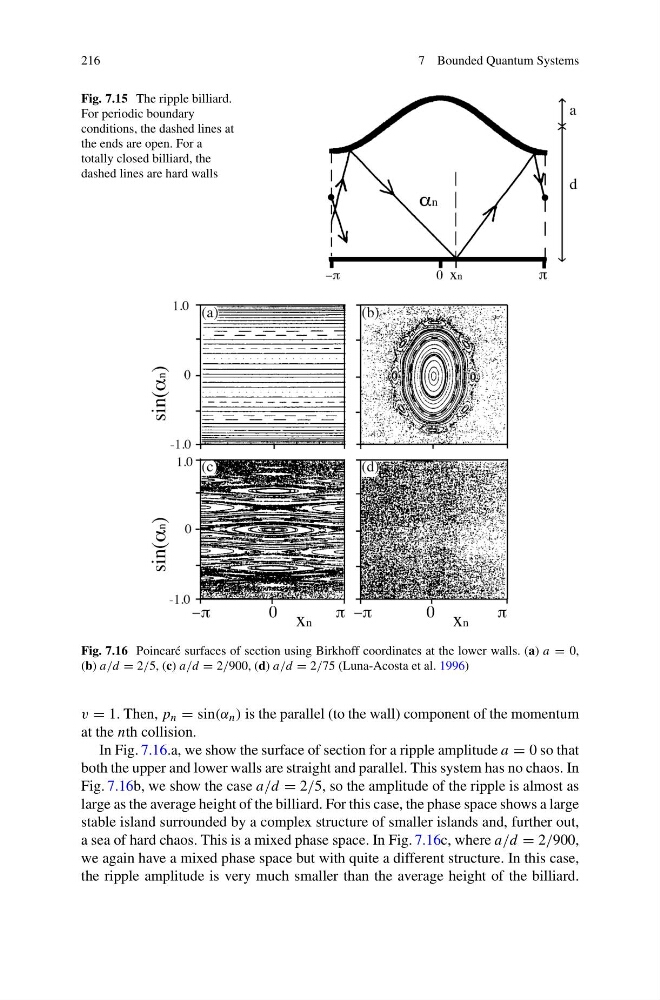
Fig. 7.15 The ripple billiard.
For periodic boundary
conditions, the dashed lines at
the ends are open. For a
totally closed billiard, the
dashed lines are hard walls
Fig. 7.16 Poincaré surfaces of section using Birkhoff coordinates at the lower walls. (a) a = 0,
(b) a/d = 2/5, (c) a/d = 2/900, (d) a/d = 2/75 (Luna-Acosta et al. 1996)
v = 1. Then, p n = sin(α n ) is the parallel (to the wall) component of the momentum
at the nth collision.
In Fig. 7.16.a, we show the surface of section for a ripple amplitude a = 0 so that
both the upper and lower walls are straight and parallel. This system has no chaos. In
Fig. 7.16b, we show the case a/d = 2/5, so the amplitude of the ripple is almost as
large as the average height of the billiard. For this case, the phase space shows a large
stable island surrounded by a complex structure of smaller islands and, further out,
a sea of hard chaos. This is a mixed phase space. In Fig. 7.16c, where a/d = 2/900,
we again have a mixed phase space but with quite a different structure. In this case,
the ripple amplitude is very much smaller than the average height of the billiard.
7 Bounded Quantum Systems
Fig. 7.15 The ripple billiard.
For periodic boundary
conditions, the dashed lines at
the ends are open. For a
totally closed billiard, the
dashed lines are hard walls
Fig. 7.16 Poincaré surfaces of section using Birkhoff coordinates at the lower walls. (a) a = 0,
(b) a/d = 2/5, (c) a/d = 2/900, (d) a/d = 2/75 (Luna-Acosta et al. 1996)
v = 1. Then, p n = sin(α n ) is the parallel (to the wall) component of the momentum
at the nth collision.
In Fig. 7.16.a, we show the surface of section for a ripple amplitude a = 0 so that
both the upper and lower walls are straight and parallel. This system has no chaos. In
Fig. 7.16b, we show the case a/d = 2/5, so the amplitude of the ripple is almost as
large as the average height of the billiard. For this case, the phase space shows a large
stable island surrounded by a complex structure of smaller islands and, further out,
a sea of hard chaos. This is a mixed phase space. In Fig. 7.16c, where a/d = 2/900,
we again have a mixed phase space but with quite a different structure. In this case,
the ripple amplitude is very much smaller than the average height of the billiard.