

184
6 Quantum Dynamics and Random Matrix Theory
Some General Properties
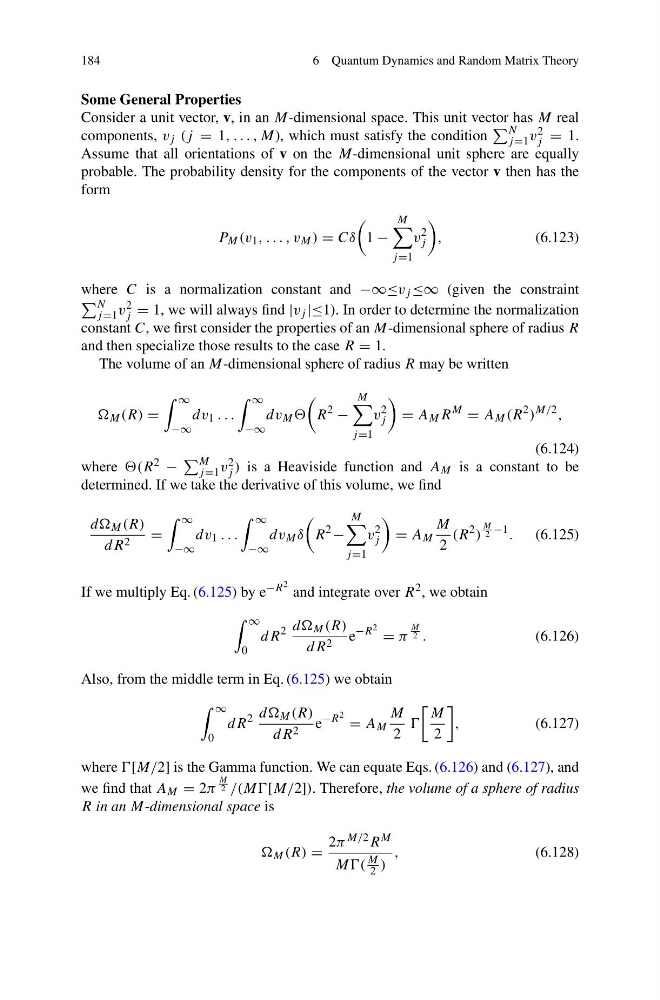
Consider a unit vector, v, in an M-dimensional space. This unit vector has M real
components, v j (j = 1, . . . , M), which must satisfy the condition
N
j =1 v 2
j = 1.
Assume that all orientations of v on the M-dimensional unit sphere are equally
probable. The probability density for the components of the vector v then has the
form
P M (v 1 , . . . , v M ) = Cδ
1 −
M
j =1
v
2
j
,
(6.123)
where C is a normalization constant and −∞≤v j ≤∞ (given the constraint
N
j =1 v 2
j = 1, we will always find |v j |≤1). In order to determine the normalization
constant C, we first consider the properties of an M-dimensional sphere of radius R
and then specialize those results to the case R = 1.
The volume of an M-dimensional sphere of radius R may be written
M (R) =
∞
−∞
dv 1 . . .
∞
−∞
dv M
R
2
−
M
j =1
v
2
j
= A M R
M
= A M (R
2 )
M/2 ,
(6.124)
where (R 2 −
M
j =1 v 2
j ) is a Heaviside function and A M is a constant to be
determined. If we take the derivative of this volume, we find
dd M (R)
dR 2 =
∞
−∞
dv 1 . . .
∞
−∞
dv M δ
R
2
−
M
j =1
v
2
j
= A M
M
2
(R
2 )
M
2 −1 .
(6.125)
If we multiply Eq. (6.125) by e −R 2 and integrate over R 2 , we obtain
∞
0
dR
2 dd M (R)
dR 2 e
−R 2 = π
M
2 .
(6.126)
Also, from the middle term in Eq. (6.125) we obtain
∞
0
dR
2 dd M (R)
dR 2 e
−R 2 = A M
M
2
M
2
,
(6.127)
where [M/2] is the Gamma function. We can equate Eqs. (6.126) and (6.127), and
we find that A M = 2π
M
2 /(MM[M/2]). Therefore, the volume of a sphere of radius
R in an M-dimensional space is
M (R) =
2π M/2 R M
MM(
M
2 )
,
(6.128)
6 Quantum Dynamics and Random Matrix Theory
Some General Properties
Consider a unit vector, v, in an M-dimensional space. This unit vector has M real
components, v j (j = 1, . . . , M), which must satisfy the condition
N
j =1 v 2
j = 1.
Assume that all orientations of v on the M-dimensional unit sphere are equally
probable. The probability density for the components of the vector v then has the
form
P M (v 1 , . . . , v M ) = Cδ
1 −
M
j =1
v
2
j
,
(6.123)
where C is a normalization constant and −∞≤v j ≤∞ (given the constraint
N
j =1 v 2
j = 1, we will always find |v j |≤1). In order to determine the normalization
constant C, we first consider the properties of an M-dimensional sphere of radius R
and then specialize those results to the case R = 1.
The volume of an M-dimensional sphere of radius R may be written
M (R) =
∞
−∞
dv 1 . . .
∞
−∞
dv M
R
2
−
M
j =1
v
2
j
= A M R
M
= A M (R
2 )
M/2 ,
(6.124)
where (R 2 −
M
j =1 v 2
j ) is a Heaviside function and A M is a constant to be
determined. If we take the derivative of this volume, we find
dd M (R)
dR 2 =
∞
−∞
dv 1 . . .
∞
−∞
dv M δ
R
2
−
M
j =1
v
2
j
= A M
M
2
(R
2 )
M
2 −1 .
(6.125)
If we multiply Eq. (6.125) by e −R 2 and integrate over R 2 , we obtain
∞
0
dR
2 dd M (R)
dR 2 e
−R 2 = π
M
2 .
(6.126)
Also, from the middle term in Eq. (6.125) we obtain
∞
0
dR
2 dd M (R)
dR 2 e
−R 2 = A M
M
2
M
2
,
(6.127)
where [M/2] is the Gamma function. We can equate Eqs. (6.126) and (6.127), and
we find that A M = 2π
M
2 /(MM[M/2]). Therefore, the volume of a sphere of radius
R in an M-dimensional space is
M (R) =
2π M/2 R M
MM(
M
2 )
,
(6.128)