

6.5 Eigenvector Statistics: Gaussian Orthogonal Ensemble
183
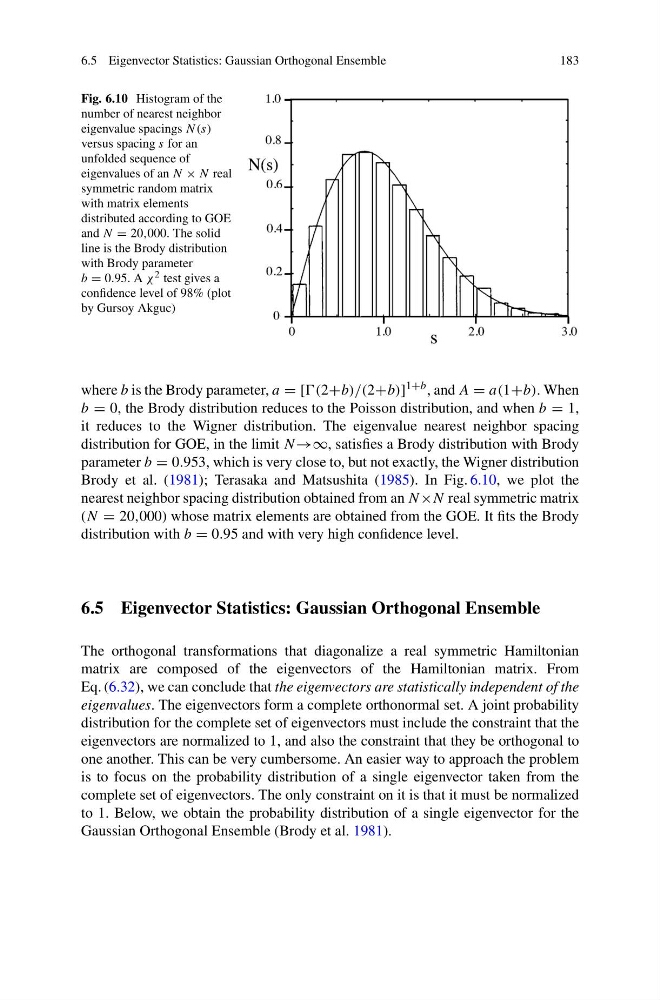
Fig. 6.10 Histogram of the
number of nearest neighbor
eigenvalue spacings N(s)
versus spacing s for an
unfolded sequence of
eigenvalues of an N × N real
symmetric random matrix
with matrix elements
distributed according to GOE
and N = 20,000. The solid
line is the Brody distribution
with Brody parameter
b = 0.95. A χ 2 test gives a
confidence level of 98% (plot
by Gursoy Akguc)
where b is the Brody parameter, a = [ 1+b , and A = a(1+b). When
b = 0, the Brody distribution reduces to the Poisson distribution, and when b = 1,
it reduces to the Wigner distribution. The eigenvalue nearest neighbor spacing
distribution for GOE, in the limit N →∞, satisfies a Brody distribution with Brody
parameter b = 0.953, which is very close to, but not exactly, the Wigner distribution
Brody et al. (1981); Terasaka and Matsushita (1985). In Fig. 6.10, we plot the
nearest neighbor spacing distribution obtained from an N×N real symmetric matrix
(N = 20,000) whose matrix elements are obtained from the GOE. It fits the Brody
distribution with b = 0.95 and with very high confidence level.
6.5 Eigenvector Statistics: Gaussian Orthogonal Ensemble
The orthogonal transformations that diagonalize a real symmetric Hamiltonian
matrix are composed of the eigenvectors of the Hamiltonian matrix. From
Eq. (6.32), we can conclude that the eigenvectors are statistically independent of the
eigenvalues. The eigenvectors form a complete orthonormal set. A joint probability
distribution for the complete set of eigenvectors must include the constraint that the
eigenvectors are normalized to 1, and also the constraint that they be orthogonal to
one another. This can be very cumbersome. An easier way to approach the problem
is to focus on the probability distribution of a single eigenvector taken from the
complete set of eigenvectors. The only constraint on it is that it must be normalized
to 1. Below, we obtain the probability distribution of a single eigenvector for the
Gaussian Orthogonal Ensemble (Brody et al. 1981).
183
Fig. 6.10 Histogram of the
number of nearest neighbor
eigenvalue spacings N(s)
versus spacing s for an
unfolded sequence of
eigenvalues of an N × N real
symmetric random matrix
with matrix elements
distributed according to GOE
and N = 20,000. The solid
line is the Brody distribution
with Brody parameter
b = 0.95. A χ 2 test gives a
confidence level of 98% (plot
by Gursoy Akguc)
where b is the Brody parameter, a = [ 1+b , and A = a(1+b). When
b = 0, the Brody distribution reduces to the Poisson distribution, and when b = 1,
it reduces to the Wigner distribution. The eigenvalue nearest neighbor spacing
distribution for GOE, in the limit N →∞, satisfies a Brody distribution with Brody
parameter b = 0.953, which is very close to, but not exactly, the Wigner distribution
Brody et al. (1981); Terasaka and Matsushita (1985). In Fig. 6.10, we plot the
nearest neighbor spacing distribution obtained from an N×N real symmetric matrix
(N = 20,000) whose matrix elements are obtained from the GOE. It fits the Brody
distribution with b = 0.95 and with very high confidence level.
6.5 Eigenvector Statistics: Gaussian Orthogonal Ensemble
The orthogonal transformations that diagonalize a real symmetric Hamiltonian
matrix are composed of the eigenvectors of the Hamiltonian matrix. From
Eq. (6.32), we can conclude that the eigenvectors are statistically independent of the
eigenvalues. The eigenvectors form a complete orthonormal set. A joint probability
distribution for the complete set of eigenvectors must include the constraint that the
eigenvectors are normalized to 1, and also the constraint that they be orthogonal to
one another. This can be very cumbersome. An easier way to approach the problem
is to focus on the probability distribution of a single eigenvector taken from the
complete set of eigenvectors. The only constraint on it is that it must be normalized
to 1. Below, we obtain the probability distribution of a single eigenvector for the
Gaussian Orthogonal Ensemble (Brody et al. 1981).