

182
6 Quantum Dynamics and Random Matrix Theory
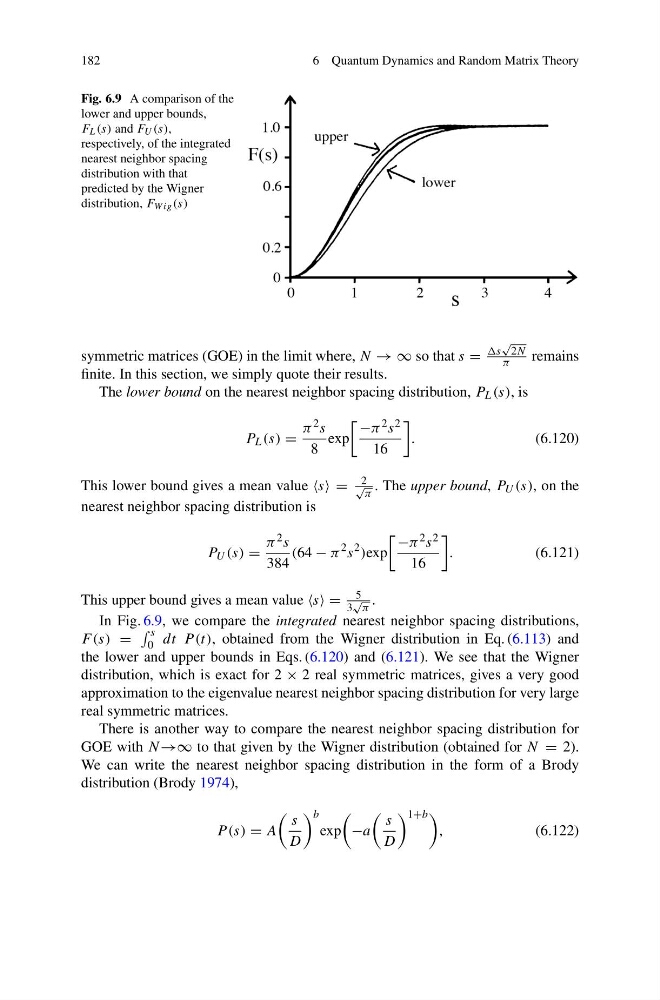
Fig. 6.9 A comparison of the
lower and upper bounds,
F L (s) and F U (s),
respectively, of the integrated
nearest neighbor spacing
distribution with that
predicted by the Wigner
distribution, F W ig (s)
symmetric matrices (GOE) in the limit where, N → ∞ so that s =
√
2N
π
remains
finite. In this section, we simply quote their results.
The lower bound on the nearest neighbor spacing distribution, P L (s), is
P L (s) =
π 2 s
8
exp
−π 2 s 2
16
.
(6.120)
This lower bound gives a mean value =
2
√
π
. The upper bound, P U (s), on the
nearest neighbor spacing distribution is
P U (s) =
π 2 s
384
(64 − π
2 s
2 )exp
−π 2 s 2
16
.
(6.121)
This upper bound gives a mean value =
5
3
√
π
.
In Fig. 6.9, we compare the integrated nearest neighbor spacing distributions,
F (s) =
s
0 dt P (t), obtained from the Wigner distribution in Eq. (6.113) and
the lower and upper bounds in Eqs. (6.120) and (6.121). We see that the Wigner
distribution, which is exact for 2 × 2 real symmetric matrices, gives a very good
approximation to the eigenvalue nearest neighbor spacing distribution for very large
real symmetric matrices.
There is another way to compare the nearest neighbor spacing distribution for
GOE with N→∞ to that given by the Wigner distribution (obtained for N = 2).
We can write the nearest neighbor spacing distribution in the form of a Brody
distribution (Brody 1974),
P (s) = A
s
D
b
exp
−a
s
D
1+b
,
(6.122)
6 Quantum Dynamics and Random Matrix Theory
Fig. 6.9 A comparison of the
lower and upper bounds,
F L (s) and F U (s),
respectively, of the integrated
nearest neighbor spacing
distribution with that
predicted by the Wigner
distribution, F W ig (s)
symmetric matrices (GOE) in the limit where, N → ∞ so that s =
√
2N
π
remains
finite. In this section, we simply quote their results.
The lower bound on the nearest neighbor spacing distribution, P L (s), is
P L (s) =
π 2 s
8
exp
−π 2 s 2
16
.
(6.120)
This lower bound gives a mean value =
2
√
π
. The upper bound, P U (s), on the
nearest neighbor spacing distribution is
P U (s) =
π 2 s
384
(64 − π
2 s
2 )exp
−π 2 s 2
16
.
(6.121)
This upper bound gives a mean value =
5
3
√
π
.
In Fig. 6.9, we compare the integrated nearest neighbor spacing distributions,
F (s) =
s
0 dt P (t), obtained from the Wigner distribution in Eq. (6.113) and
the lower and upper bounds in Eqs. (6.120) and (6.121). We see that the Wigner
distribution, which is exact for 2 × 2 real symmetric matrices, gives a very good
approximation to the eigenvalue nearest neighbor spacing distribution for very large
real symmetric matrices.
There is another way to compare the nearest neighbor spacing distribution for
GOE with N→∞ to that given by the Wigner distribution (obtained for N = 2).
We can write the nearest neighbor spacing distribution in the form of a Brody
distribution (Brody 1974),
P (s) = A
s
D
b
exp
−a
s
D
1+b
,
(6.122)