

6.4 Eigenvalue Statistics: Gaussian Orthogonal Ensemble
173
The 3 -statistic depends only on two-body correlations between eigenvalues.
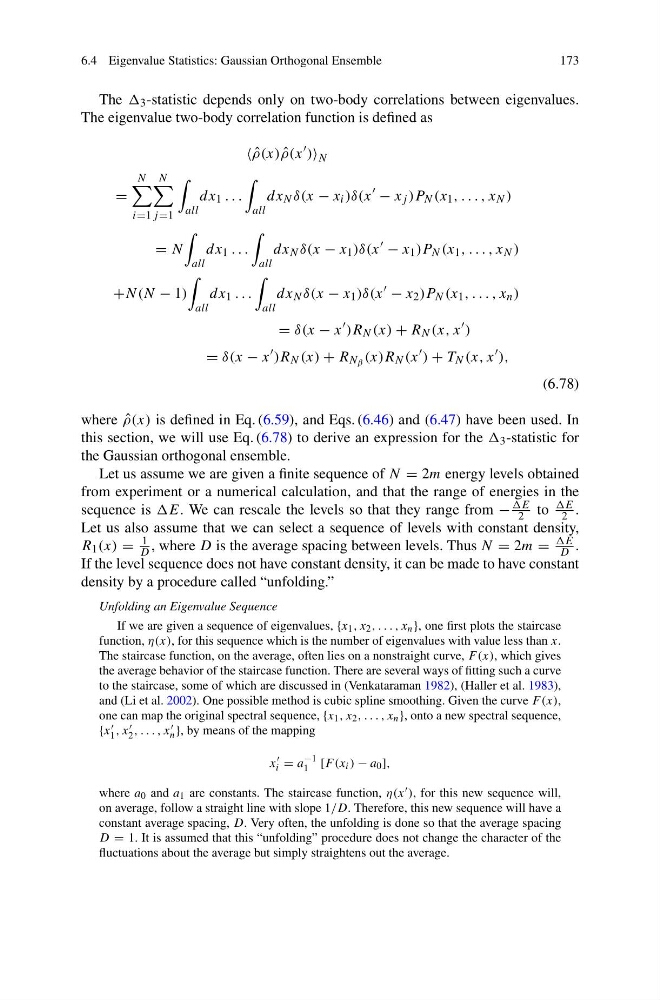
The eigenvalue two-body correlation function is defined as
ˆ
ρ(x) ˆ
ρ(x
) N
=
N
i=1
N
j =1
all
dx 1 . . .
all
dx N δ(x − x i )δ(x
− x j )P N (x 1 , . . . , x N )
= N
all
dx 1 . . .
all
dx N δ(x − x 1 )δ(x
− x 1 )P N (x 1 , . . . , x N )
+N(N − 1)
all
dx 1 . . .
all
dx N δ(x − x 1 )δ(x
− x 2 )P N (x 1 , . . . , x n )
= δ(x − x
)R N (x) + R N (x, x
)
= δ(x − x
)R N (x) + R N β (x)R N (x
) + T N (x, x
),
(6.78)
where ˆ
ρ(x) is defined in Eq. (6.59), and Eqs. (6.46) and (6.47) have been used. In
this section, we will use Eq. (6.78) to derive an expression for the 3 -statistic for
the Gaussian orthogonal ensemble.
Let us assume we are given a finite sequence of N = 2m energy levels obtained
from experiment or a numerical calculation, and that the range of energies in the
sequence is E. We can rescale the levels so that they range from −
E
2 to
E
2 .
Let us also assume that we can select a sequence of levels with constant density,
R 1 (x) =
1
D , where D is the average spacing between levels. Thus N = 2m =
E
D .
If the level sequence does not have constant density, it can be made to have constant
density by a procedure called “unfolding.”
Unfolding an Eigenvalue Sequence
If we are given a sequence of eigenvalues, {x 1 , x 2 , . . . , x n }, one first plots the staircase
function, η(x), for this sequence which is the number of eigenvalues with value less than x.
The staircase function, on the average, often lies on a nonstraight curve, F (x), which gives
the average behavior of the staircase function. There are several ways of fitting such a curve
to the staircase, some of which are discussed in (Venkataraman 1982), (Haller et al. 1983),
and (Li et al. 2002). One possible method is cubic spline smoothing. Given the curve F (x),
one can map the original spectral sequence, {x 1 , x 2 , . . . , x n }, onto a new spectral sequence,
{x
1 , x
2 , . . . , x
n }, by means of the mapping
x
i = a
−1
1 [F (x i ) − a 0 ],
where a 0 and a 1 are constants. The staircase function, η(x ), for this new sequence will,
on average, follow a straight line with slope 1/D. Therefore, this new sequence will have a
constant average spacing, D. Very often, the unfolding is done so that the average spacing
D = 1. It is assumed that this “unfolding” procedure does not change the character of the
fluctuations about the average but simply straightens out the average.
173
The 3 -statistic depends only on two-body correlations between eigenvalues.
The eigenvalue two-body correlation function is defined as
ˆ
ρ(x) ˆ
ρ(x
) N
=
N
i=1
N
j =1
all
dx 1 . . .
all
dx N δ(x − x i )δ(x
− x j )P N (x 1 , . . . , x N )
= N
all
dx 1 . . .
all
dx N δ(x − x 1 )δ(x
− x 1 )P N (x 1 , . . . , x N )
+N(N − 1)
all
dx 1 . . .
all
dx N δ(x − x 1 )δ(x
− x 2 )P N (x 1 , . . . , x n )
= δ(x − x
)R N (x) + R N (x, x
)
= δ(x − x
)R N (x) + R N β (x)R N (x
) + T N (x, x
),
(6.78)
where ˆ
ρ(x) is defined in Eq. (6.59), and Eqs. (6.46) and (6.47) have been used. In
this section, we will use Eq. (6.78) to derive an expression for the 3 -statistic for
the Gaussian orthogonal ensemble.
Let us assume we are given a finite sequence of N = 2m energy levels obtained
from experiment or a numerical calculation, and that the range of energies in the
sequence is E. We can rescale the levels so that they range from −
E
2 to
E
2 .
Let us also assume that we can select a sequence of levels with constant density,
R 1 (x) =
1
D , where D is the average spacing between levels. Thus N = 2m =
E
D .
If the level sequence does not have constant density, it can be made to have constant
density by a procedure called “unfolding.”
Unfolding an Eigenvalue Sequence
If we are given a sequence of eigenvalues, {x 1 , x 2 , . . . , x n }, one first plots the staircase
function, η(x), for this sequence which is the number of eigenvalues with value less than x.
The staircase function, on the average, often lies on a nonstraight curve, F (x), which gives
the average behavior of the staircase function. There are several ways of fitting such a curve
to the staircase, some of which are discussed in (Venkataraman 1982), (Haller et al. 1983),
and (Li et al. 2002). One possible method is cubic spline smoothing. Given the curve F (x),
one can map the original spectral sequence, {x 1 , x 2 , . . . , x n }, onto a new spectral sequence,
{x
1 , x
2 , . . . , x
n }, by means of the mapping
x
i = a
−1
1 [F (x i ) − a 0 ],
where a 0 and a 1 are constants. The staircase function, η(x ), for this new sequence will,
on average, follow a straight line with slope 1/D. Therefore, this new sequence will have a
constant average spacing, D. Very often, the unfolding is done so that the average spacing
D = 1. It is assumed that this “unfolding” procedure does not change the character of the
fluctuations about the average but simply straightens out the average.