

172
6 Quantum Dynamics and Random Matrix Theory
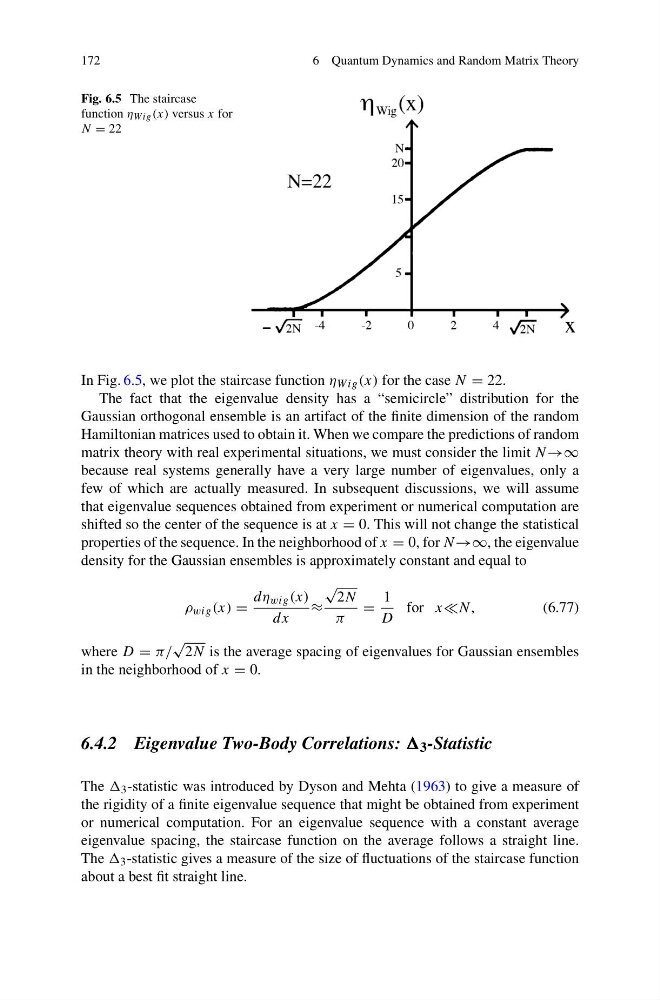
Fig. 6.5 The staircase
function η W ig (x) versus x for
N = 22
In Fig. 6.5, we plot the staircase function η W ig (x) for the case N = 22.
The fact that the eigenvalue density has a “semicircle” distribution for the
Gaussian orthogonal ensemble is an artifact of the finite dimension of the random
Hamiltonian matrices used to obtain it. When we compare the predictions of random
matrix theory with real experimental situations, we must consider the limit N →∞
because real systems generally have a very large number of eigenvalues, only a
few of which are actually measured. In subsequent discussions, we will assume
that eigenvalue sequences obtained from experiment or numerical computation are
shifted so the center of the sequence is at x = 0. This will not change the statistical
properties of the sequence. In the neighborhood of x = 0, for N →∞, the eigenvalue
density for the Gaussian ensembles is approximately constant and equal to
ρ wig (x) =
dη wig (x)
dx
≈
√
2N
π
=
1
D
for xN,
(6.77)
where D = π/
√
2N is the average spacing of eigenvalues for Gaussian ensembles
in the neighborhood of x = 0.
6.4.2 Eigenvalue Two-Body Correlations: 3 -Statistic
The 3 -statistic was introduced by Dyson and Mehta (1963) to give a measure of
the rigidity of a finite eigenvalue sequence that might be obtained from experiment
or numerical computation. For an eigenvalue sequence with a constant average
eigenvalue spacing, the staircase function on the average follows a straight line.
The 3 -statistic gives a measure of the size of fluctuations of the staircase function
about a best fit straight line.
6 Quantum Dynamics and Random Matrix Theory
Fig. 6.5 The staircase
function η W ig (x) versus x for
N = 22
In Fig. 6.5, we plot the staircase function η W ig (x) for the case N = 22.
The fact that the eigenvalue density has a “semicircle” distribution for the
Gaussian orthogonal ensemble is an artifact of the finite dimension of the random
Hamiltonian matrices used to obtain it. When we compare the predictions of random
matrix theory with real experimental situations, we must consider the limit N →∞
because real systems generally have a very large number of eigenvalues, only a
few of which are actually measured. In subsequent discussions, we will assume
that eigenvalue sequences obtained from experiment or numerical computation are
shifted so the center of the sequence is at x = 0. This will not change the statistical
properties of the sequence. In the neighborhood of x = 0, for N →∞, the eigenvalue
density for the Gaussian ensembles is approximately constant and equal to
ρ wig (x) =
dη wig (x)
dx
≈
√
2N
π
=
1
D
for xN,
(6.77)
where D = π/
√
2N is the average spacing of eigenvalues for Gaussian ensembles
in the neighborhood of x = 0.
6.4.2 Eigenvalue Two-Body Correlations: 3 -Statistic
The 3 -statistic was introduced by Dyson and Mehta (1963) to give a measure of
the rigidity of a finite eigenvalue sequence that might be obtained from experiment
or numerical computation. For an eigenvalue sequence with a constant average
eigenvalue spacing, the staircase function on the average follows a straight line.
The 3 -statistic gives a measure of the size of fluctuations of the staircase function
about a best fit straight line.