

6.3 Probability Density that Extremizes Information
165
where
r n =
∞
−∞
. . .
∞
−∞
R N (x 1 , . . . , x n )
n
i=1
a i dx i
.
(6.39)
The n-eigenvalue reduced joint probability densities are given by
R N (x
1 , x
2 , . . . , x
n ) =
1
n!
δ n R ∞ (1)
δa
1 δa
2 . . . δa
n
{a=0}
(6.40)
(where
δa i
δa
j
= δ x i ,x
j
) and contain all possible information about clusters of n
eigenvalues, even if the eigenvalues in a cluster are uncorrelated.
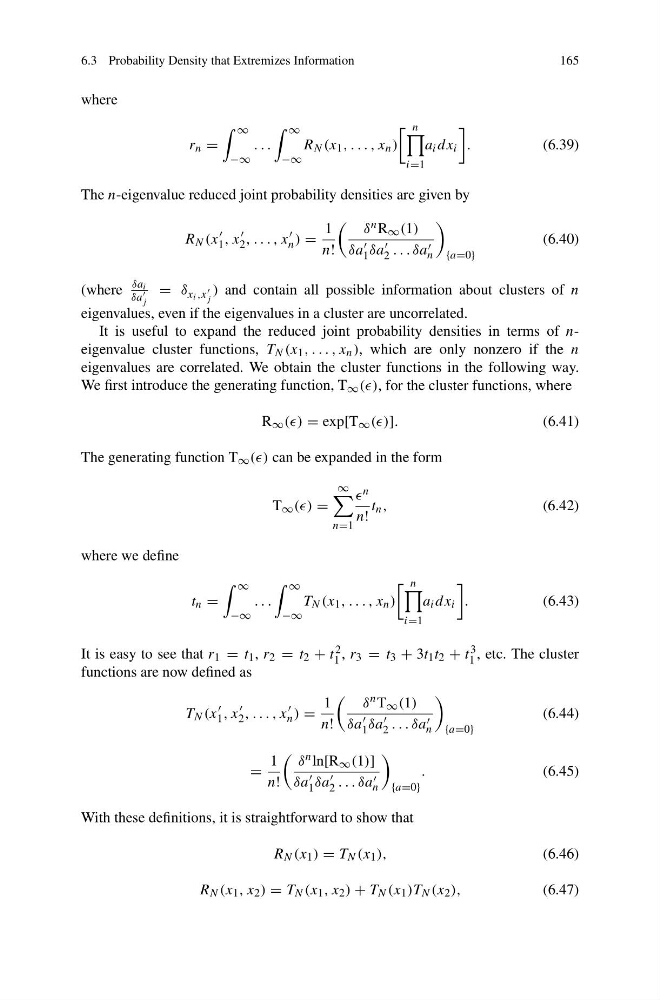
It is useful to expand the reduced joint probability densities in terms of neigenvalue cluster functions, T N (x 1 , . . . , x n ), which are only nonzero if the n
eigenvalues are correlated. We obtain the cluster functions in the following way.
We first introduce the generating function, T ∞ ((), for the cluster functions, where
R ∞ (() = exp[T ∞ (()].
(6.41)
The generating function T ∞ (() can be expanded in the form
T ∞ (() =
∞
n=1
n
n!
t n ,
(6.42)
where we define
t n =
∞
−∞
. . .
∞
−∞
T N (x 1 , . . . , x n )
n
i=1
a i dx i
.
(6.43)
It is easy to see that r 1 = t 1 , r 2 = t 2 + t 2
1 , r 3 = t 3 + 3t 1 t 2 + t 3
1 , etc. The cluster
functions are now defined as
T N (x
1 , x
2 , . . . , x
n ) =
1
n!
δ n T ∞ (1)
δa
1 δa
2 . . . δa
n
{a=0}
(6.44)
=
1
n!
δ n ln[R ∞ (1)]
δa
1 δa
2 . . . δa
n
{a=0}
.
(6.45)
With these definitions, it is straightforward to show that
R N (x 1 ) = T N (x 1 ),
(6.46)
R N (x 1 , x 2 ) = T N (x 1 , x 2 ) + T N (x 1 )T N (x 2 ),
(6.47)
165
where
r n =
∞
−∞
. . .
∞
−∞
R N (x 1 , . . . , x n )
n
i=1
a i dx i
.
(6.39)
The n-eigenvalue reduced joint probability densities are given by
R N (x
1 , x
2 , . . . , x
n ) =
1
n!
δ n R ∞ (1)
δa
1 δa
2 . . . δa
n
{a=0}
(6.40)
(where
δa i
δa
j
= δ x i ,x
j
) and contain all possible information about clusters of n
eigenvalues, even if the eigenvalues in a cluster are uncorrelated.
It is useful to expand the reduced joint probability densities in terms of neigenvalue cluster functions, T N (x 1 , . . . , x n ), which are only nonzero if the n
eigenvalues are correlated. We obtain the cluster functions in the following way.
We first introduce the generating function, T ∞ ((), for the cluster functions, where
R ∞ (() = exp[T ∞ (()].
(6.41)
The generating function T ∞ (() can be expanded in the form
T ∞ (() =
∞
n=1
n
n!
t n ,
(6.42)
where we define
t n =
∞
−∞
. . .
∞
−∞
T N (x 1 , . . . , x n )
n
i=1
a i dx i
.
(6.43)
It is easy to see that r 1 = t 1 , r 2 = t 2 + t 2
1 , r 3 = t 3 + 3t 1 t 2 + t 3
1 , etc. The cluster
functions are now defined as
T N (x
1 , x
2 , . . . , x
n ) =
1
n!
δ n T ∞ (1)
δa
1 δa
2 . . . δa
n
{a=0}
(6.44)
=
1
n!
δ n ln[R ∞ (1)]
δa
1 δa
2 . . . δa
n
{a=0}
.
(6.45)
With these definitions, it is straightforward to show that
R N (x 1 ) = T N (x 1 ),
(6.46)
R N (x 1 , x 2 ) = T N (x 1 , x 2 ) + T N (x 1 )T N (x 2 ),
(6.47)