

164
6 Quantum Dynamics and Random Matrix Theory
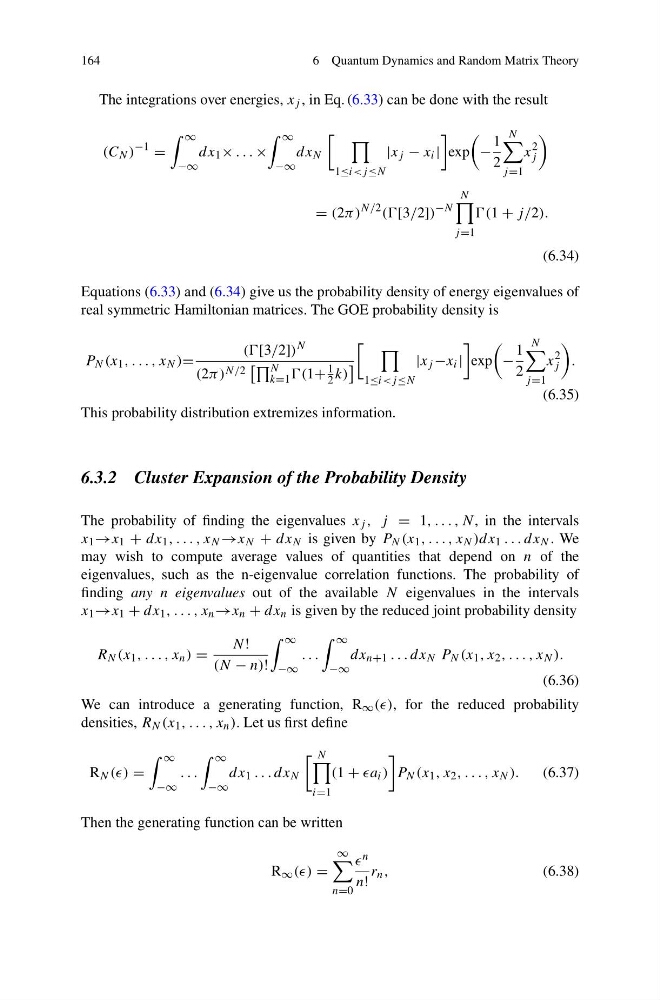
The integrations over energies, x j , in Eq. (6.33) can be done with the result
(C N )
−1
=
∞
−∞
dx 1 × . . . ×
∞
−∞
dx N
1≤i
exp
−
1
2
N
j =1
x
2
j
= (2π)
N/2 (([3/2])
−N
N
j =1
(1 + j/2).
(6.34)
Equations (6.33) and (6.34) give us the probability density of energy eigenvalues of
real symmetric Hamiltonian matrices. The GOE probability density is
P N (x 1 , . . . , x N )=
([3/2])
N
(2π) N/2
N
k=1 (1+
1
2 k)
1≤i
exp
−
1
2
N
j =1
x
2
j
.
(6.35)
This probability distribution extremizes information.
6.3.2 Cluster Expansion of the Probability Density
The probability of finding the eigenvalues x j , j = 1, . . . , N, in the intervals
x 1 →x 1 + dx 1 , . . . , x N →x N + dx N is given by P N (x 1 , . . . , x N )dx 1 . . . dx N . We
may wish to compute average values of quantities that depend on n of the
eigenvalues, such as the n-eigenvalue correlation functions. The probability of
finding any n eigenvalues out of the available N eigenvalues in the intervals
x 1 →x 1 + dx 1 , . . . , x n →x n + dx n is given by the reduced joint probability density
R N (x 1 , . . . , x n ) =
N!
(N − n)!
∞
−∞
. . .
∞
−∞
dx n+1 . . . dx N P N (x 1 , x 2 , . . . , x N ).
(6.36)
We can introduce a generating function, R ∞ ((), for the reduced probability
densities, R N (x 1 , . . . , x n ). Let us first define
R N (() =
∞
−∞
. . .
∞
−∞
dx 1 . . . dx N
N
i=1
(1 + a i )
P N (x 1 , x 2 , . . . , x N ).
(6.37)
Then the generating function can be written
R ∞ (() =
∞
n=0
n
n!
r n ,
(6.38)
6 Quantum Dynamics and Random Matrix Theory
The integrations over energies, x j , in Eq. (6.33) can be done with the result
(C N )
−1
=
∞
−∞
dx 1 × . . . ×
∞
−∞
dx N
1≤i
exp
−
1
2
N
j =1
x
2
j
= (2π)
N/2 (([3/2])
−N
N
j =1
(1 + j/2).
(6.34)
Equations (6.33) and (6.34) give us the probability density of energy eigenvalues of
real symmetric Hamiltonian matrices. The GOE probability density is
P N (x 1 , . . . , x N )=
([3/2])
N
(2π) N/2
N
k=1 (1+
1
2 k)
1≤i
exp
−
1
2
N
j =1
x
2
j
.
(6.35)
This probability distribution extremizes information.
6.3.2 Cluster Expansion of the Probability Density
The probability of finding the eigenvalues x j , j = 1, . . . , N, in the intervals
x 1 →x 1 + dx 1 , . . . , x N →x N + dx N is given by P N (x 1 , . . . , x N )dx 1 . . . dx N . We
may wish to compute average values of quantities that depend on n of the
eigenvalues, such as the n-eigenvalue correlation functions. The probability of
finding any n eigenvalues out of the available N eigenvalues in the intervals
x 1 →x 1 + dx 1 , . . . , x n →x n + dx n is given by the reduced joint probability density
R N (x 1 , . . . , x n ) =
N!
(N − n)!
∞
−∞
. . .
∞
−∞
dx n+1 . . . dx N P N (x 1 , x 2 , . . . , x N ).
(6.36)
We can introduce a generating function, R ∞ ((), for the reduced probability
densities, R N (x 1 , . . . , x n ). Let us first define
R N (() =
∞
−∞
. . .
∞
−∞
dx 1 . . . dx N
N
i=1
(1 + a i )
P N (x 1 , x 2 , . . . , x N ).
(6.37)
Then the generating function can be written
R ∞ (() =
∞
n=0
n
n!
r n ,
(6.38)