

6.3 Probability Density that Extremizes Information
163
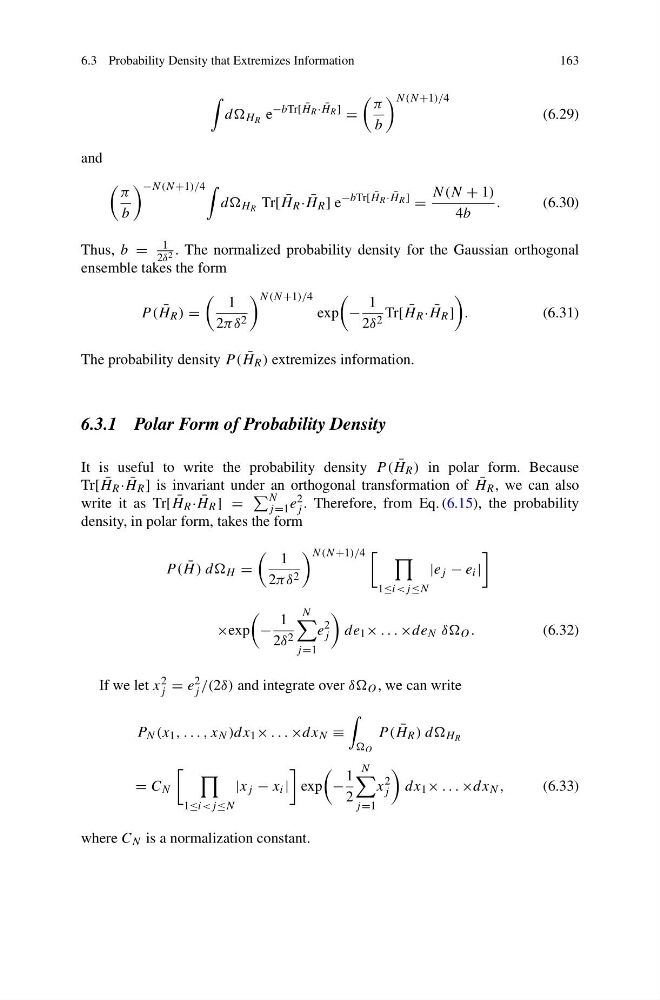
dd H R e
−bTr[ ¯
H R · ¯
H R ]
=
π
b
N(N+1)/4
(6.29)
and
π
b
−N(N+1)/4
dd H R Tr[ ¯
H R · ¯
H R ] e
−bTr[ ¯
H R · ¯
H R ]
=
N(N + 1)
4b
.
(6.30)
Thus, b =
1
2δ 2 . The normalized probability density for the Gaussian orthogonal
ensemble takes the form
P ( ¯
H R ) =
1
2πδ 2
N(N+1)/4
exp
−
1
2δ 2 Tr[ ¯
H R · ¯
H R ]
.
(6.31)
The probability density P ( ¯
H R ) extremizes information.
6.3.1 Polar Form of Probability Density
It is useful to write the probability density P ( ¯
H R ) in polar form. Because
Tr[ ¯
H R · ¯
H R ] is invariant under an orthogonal transformation of ¯
H R , we can also
write it as Tr[ ¯
H R · ¯
H R ] =
N
j =1 e 2
j . Therefore, from Eq. (6.15), the probability
density, in polar form, takes the form
P ( ¯
H ) dd H =
1
2πδ 2
N(N+1)/4
1≤i
×exp
−
1
2δ 2
N
j =1
e
2
j
de 1 × . . . ×de N δδ O .
(6.32)
If we let x 2
j = e 2
j /(2δ) and integrate over δδ O , we can write
P N (x 1 , . . . , x N )dx 1 × . . . ×dx N ≡
O
P ( ¯
H R ) dd H R
= C N
1≤i
exp
−
1
2
N
j =1
x
2
j
dx 1 × . . . ×dx N ,
(6.33)
where C N is a normalization constant.
163
dd H R e
−bTr[ ¯
H R · ¯
H R ]
=
π
b
N(N+1)/4
(6.29)
and
π
b
−N(N+1)/4
dd H R Tr[ ¯
H R · ¯
H R ] e
−bTr[ ¯
H R · ¯
H R ]
=
N(N + 1)
4b
.
(6.30)
Thus, b =
1
2δ 2 . The normalized probability density for the Gaussian orthogonal
ensemble takes the form
P ( ¯
H R ) =
1
2πδ 2
N(N+1)/4
exp
−
1
2δ 2 Tr[ ¯
H R · ¯
H R ]
.
(6.31)
The probability density P ( ¯
H R ) extremizes information.
6.3.1 Polar Form of Probability Density
It is useful to write the probability density P ( ¯
H R ) in polar form. Because
Tr[ ¯
H R · ¯
H R ] is invariant under an orthogonal transformation of ¯
H R , we can also
write it as Tr[ ¯
H R · ¯
H R ] =
N
j =1 e 2
j . Therefore, from Eq. (6.15), the probability
density, in polar form, takes the form
P ( ¯
H ) dd H =
1
2πδ 2
N(N+1)/4
1≤i
×exp
−
1
2δ 2
N
j =1
e
2
j
de 1 × . . . ×de N δδ O .
(6.32)
If we let x 2
j = e 2
j /(2δ) and integrate over δδ O , we can write
P N (x 1 , . . . , x N )dx 1 × . . . ×dx N ≡
O
P ( ¯
H R ) dd H R
= C N
1≤i
exp
−
1
2
N
j =1
x
2
j
dx 1 × . . . ×dx N ,
(6.33)
where C N is a normalization constant.