

5.7 Colliding Beam Synchrotron Particle Accelerator
151
Time (Gyr)
Mars
Neptune
Jupiter
Saturn
Uranus
Mercury
Vonus
Earth
-10
-5
0
0.1
0.2
0
0.1
0.2
eccentricity
0.3
0.4
0.5
10
15
5
0
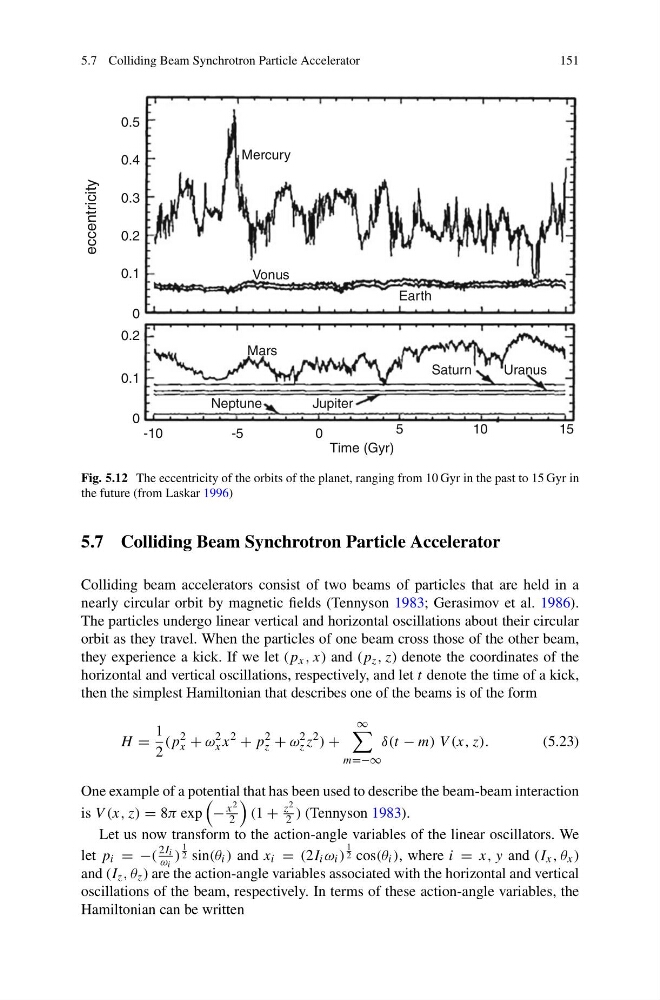
Fig. 5.12 The eccentricity of the orbits of the planet, ranging from 10 Gyr in the past to 15 Gyr in
the future (from Laskar 1996)
5.7 Colliding Beam Synchrotron Particle Accelerator
Colliding beam accelerators consist of two beams of particles that are held in a
nearly circular orbit by magnetic fields (Tennyson 1983; Gerasimov et al. 1986).
The particles undergo linear vertical and horizontal oscillations about their circular
orbit as they travel. When the particles of one beam cross those of the other beam,
they experience a kick. If we let (p x , x) and (p z , z) denote the coordinates of the
horizontal and vertical oscillations, respectively, and let t denote the time of a kick,
then the simplest Hamiltonian that describes one of the beams is of the form
H =
1
2
(p
2
x + ω
2
x x
2
+ p
2
z + ω
2
z z
2 ) +
∞
m=−∞
δ(t − m) V (x, z).
(5.23)
One example of a potential that has been used to describe the beam-beam interaction
is V (x, z) = 8π exp
−
x 2
2
(1 +
z 2
2 ) (Tennyson 1983).
Let us now transform to the action-angle variables of the linear oscillators. We
let p i = −(
2I i
ω i
)
1
2 sin(θ i ) and x i = (2I i ω i )
1
2 cos(θ i ), where i = x, y and (I x , θ x )
and (I z , θ z ) are the action-angle variables associated with the horizontal and vertical
oscillations of the beam, respectively. In terms of these action-angle variables, the
Hamiltonian can be written
151
Time (Gyr)
Mars
Neptune
Jupiter
Saturn
Uranus
Mercury
Vonus
Earth
-10
-5
0
0.1
0.2
0
0.1
0.2
eccentricity
0.3
0.4
0.5
10
15
5
0
Fig. 5.12 The eccentricity of the orbits of the planet, ranging from 10 Gyr in the past to 15 Gyr in
the future (from Laskar 1996)
5.7 Colliding Beam Synchrotron Particle Accelerator
Colliding beam accelerators consist of two beams of particles that are held in a
nearly circular orbit by magnetic fields (Tennyson 1983; Gerasimov et al. 1986).
The particles undergo linear vertical and horizontal oscillations about their circular
orbit as they travel. When the particles of one beam cross those of the other beam,
they experience a kick. If we let (p x , x) and (p z , z) denote the coordinates of the
horizontal and vertical oscillations, respectively, and let t denote the time of a kick,
then the simplest Hamiltonian that describes one of the beams is of the form
H =
1
2
(p
2
x + ω
2
x x
2
+ p
2
z + ω
2
z z
2 ) +
∞
m=−∞
δ(t − m) V (x, z).
(5.23)
One example of a potential that has been used to describe the beam-beam interaction
is V (x, z) = 8π exp
−
x 2
2
(1 +
z 2
2 ) (Tennyson 1983).
Let us now transform to the action-angle variables of the linear oscillators. We
let p i = −(
2I i
ω i
)
1
2 sin(θ i ) and x i = (2I i ω i )
1
2 cos(θ i ), where i = x, y and (I x , θ x )
and (I z , θ z ) are the action-angle variables associated with the horizontal and vertical
oscillations of the beam, respectively. In terms of these action-angle variables, the
Hamiltonian can be written